Drawing the contour with a branch cut

Click For Summary
SUMMARY

The discussion focuses on determining the appropriate contour for integration in the context of complex analysis, specifically involving branch points and poles located at s=0 and s=-a. It clarifies that branch cuts cannot be included in the contour, which raises the question of whether the poles can also be excluded. The conversation emphasizes the distinction between branch points, which are singular points of multivalued functions, and poles, which are singular points of single-valued functions. The Bromwich contour is identified as the standard contour for inverse Laplace transforms, ensuring that it lies to the right of all singular points.

PREREQUISITES
  • Understanding of complex analysis, specifically contour integration
  • Familiarity with branch points and poles in complex functions
  • Knowledge of the Bromwich contour for inverse Laplace transforms
  • Experience with numerical integration techniques in mathematical software
NEXT STEPS
  • Study the properties of branch cuts in complex analysis
  • Learn about the application of the Bromwich contour in inverse Laplace transforms
  • Explore numerical integration methods using tools like Mathematica or MATLAB
  • Investigate the differences between multivalued and single-valued functions in complex analysis
USEFUL FOR

Mathematicians, physicists, and engineers working with complex analysis, particularly those involved in contour integration and inverse Laplace transforms.

spacetimedude
Messages
87
Reaction score
1
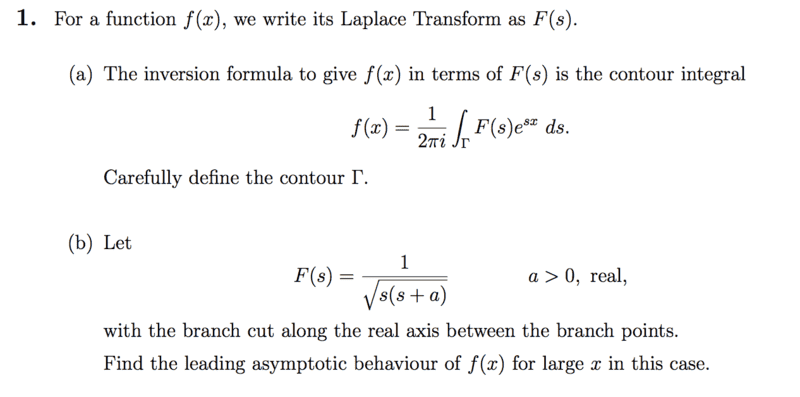
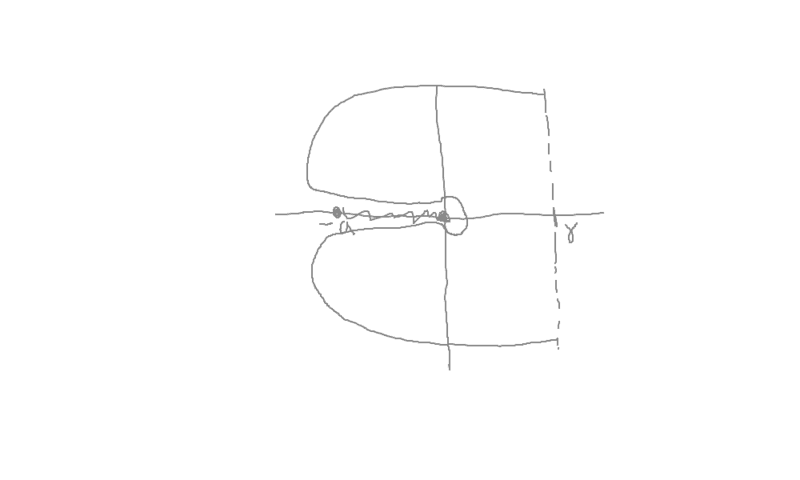
I am trying to determine the contour required in solving part b. The branch points (poles) are at s=0 and s= -a and in between these two values, there is a branch cut.

I know that the branch cut cannot be included in the contour so does this mean the poles also cannot be in the contour? Would it be the one shown in the second image?

Thank you.

EDIT: Got branch points and poles mixed up. Reattempting now.
EDIT2: Hmm, are the branch points the same as poles in this case? Clarification would be appreciated.
Screenshot 2017-12-06 22.27.53.png
export.png
 

Attachments

  • Screenshot 2017-12-06 22.27.53.png
    Screenshot 2017-12-06 22.27.53.png
    21.1 KB · Views: 1,223
  • export.png
    export.png
    3.7 KB · Views: 1,066
Last edited:
Physics news on Phys.org
spacetimedude said:
I am trying to determine the contour required in solving part b. The branch points (poles) are at s=0 and s= -a and in between these two values, there is a branch cut.

I know that the branch cut cannot be included in the contour so does this mean the poles also cannot be in the contour? Would it be the one shown in the second image?

Thank you.

EDIT: Got branch points and poles mixed up. Reattempting now.
EDIT2: Hmm, are the branch points the same as poles in this case? Clarification would be appreciated.

View attachment 216246 View attachment 216247

The idea behind contour integrals is that you have some contour that you want to integrate over, \mathcal{C}_0, which is typically not a closed curved. Then you add a bunch of other contours: \mathcal{C}_1, \mathcal{C}_2, ... such that
  • If you connect them, then the add up to a closed curve, \mathcal{C} = \mathcal{C}_0 + \mathcal{C}_1 + ...
  • The closed curve \mathcal{C} encloses no singularities (so the integral over it is zero).
  • The new contours \mathcal{C}_1, \mathcal{C}_2, ... are easy (or at least possible) to do.
Then you can compute the original integral by:

\int_{\mathcal{C}_0} ds + \int_{\mathcal{C}_1} ds + \int_{\mathcal{C}_2} + ... = \int_{\mathcal{C}} ds = 0

In your case, you have \mathcal{C}_0 is the vertical line on the right side of your drawing, and \mathcal{C}_1 is that funny shape with two bumps. The problem with your drawing is that it's not clear how you should compute the integral around the funny-shaped contour.
 
  • Like
Likes   Reactions: Delta2
spacetimedude said:
EDIT2: Hmm, are the branch points the same as poles in this case? Clarification would be appreciated.

View attachment 216246 View attachment 216247

Branch points refer to singular points of multivalued functions, poles are singular points of single-valued functions. Also, the contour for an inverse Laplace transform is just the Bromwich contour: a straight line from ##\gamma-i\infty## to ##\gamma+i\infty## such that ##\gamma## is to the right of all the singular points of the integrand so say ##\gamma=1## for example.

Did you try to just numerically integrate it to get a ball-park of what's going on? Note in the definition below, we need dz=i along that path so I canceled i in the denominator.

Code:
g[(x_)?NumericQ, (a_)?NumericQ] :=
 (1/(2*Pi))*NIntegrate[Exp[x*z]/Sqrt[z*(z + 1)] /. z -> 1 + I*y, {y, -a, a}];

And after you do that and get a sense of what happens as x gets large, can you explain why it tends to that value? What about just computing what the actual inverse transform is and then taking the limit of that as x goes to infinity?
 

Similar threads

  • · Replies 1 ·
Replies
1
Views
2K
  • · Replies 3 ·
Replies
3
Views
3K
  • · Replies 5 ·
Replies
5
Views
3K
  • · Replies 1 ·
Replies
1
Views
3K
  • · Replies 3 ·
Replies
3
Views
3K
  • · Replies 1 ·
Replies
1
Views
5K
  • · Replies 9 ·
Replies
9
Views
13K
  • · Replies 19 ·
Replies
19
Views
799
  • · Replies 2 ·
Replies
2
Views
2K
  • · Replies 2 ·
Replies
2
Views
6K