Dynamics of Rotational Motion and hinge

Click For Summary
The discussion focuses on calculating the angular velocity and angular acceleration of a uniform rod connected to a frictionless hinge at various angles. The rod, with a length of 0.8 m and a mass of 2 kg, is initially held horizontally and then released. The user provided initial calculations, noting that only the results for angular velocity at θ=90° and angular acceleration at θ=0° were correct. Participants emphasized the importance of showing work to identify errors in calculations and suggested using the relationship between torque and angular acceleration for accurate results. The conversation highlights the need for clarity in problem-solving to ensure correct application of physics principles.
denny2
Messages
1
Reaction score
0
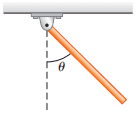
One end of a thin, uniform rod is connected to a frictionless hinge as shown in Figure 1. The rod has a length of 0.8 mand a mass of 2 kg. It is held up in the horizontal position (θ=90∘) and then released.
1)Calculate the angular velocity of the rod at θ=90∘.
2)Calculate the angular acceleration of the rod at θ=90∘.
3)Calculate the angular velocity of the rod at θ=60∘
4)Calculate the angular acceleration of the rod at θ=60∘
5)Calculate the angular velocity of the rod at θ=0∘.
6)Calculate the angular acceleration of the rod at θ=0∘.
1067.PNG

Homework Equations


mgh=1/2 Iw^2
a = ((mgcos)1/2)/I

The Attempt at a Solution


I got these answers and only 1 and 6 were correct
1)0 rad/s
2)74 rad/s^2
3)8.6 rad/s
4)64 rad/s^2
5)12 rad/s
6)0 rad/s^2

Any help is appreciated thank you :)
 
Physics news on Phys.org
denny2 said:
Calculate the angular acceleration of the rod at θ=90∘.
3)Calculate the angular velocity of the rod at θ=60∘
4)Calculate the angular acceleration of the rod at θ=60∘
5)Calculate the angular velocity of the rod at θ=0∘.

you are having problem with above - so check expression for angular acceleration.
moment of inertia xangular acceleration = torque on the rod =forcex the the perpendicular distance from the axis of rotation
and for angular velocity one can use the work- energy conversion
work done by a torque is torquex angular displacement= rotational energy
 
  • Like
Likes denny2
denny2 said:
One end of a thin, uniform rod is connected to a frictionless hinge as shown in Figure 1. The rod has a length of 0.8 mand a mass of 2 kg. It is held up in the horizontal position (θ=90∘) and then released.
1)Calculate the angular velocity of the rod at θ=90∘.
2)Calculate the angular acceleration of the rod at θ=90∘.
3)Calculate the angular velocity of the rod at θ=60∘
4)Calculate the angular acceleration of the rod at θ=60∘
5)Calculate the angular velocity of the rod at θ=0∘.
6)Calculate the angular acceleration of the rod at θ=0∘.
1067.PNG

Homework Equations


mgh=1/2 Iw^2
a = ((mgcos)1/2)/I

The Attempt at a Solution


I got these answers and only 1 and 6 were correct
1)0 rad/s
2)74 rad/s^2
3)8.6 rad/s
4)64 rad/s^2
5)12 rad/s
6)0 rad/s^2

Any help is appreciated thank you :)
We cannot tell where you are going wrong if you do not post your working.
 
The book claims the answer is that all the magnitudes are the same because "the gravitational force on the penguin is the same". I'm having trouble understanding this. I thought the buoyant force was equal to the weight of the fluid displaced. Weight depends on mass which depends on density. Therefore, due to the differing densities the buoyant force will be different in each case? Is this incorrect?

Similar threads

Replies
3
Views
2K
  • · Replies 3 ·
Replies
3
Views
2K
  • · Replies 19 ·
Replies
19
Views
4K
Replies
23
Views
1K
Replies
3
Views
2K
Replies
9
Views
3K
  • · Replies 5 ·
Replies
5
Views
2K
  • · Replies 17 ·
Replies
17
Views
3K
Replies
7
Views
2K
Replies
4
Views
2K