Effect of the Location of the Center of Mass on the Falling Time....

Click For Summary
SUMMARY

The discussion centers on the effect of the Center of Mass (CM) on the falling time of a meter stick with an attached weight. It is established that as the weight is positioned higher on the stick, the CM also rises, resulting in a longer falling time due to increased height. The participants emphasize the importance of considering both the CM and the Moment of Inertia (MOI) when analyzing the stability and falling dynamics of the system. The conversation concludes that the time to topple is sensitive to the initial angle of the stick, with a perfectly vertical position theoretically resulting in infinite fall time.

PREREQUISITES
  • Understanding of Center of Mass (CM) and Center of Gravity (CG)
  • Familiarity with kinematics equations, specifically free-fall equations
  • Knowledge of Moment of Inertia (MOI) and its impact on stability
  • Basic principles of angular motion and torque
NEXT STEPS
  • Explore the relationship between Center of Mass and stability in physical systems
  • Study the effects of Moment of Inertia on angular acceleration and motion
  • Learn about the dynamics of topple motion and its mathematical modeling
  • Investigate practical experiments to measure falling time and stability of objects with varying CM
USEFUL FOR

Physics students, educators, and anyone interested in mechanics, particularly those studying dynamics and stability in physical systems.

H Quizzagan
Messages
5
Reaction score
1
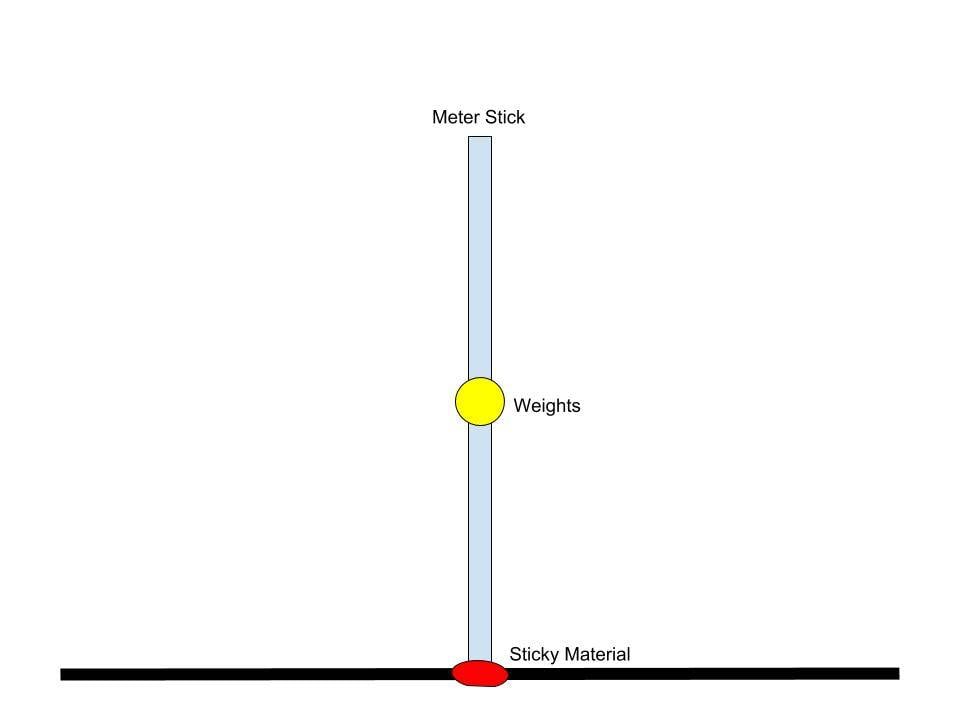
The set-up of the system is like the following:
Setup.jpg

The thing is, a weight was attached to the meter stick and it was placed in different locations. Then the system composed of the meter-stick and the added weight was then released and the time it took for the meter stick to hit the floor was measured.

For the sake of simplicity, let us say it was placed in 2 different locations. This causes the Center of Gravity [CG] or Center of Mass [CM] to shift, right?

The lower the weight is, the closer to the ground the CG/CM is compared to when you place the weight higher along the meter-stick.

For each position, the amount of falling time was recorded.

QUESTION: How does the position of the CG/CM affect this quantity: falling time?

INITIAL THOUGHTS: I treated the system as a singular mass and found the CM of the entire system. Then, the motion of the CM was treated as just a free-fall so I can just use kinematics equations to calculate the total falling time.
$$ d = v_i t + \dfrac{1}{2} gt^2 = \dfrac{1}{2} gt^2 $$
So, initially, I think that as with the weights placed higher = higher location of CM = higher height to fall, means longer time to fall. Does this physics reflect anything about the reality of the system?

It is very simple I know but it got me all confused with the consideration of CM.
 

Attachments

  • Setup.jpg
    Setup.jpg
    12.5 KB · Views: 1,052
Last edited:
Physics news on Phys.org
H Quizzagan said:
The set-up of the system is like the following:
View attachment 239744
The thing is, a weight was attached to the meter stick and it was placed in different locations. Then the system composed of the meter-stick and the added weight was then released and the time it took for the meter stick to hit the floor was measured.

For the sake of simplicity, let us say it was placed in 2 different locations. This causes the Center of Gravity [CG] or Center of Mass [CM] to shift, right?

The lower the weight is, the closer to the ground the CG/CM is compared to when you place the weight higher along the meter-stick.

For each position, the amount of falling time was recorded.

QUESTION: How does the position of the CG/CM affect this quantity: falling time?

INITIAL THOUGHTS: I treated the system as a singular mass and found the CM of the entire system. Then, the motion of the CM was treated as just a free-fall so I can just use kinematics equations to calculate the total falling time.
$$ d = v_i t + \dfrac{1}{2} gt^2 = \dfrac{1}{2} gt^2 $$
So, initially, I think that as with the weights placed higher = higher location of CM = higher height to fall, means longer time to fall. Does this physics reflect anything about the reality of the system?

It is very simple I know but it got me all confused with the consideration of CM.
If I understand the set-up, the weight remains attached to the stick, so the two together fall sideways. That is not free fall.
But then, the falling time would be quite unpredictable. If you managed to position the upright stick perfectly it could remain upright for some time.
 
haruspex said:
If I understand the set-up, the weight remains attached to the stick, so the two together fall sideways. That is not free fall.
But then, the falling time would be quite unpredictable. If you managed to position the upright stick perfectly it could remain upright for some time.

Yep, the two are attached so they can become one body. We can reimagine it as though it is a singular meter stick just so happens that the CM of the stick is not in its geometric centre. If it's okay, why would it be unpredictable? I mean what could be the factors influencing the motion of the system?

Also, yes, the stick remained upright for quite sometime. Also, theoretically speaking, the lower the CG of the system, the more stable or harder for it to topple, right?
 
H Quizzagan said:
Yep, the two are attached so they can become one body. We can reimagine it as though it is a singular meter stick just so happens that the CM of the stick is not in its geometric centre. If it's okay, why would it be unpredictable? I mean what could be the factors influencing the motion of the system?

Also, yes, the stick remained upright for quite sometime. Also, theoretically speaking, the lower the CG of the system, the more stable or harder for it to topple, right?

You need to consider the COM and the Moment of Inertia of the system. The angular acceleration will depend on the torque, which depends on the COM, and the MOI.

I think this problem might get quite complicated.

In terms of stablility, that depends on the base of the stick. For 1D needle, technically it makes no difference. But, when the bottom of the stick is given a dimension, the stick is stable as long as the COM is above the base. The higher the mass, the less angle it takes to move the COM outside the base, hence the reduction in stability.
 
PeroK said:
I think this problem might get quite complicated.
You might be it making more complicated, than necessary. The question is about the pure fall time, not about the falling over afterwards:
H Quizzagan said:
...the time it took for the meter stick to hit the floor was measured
 
A.T. said:
You might be it making more complicated, than necessary. The question is about the pure fall time, not about the falling over afterwards:

The stick, as I understand it, is stuck to the floor. By "fall", the OP means fall over, as in topple!
 
PeroK said:
The stick, as I understand it, is stuck to the floor. By "fall", the OP means fall over, as in topple!
You might be right. I misinterpreted it because the OP used the formulas for free fall.
 
H Quizzagan said:
So, initially, I think that as with the weights placed higher = higher location of CM = higher height to fall, means longer time to fall. Does this physics reflect anything about the reality of the system?
With higher CM, it's more difficult to balance it statically (sticky attachment), but easier to balance it dynamically (on a finger). For the math you have to use the moment of inertia as PeroK wrote.
 
H Quizzagan said:
why would it be unpredictable?
The time to topple to the floor depends on the initial angle to the vertical of the line from the floor contact through the mass centre. If exactly vertical then, theoretically the time is infinite. Even if known to be at some small nonzero angle to the vertical, the time taken will be very sensitive to any small error in that angle.
 
  • Like
Likes   Reactions: CWatters and Asymptotic

Similar threads

  • · Replies 2 ·
Replies
2
Views
1K
  • · Replies 11 ·
Replies
11
Views
3K
  • · Replies 31 ·
2
Replies
31
Views
3K
  • · Replies 12 ·
Replies
12
Views
3K
  • · Replies 2 ·
Replies
2
Views
2K
  • · Replies 4 ·
Replies
4
Views
5K
  • · Replies 2 ·
Replies
2
Views
2K
  • · Replies 3 ·
Replies
3
Views
2K
  • · Replies 14 ·
Replies
14
Views
10K
  • · Replies 2 ·
Replies
2
Views
2K