How Does the Angle at P1 Change Over Time Until the Object Falls?

Join the discussion
Ask a follow-up here, or get your own question answered by working scientists, mathematicians and engineers — people, not an autocomplete.
Real named experts · corrections over time · the nuance an AI answer skips
2 replies · 2K views
AI_Messiah
Messages
5
Reaction score
0
TL;DR
I have provided an illustration so that anyone who understands enough about rigid body physics can understand what I mean.
So I have 2 Points P1 and P2. P2 is the center of mass which has an X and Y coordinate. P1 is where I think that it will fall over from and only has an X location.
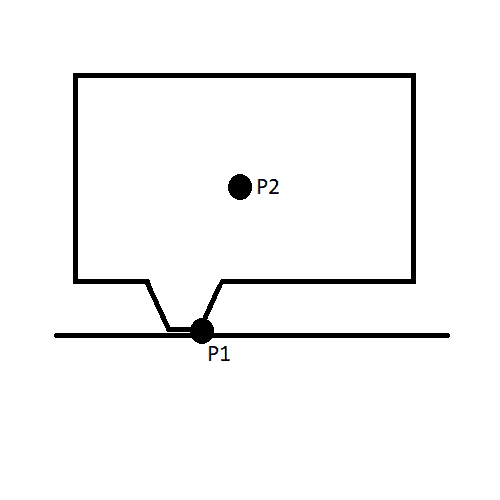
physexpl.png

Now what I want is to find a way to get how far the angle at P1 will change in relation to where these points are within a given amount of time until the edge on the far right bottom hits the floor and this object may or may not have a velocity when I am making the calculation.
 
Physics news on Phys.org
AI_Messiah said:
Summary:: I have provided an illustration so that anyone who understands enough about rigid body physics can understand what I mean.

So I have 2 Points P1 and P2. P2 is the center of mass which has an X and Y coordinate. P1 is where I think that it will fall over from and only has an X location.

View attachment 297108
Now what I want is to find a way to get how far the angle at P1 will change in relation to where these points are within a given amount of time until the edge on the far right bottom hits the floor and this object may or may not have a velocity when I am making the calculation.
So as @Dale says, you just sum the moments on your Free Body Diagram (FBD) that you draw for the mechanical system. Do you know how to do that yet? Is this related to your other thread start here at PF?

https://www.physicsforums.com/threads/rigid-body-physics-machine-learning-environment.1012171/