Efficient Q-Tree Algorithm: Understanding Parent-Child Relationships

  • Thread starter Thread starter sayuri2009
  • Start date Start date
  • Tags Tags
    Algorithm Search
Click For Summary
SUMMARY

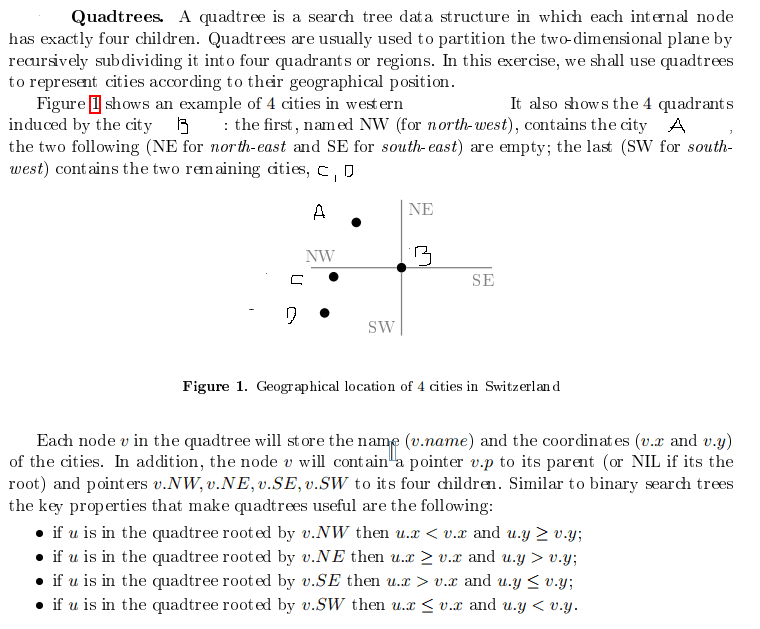
The discussion focuses on the efficient implementation of the Q-Tree algorithm, specifically addressing the parent-child relationships within the quadtree structure. The variable "u" represents any node in the quadtree, which can function as both a parent and a child. When considering node B as the root, its children can include nodes A, C, and D, depending on the specific construction of the quadtree. The conversation highlights that quadtrees are more effective for square lattice representations rather than for scattered points due to potential sparsity and imbalance.

PREREQUISITES
  • Understanding of quadtree data structures
  • Familiarity with spatial partitioning algorithms
  • Knowledge of parent-child relationships in tree structures
  • Basic concepts of node representation in data structures
NEXT STEPS
  • Research quadtree construction techniques and variations
  • Learn about spatial partitioning algorithms and their applications
  • Explore the advantages of quadtrees for specific data types
  • Study the performance implications of using quadtrees for spatial queries
USEFUL FOR

Software developers, data scientists, and researchers working with spatial data structures and algorithms, particularly those interested in optimizing spatial queries and data representation.

sayuri2009
Messages
13
Reaction score
2
TL;DR
Cities
Hi,

I don't get what the conditions below exactly means.
1610198442449.png

Its which u they are talking about? Is the u the parent or children? Does it mean u = B? and the children are A,C,D?
if u is in the quadtree rooted by v:NW then u:x < v:x and u:y ≥ v:y;

Thanks,
 
Technology news on Phys.org
sayuri2009 said:
Its which u they are talking about?
## u ## stands for any node, not any particular one.

sayuri2009 said:
Is the u the parent or children?
Every node can be both a parent and a child.

sayuri2009 said:
Does it mean u = B? and the children are A,C,D?
There are many ways to build a quadtree, but if you start with B at the root then ## B.parent = B.NE = B.SE = \mathrm{null} ##, ## B.NW = A ## and ## B.SW ## can be either of ## C ## or ## D ## depending on how you build the tree.

Edit: quadtrees are less useful for representing scattered points as they are likely to be sparse and unbalanced, they are more useful for representing a square lattice.
 

Similar threads

  • · Replies 1 ·
Replies
1
Views
6K
  • · Replies 0 ·
Replies
0
Views
2K
  • · Replies 1 ·
Replies
1
Views
9K
  • · Replies 83 ·
3
Replies
83
Views
13K
Replies
3
Views
3K
  • · Replies 1 ·
Replies
1
Views
3K
  • · Replies 2 ·
Replies
2
Views
576
  • · Replies 175 ·
6
Replies
175
Views
28K
  • · Replies 67 ·
3
Replies
67
Views
16K
  • · Replies 77 ·
3
Replies
77
Views
12K