Eigenvector Calculations and Verification for y1+y2=5

  • Context: MHB 
  • Thread starter Thread starter ertagon2
  • Start date Start date
  • Tags Tags
    Eigenvector
Click For Summary
SUMMARY

The eigenvector calculations for the equation y1 + y2 = 5 are confirmed as correct, with the characteristic polynomial derived as det(yI - A) = 0, leading to (y - 1)(y - 4) = 0. The eigenvalues of the triangular matrix are 1 and 4, which sum to 5, consistent with the trace of the matrix. The discussion emphasizes the utility of using the trace to simplify eigenvalue calculations without the characteristic polynomial, although the latter is straightforward in this case. Wolfram Alpha (W|A) corroborates these findings for the matrix ((1,0),(3,4)).

PREREQUISITES
  • Understanding of eigenvalues and eigenvectors
  • Familiarity with triangular matrices
  • Knowledge of matrix trace
  • Experience with characteristic polynomials
NEXT STEPS
  • Study the properties of triangular matrices in linear algebra
  • Learn how to compute the trace of a matrix
  • Explore eigenvalue calculations using Wolfram Alpha
  • Investigate the implications of the characteristic polynomial in different matrix types
USEFUL FOR

Students and professionals in mathematics, particularly those focusing on linear algebra, eigenvalue problems, and matrix theory.
ertagon2
Messages
36
Reaction score
0
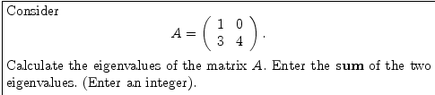
Can you please confirm my answer?
View attachment 7539
det(yI-A) = 0
(y-1)(y-4)=0
y1+y2=5
 

Attachments

  • 2.png
    2.png
    2.3 KB · Views: 134
Physics news on Phys.org
Yes, it is correct.

Incidentally, did you already learn about the eigenvalues of triangular matrices?
Did you perhaps already learn about the trace of a matrix (= the sum along the main diagonal)?

This could help you to calculate the required quantity without having to set up the characteristic polynomial. (Of course, that is not much work here, either.)
 
I get the characteristic equation:

$$x^2-(1+4)x+(1\cdot4-0\cdot3)=x^2-5x+4=(x-1)(x-4)=0$$

Hence:

$$\lambda_1+\lambda_2=1+4=5\quad\checkmark$$

W|A confirms our results:

W|A - eigenvalues for ((1,0),(3,4))
 

Similar threads

  • · Replies 4 ·
Replies
4
Views
1K
  • · Replies 1 ·
Replies
1
Views
2K
  • · Replies 14 ·
Replies
14
Views
2K
  • · Replies 3 ·
Replies
3
Views
3K
  • · Replies 1 ·
Replies
1
Views
2K
  • · Replies 9 ·
Replies
9
Views
5K
Replies
8
Views
5K
  • · Replies 7 ·
Replies
7
Views
10K
  • · Replies 2 ·
Replies
2
Views
1K
  • · Replies 1 ·
Replies
1
Views
3K