Electric field of a charged disc

Click For Summary

Discussion Overview

The discussion revolves around the electric field generated by a charged disc, focusing on the mathematical derivation and limits of the electric field as the radius of the disc approaches zero and infinity. Participants explore various approaches to the problem, including Taylor series and binomial expansions, while addressing the implications of charge density and field behavior in these limits.

Discussion Character

  • Technical explanation
  • Mathematical reasoning
  • Debate/contested

Main Points Raised

  • One participant states that the charge density σ remains constant as the radius a changes, leading to a specific limit for the electric field as a approaches infinity.
  • Another participant challenges the reasoning for the limit as a approaches zero, suggesting that a more careful expansion is needed to derive the electric field from a point charge.
  • A participant mentions the use of Taylor series and expresses confusion about the choice of expansion point, questioning why expansion about infinity is preferred in this context.
  • Another participant clarifies their approach by stating they are expanding around (a/z) = 0, which leads to a first-order approximation in the binomial series.
  • There is a discussion about the validity of using the binomial expansion with non-integer exponents, with one participant asserting its usefulness in physics.
  • Participants agree that considering (a/z) << 1 or (a/z)^2 << 1 leads to similar results in the context of the binomial expansion.

Areas of Agreement / Disagreement

Participants express differing views on the appropriate mathematical approach to take when evaluating the electric field limits, particularly regarding the use of Taylor series and binomial expansions. There is no consensus on the best method, and the discussion remains unresolved.

Contextual Notes

Limitations include potential misunderstandings of the mathematical expansions and their applicability in this context, as well as the assumptions made regarding the behavior of charge density and electric field in the limits discussed.

jewbinson
Messages
127
Reaction score
0
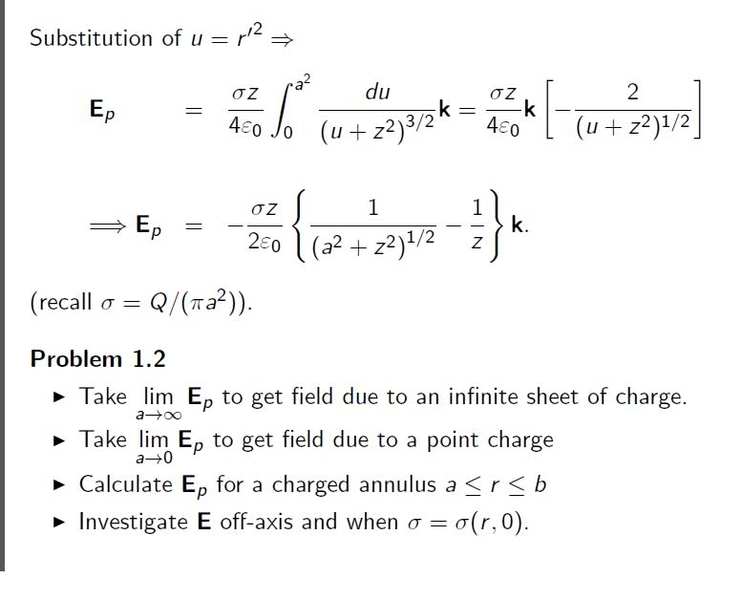
... with constant charge density σ = Q/((pi)a^2)

The Electric field is, after some calculation, is given by E_p below:
15cga35.jpg


z is the z-axis, and a is the radius of the disc.

Now for the questions at the bottom of the page, here are my thoughts:

σ is independent of a because as a->2a, Q->4Q, and a^2 -> 4a^2. Same for all changes of scale.

As a -> infinity, E_p -> σ/(2ε_0)

But the second one I'm not sure about.

As a -> 0, surely the charge density stays constant i.e. at σ. Thus the field appears to be the 0 vector. However, we know that the field due to a point charge is proportional to r^/r^2, where r^ is the outward/inward unit vector and r is it's magnitude.

I know our area tends to 0 as a -> 0, so our charge Q must tend to 0 also. But this means our field from the "point charge" must be 0, disagreeing with the usual electric field for a point charge...
 
Physics news on Phys.org
Regarding the second question, you've thrown away the baby with the bath-water, when taking your limit. You need to work to first order in (a/z)2...

\frac{1}{\left(z^2+a^2\right)^\frac{1}{2}} = \frac{1}{z}\left(1+\frac {a^2}{z^2}\right)^{-\frac{1}{2}}\approx\frac{1}{z}\left(1-\frac {a^2}{2z^2}\right).

Make this substitution, and you'll finish up with the usual equation for the field due to a point source.
 
Last edited:
Right. At first I tried taylor series at x=0 but didn't try it at x = infinity. I guess I hadn't come across using expansion about infinity in physics yet... only complex analysis.

Maybe there is something simple I am missing but why do you automatically look for expansion about infinity?

Attempt to answer own question: because we are taking limit of a tending to 0. Expansion about z = 0 is a polynomial in z with a^i on the bottom, so the expansion will be something like infinity - infinity + infinity - ... which won't help us. Using expansion about infinity, we get a^i's on top and so the limit as a -> 0 is valid and useful. Amirite?

Also, your ways works because the 1/z's cancel, giving the simple answer, as opposed to a polynomial in z, where we can't make progress without taking steps backwards...
 
Last edited:
I'm not regarding it as an expansion about infinity. I'm regarding (a/z), and therefore (a/z)2 as << 1, and expanding about (a/z) = 0. This amounts to using the binomial series (a special Taylor series), which is what I'm quoting, to first order in (a/z)2.
 
Last edited:
I'm not sure I get that at all. Are you sure you're not considering (a/z)^2 and therefore (a/z)^4 << 1 and similar for higher order terms? Because then the Binomial expansion formula would seem to work. I'm not used to using it with the exponent non-integer.

What I said in my last post is basically just writing out the Taylor series which is the same as the Binomial expansion because the Binomial expansion is the special case of Taylor we are dealing with...
 
I am, as I said, taking the case of (a/z)<<1. This implies that (a/z)2<<<1 and (a/z)4<<<< 1, and so on. Therefore I'm neglecting all terms higher than the one in (a/z)2. It was one of Newton's discoveries that the binomial expansion also worked with non-integral indices, but went on for ever. It is extremely useful in Physics.
(1+x)^n = 1 + nx + \frac{n(n-1)}{2!}x^2 + \frac{n(n-1)(n-2)}{3!}x^3 ...
 
Last edited:
I see. Considering (a/z)<<1 or instead considering (a/z)^2<<1 leads to the same result (no information is lost w.r.t. the Binomial expansion approximation). But in both cases x = (a/z)^2
 

Similar threads

  • · Replies 22 ·
Replies
22
Views
2K
  • · Replies 7 ·
Replies
7
Views
2K
  • · Replies 10 ·
Replies
10
Views
2K
  • · Replies 8 ·
Replies
8
Views
2K
  • · Replies 3 ·
Replies
3
Views
1K
  • · Replies 6 ·
Replies
6
Views
1K
  • · Replies 2 ·
Replies
2
Views
2K
  • · Replies 3 ·
Replies
3
Views
714
  • · Replies 1 ·
Replies
1
Views
2K
  • · Replies 16 ·
Replies
16
Views
2K