Electric Field of a Point Charge

Click For Summary

Homework Help Overview

The discussion revolves around calculating the electric field at a specific point due to a point charge, with given parameters such as charge magnitude and distances. The original poster presents their calculations and seeks validation of their results.

Discussion Character

  • Mathematical reasoning, Assumption checking

Approaches and Questions Raised

  • The original poster attempts to calculate the electric field using the formula for electric field strength and breaks it down into components. Participants suggest considering rounding errors and the importance of maintaining significant figures throughout the calculations.

Discussion Status

Participants are engaged in exploring the accuracy of the calculations, with some suggesting that rounding errors may have affected the results. There is a focus on ensuring precision in intermediate steps and the final answer, but no consensus on the correctness of the original poster's answer has been reached.

Contextual Notes

There is mention of a computer grading system that may not account for minor discrepancies in significant figures, which could impact the grading outcome.

nezsmith
Messages
2
Reaction score
0
[moderators note: moved from technical forum, so no template]

Summary: I can't tell where the mistake in my process is. The computer keeps telling me I am wrong.

The Question:

What is the electric field at point 1 in the figure? Give your answer in component form.(Figure 1)Assume that a = 2.5 cm ,b = 0.70 cm , and q = 4.8 nC .
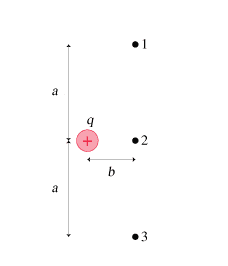
1574620223313.png


The formulas:

Electric Field at the point = k|q|/r^2 = E1

E1 as components = E1cos(theta)i + E1sin(theta)j

Theta = arctan(0.025/0.007)= 74 degrees

r1=r3= sqrt(0.025^2+0.007^2) = 0.026 m

The attempt:

8.99e^9|4.8e^-9|/(0.026^2) = 63 834 N/C

E(vector) = 63834cos74i + 63834sin74j

E1x = 1.8 x 10^4 and E1y = 6.1 x 10^4 N/C

Can anyone confirm or deny this answer?
 
Last edited by a moderator:
Physics news on Phys.org
Your work looks good to me. However, when you plug in numbers as you go, you run the risk of accumulating "rounding" error. You can avoid this by working out expressions for ##E_x## and ##E_y## symbolically in terms of the given quantities ##q##, ##a## and ##b##. Plug in numbers only at the very end. When I do that, I find that I get a slightly different result to 2 significant figures. If you have a problem where it really is more convenient to calculate as you go, then keep a couple of extra significant figures in the intermediate calculations and round to the proper number of significant figures at the end.

I think it's pretty lousy if the computer grader doesn't allow for some tolerance.

It could be that the computer's answer is just wrong.
 
  • Like
Likes   Reactions: vela
I get that both answers are wrong by 1 in the second digit. As TSny suggested, I believe you have just made enough round off or truncation error in intermediate calculations that your answers rounded off the wrong direction from correct. Do the whole calculation at full precision and just round off to the appropriate number of digits at the end.
 
Thank you to both of you. That would seem to be the case.

There is some room for being off but only if you get the significant digits correct. So if 2.2 is the answer 2.21 or 2.29 may work. In this case I'm off in my significant figures so it won't give me the grade.

In any case, thank you again for the confirmation.
 

Similar threads

  • · Replies 5 ·
Replies
5
Views
2K
  • · Replies 4 ·
Replies
4
Views
2K
  • · Replies 6 ·
Replies
6
Views
1K
  • · Replies 5 ·
Replies
5
Views
2K
Replies
3
Views
1K
Replies
23
Views
5K
  • · Replies 3 ·
Replies
3
Views
2K
Replies
3
Views
1K
Replies
11
Views
4K