Electric Field of a Point Charge and Thin Ring: A Comparative Analysis

Click For Summary

Homework Help Overview

The discussion revolves around calculating the electric field of a point charge and a thin ring, comparing their contributions to the net electric field in various scenarios. The subject area is electrostatics, specifically focusing on electric fields generated by charge distributions.

Discussion Character

  • Exploratory, Conceptual clarification, Mathematical reasoning, Assumption checking

Approaches and Questions Raised

  • Participants discuss the expressions for the electric fields due to a point charge and a thin ring, with attempts to simplify the net electric field expression under the assumption that the distance x is much greater than the radius R of the ring. Questions are raised about the validity of approximations and the implications of the limits involved.

Discussion Status

Some participants have provided guidance on simplifying the expressions and exploring the implications of the approximations made. There is an ongoing examination of the assumptions related to the limits of x compared to R, and various interpretations of the results are being explored.

Contextual Notes

Participants are considering the implications of the approximation where the distance from the charge is much larger than the dimensions of the charge distribution, and how this affects the behavior of the electric field. There is also mention of homework constraints regarding the presentation of solutions.

Physicslearner500039
Messages
124
Reaction score
6
Homework Statement
A point charge q is located at the center of a thin ring of radius R with uniformly distributed charge —q. Find the magnitude of the electric field strength vector at the point lying on the axis of the ring at a distance x from its center, if x » R.
Relevant Equations
NA
I thought it was easy but i am not getting the correct answer
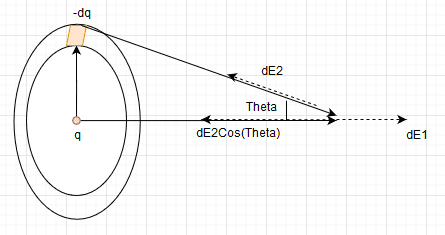
1588693704031.png

The electric field due the point charge q is
##
E1 = q/(4\pi\epsilon x^2)
##
The electric field due to the thin ring of radius R is considering the electric field due to the element charge dq (dS)
##
dE2 = dq/4\pi\epsilon (x^2 + R^2) \\
dE2 = \lambda * dS/(4\pi\epsilon (x^2 + R^2)) \\
dE2_{net} = dE2\cos{\theta} \\
dE2_{net} = \lambda * dS * \cos{\theta} /(4\pi\epsilon (x^2 + R^2)) \\
\cos\theta = x/(x^2 + R^2)^\frac 1 2 \\
\lambda * dS * x /(4\pi\epsilon (x^2 + R^2)^ \frac 3 2) \\
\int_0^{2\pi R} \lambda dSx/(4\pi\epsilon (x^2 + R^2)^ \frac 3 2) \\
\lambda x/(4\pi\epsilon (x^2 + R^2)^ \frac 3 2)\int_0^{2\pi R} dS\\
\lambda x 2\pi R/(4\pi\epsilon (x^2 + R^2)^ \frac 3 2) \\
E2_{net} = qx/(4\pi\epsilon (x^2 + R^2)^ \frac 3 2) \\
##
The net field is
##
E2_{net} - E1 = qx/(4\pi\epsilon (x^2 + R^2)^ \frac 3 2) - q/(4\pi\epsilon x^2)
##
For ## x > R ## the net field is 0.
 
  • Like
Likes   Reactions: Delta2
Physics news on Phys.org
Physicslearner500039 said:
The net field is
##
E2_{net} - E1 = qx/(4\pi\epsilon (x^2 + R^2)^ \frac 3 2) - q/(4\pi\epsilon x^2)
##
For ## x > R ## the net field is 0.

Your expression looks fine to me, note that you don't even need to substitute in the linear density; since all charge elements ##dq## on the ring are identical, you can just integrate up the ##dq##'s from 0 to ##-q##.

However I think you've jumped the gun a bit on the ##x\gg R## case. It might well turn out to be true, however can you think of any other way of simplifying that net field expression if ##\frac{R}{x}## is small? Especially the bit with the ##(x^2 + R^2)^{-\frac{3}{2}}##?
 
Last edited by a moderator:
  • Like
Likes   Reactions: Physicslearner500039 and Delta2
etotheipi said:
However I think you've jumped the gun a bit on the ##x\gg R## case. It might well turn out to be true, however can you think of any other way of simplifying that net field expression if ##\frac{R}{x}## is small? Especially the bit with the ##(x^2 + R^2)^{-\frac{3}{2}}##?
The way I see it is indeed approximately zero for x>>R, because if we factor out ##x^2## from the denominator of the first term and then set ##\frac{R^2}{x^2}\approx 0## we get also zero for the net electric field.

Besides that's a nice corollary from Jeffimenko's equations, using the approximation ##\frac{1}{|\vec{r}-\vec{r'}|}=\frac{1}{|\vec{r}|}##( which is valid for vector ##\vec{r}## such that it is much bigger in magnitude than the vector ##\vec{r'}## which spans the source space, which in simple words means for points far away from the source such that the distance from the source is much bigger than the dimensions of the source), we conclude that the source behaves approximately as a point source with charge equal to the total charge of the source.
 
  • Like
Likes   Reactions: Physicslearner500039 and etotheipi
My approach was to rewrite it as $$E_x = kqx^{-2}(1+\frac{R^2}{x^2})^{-\frac{3}{2}} - kqx^{-2}$$ and then you can do a binomial expansion to the first order in ##\frac{R^2}{x^2}##, which gives you a sort of nice expression in one single fraction.

I won't spoil the expression for the OP, but I do agree that it approaches zero.

Delta2 said:
Besides that's a nice corollary from Jeffimenko's equations, using the approximation ##\frac{1}{|\vec{r}-\vec{r'}|}=\frac{1}{|\vec{r}|}##( which is valid for vector ##\vec{r}## such that it is much bigger in magnitude than the vector ##\vec{r'}## which spans the source space, which in simple words means for points far away from the source such that the distance from the source is much bigger than the dimensions of the source), we conclude that the source behaves approximately as a point charge with total charge the total charge of the source.

Interesting! I'd never heard of that set of equations, but that is indeed consistent with what we got so is a nice extension! Thanks for sharing that, I've got a bit of reading to do this evening now :smile:
 
  • Like
Likes   Reactions: Physicslearner500039 and Delta2

Similar threads

  • · Replies 1 ·
Replies
1
Views
1K
  • · Replies 18 ·
Replies
18
Views
1K
Replies
6
Views
2K
  • · Replies 9 ·
Replies
9
Views
2K
Replies
64
Views
6K
  • · Replies 6 ·
Replies
6
Views
2K
  • · Replies 2 ·
Replies
2
Views
1K
Replies
11
Views
2K
Replies
3
Views
2K
  • · Replies 2 ·
Replies
2
Views
2K