Electric Field of two line charges

Click For Summary
SUMMARY

The discussion focuses on calculating the electric field at a specific point due to two line charges forming a right angle. Participants emphasize starting with the general expression for the electric field from a semi-infinite line of charge and applying the principle of superposition. The conversation highlights the need to adjust the integration limits when dealing with finite wire segments instead of semi-infinite wires. Additionally, rotating the coordinate system to align one wire segment horizontally and the other vertically simplifies the calculation of field components.

PREREQUISITES
  • Understanding of electric fields and line charges
  • Familiarity with calculus, specifically integration techniques
  • Knowledge of the principle of superposition in electrostatics
  • Ability to manipulate coordinate systems for problem-solving
NEXT STEPS
  • Research the electric field equations for finite line charges
  • Study the principle of superposition in electrostatics
  • Learn about coordinate transformations in physics
  • Explore integration techniques for calculating electric fields
USEFUL FOR

Students and professionals in physics, electrical engineering, or anyone involved in electrostatics and electric field calculations.
badluckmath
Messages
9
Reaction score
3
Homework Statement
Find the Electrical Field on the O point
Relevant Equations
##dl = dx\sqrt{1+(\frac{dy}{dx})^{2}}##
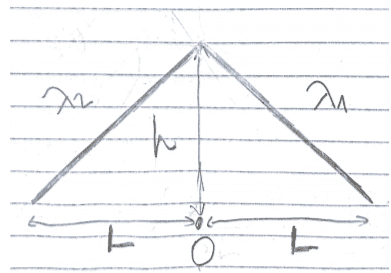
I'm trying to solve this, but i don't really know how to start this problem. There are two line charges and i must find the E. Field on the center.
q1.png
 
  • Like
Likes   Reactions: Delta2
Physics news on Phys.org
Start with the general expression for the electric field due to a semi-infinite finite line of charge. You may have to look it up or derive it. Then use superposition.
 
Last edited:
kuruman said:
Start with the general expression for the electric field due to a semi-infinite line of charge. You may have to look it up or derive it. Then use superposition.
Yeah, my confusion is what to do about the inclined wire.
 
What inclined wire? If I interpret your drawing correctly you have two wires forming a right angle and you want the electric field at distance ##h## from the corner on the 45o line between the wires. Find the contribution at that point for one wire, then do the same for the second wire. The second wire should be easy because the magnitude will be the same and you will not have to do any more integrals.

On edit: Oops! I just realized that you have wire segments not semi-infinite wires. That should only change the upper limit of integration. Also, it might be easier to do the field components if you rotated the angle so that one wire segment is horizontal and the other vertical like coordinate axes.
 
Last edited:
  • Like
Likes   Reactions: Delta2

Similar threads

  • · Replies 12 ·
Replies
12
Views
3K
Replies
1
Views
2K
Replies
4
Views
3K
  • · Replies 22 ·
Replies
22
Views
3K
Replies
9
Views
2K
  • · Replies 12 ·
Replies
12
Views
1K
  • · Replies 1 ·
Replies
1
Views
968
Replies
9
Views
827
  • · Replies 5 ·
Replies
5
Views
1K
Replies
10
Views
2K