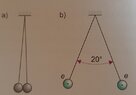
[Electrical force] 2 balls hanging from ceiling, angled

  • Thread starter Thread starter sea333
  • Start date Start date
  • Tags Tags
    Balls Force
Click For Summary
SUMMARY

The discussion centers on the calculation of electric force between two charged balls hanging from a ceiling at a 10-degree angle. The correct expression for the electric force is derived from balancing horizontal and vertical forces, leading to the equations T = mg / cos(10°) and Fx = (1/(4πEps0))(q²/r²). The participants clarify that the angle affects the relationship between tension and electric force, ultimately leading to the correct expression for r as r = 2a sin(10°). Missteps in using tangent instead of sine for angle-related calculations are also addressed.

PREREQUISITES
  • Understanding of basic physics concepts such as electric force and tension.
  • Familiarity with trigonometric functions, particularly sine and cosine.
  • Knowledge of force balance equations in physics.
  • Ability to manipulate algebraic expressions involving variables like mass (m), charge (q), and distance (r).
NEXT STEPS
  • Study the derivation of electric force equations in electrostatics.
  • Learn about the application of trigonometric identities in physics problems.
  • Explore the concept of tension in strings and its relation to angles in physics.
  • Investigate the implications of using different trigonometric functions in force calculations.
USEFUL FOR

Physics students, educators, and anyone interested in understanding the dynamics of charged particles and the forces acting on them in a gravitational field.

sea333
Messages
50
Reaction score
2
Homework Statement
2 metal balls hang from a ceiling on a thread(see picture a.) ). After the balls are charged with the same charge both thread diverge to an angle 20 degrees.(see picture b.) )
What charge is used to charge each ball.
weight of each ball = 0.02 kg
Relevant Equations
F = (1/(4*Pi*eps0))*(e*e)/r^2
20210727_191445.jpg

Capture.PNG
20210727_191509.jpg
 

Attachments

  • 20210727_191509.jpg
    20210727_191509.jpg
    22.9 KB · Views: 150
Physics news on Phys.org
Your expression ##F_e=mg\tan(10^o)## is incorrect. The electric force is equal to the horizontal component of the tension, the weight is equal to the vertical component of the tension and ##T=\sqrt{(mg)^2+F_e^2}.##
 
kuruman said:
Your expression ##F_e=mg\tan(10^o)## is incorrect. The electric force is equal to the horizontal component of the tension, the weight is equal to the vertical component of the tension and ##T=\sqrt{(mg)^2+F_e^2}.##
ok but neither the Tension nor Fe are known, and we need Fe ?
 
Write down two equations balancing forces in the horizontal and vertical directions separately and see where you can go from there.
 
kuruman said:
Write down two equations balancing forces in the horizontal and vertical directions separately and see where you can go from there.
horizontal: Fx - Fe = 0 -> Fe = Fx
vertical: Fg - Fy = 0 -> Fg = Fy
 
sea333 said:
horizontal: Fx - Fe = 0 -> Fe = Fx
vertical: Fg - Fy = 0 -> Fg = Fy
This is correct but doesn't get you very far. You need to bring in the given quantities. Please use symbols like m and q and so on, not numbers. The numbers will be substituted in the final expression for q once you have it.
 
kuruman said:
This is correct but doesn't get you very far. You need to bring in the given quantities. Please use symbols like m and q and so on, not numbers. The numbers will be substituted in the final expression for q once you have it.
Fe = Fx
Fg = Fy
Fx = (1/(4*PI*Eps0))*(q*q/r^2)
Fy = mg
 
Right. But you have not brought in the information that the string makes a 10o angle with respect to the vertical. How would you go about doing that?
 
kuruman said:
Right. But you have not brought in the information that the string makes a 10o angle with respect to the vertical. How would you go about doing that?
that is cosinus -> T = mg / Cos10
 
  • #10
Correct. What can you say about the horizontal direction?
 
  • #11
this
Fx - Fe = 0
Fx = (1/(4*PI*Eps0))*(q*q/r^2)
 
  • #12
And how is Fx related to T?
 
  • #13
Fx/T = sin 10 -> Fx = Fe = T*sin10
 
  • #14
OK. You have two equations one in the vertical direction and one in the horizontal direction involving T, mg and the electrical force. Can you write them down, one below the other?
 
  • #15
T = mg / Cos10
Fx = Fe = T*sin10
 
  • #16
How does that help you find q?
 
  • #17
Into the bottom equitation I can insert equation for T and get q which is the only unknown?
 
  • #18
Please show me how you are going to do this.
 
  • #19
q*q/(4*PI*Eps0*r^2) = (m*g / Cos10) * Sin10

And then just move everything except q on the right side
 
  • #20
That sounds about right. You already have r from your initial attempt.
 
  • #21
This looks easy, but why was my attempt flawed with Tan10 ?
 
  • #22
sea333 said:
This looks easy, but why was my attempt flawed with Tan10 ?
I explained that in post #2.
 
  • #23
sea333 said:
This looks easy, but why was my attempt flawed with Tan10 ?
That was fine, but you have a wrong sign in your use of the cosine rule to find r. Easier would have been ##r=a\sin(10°)##.

Edit: see correction in post #27.
 
Last edited:
  • #24
haruspex said:
That was fine, but you have a wrong sign in your use of the cosine rule to find r. Easier would have been ##r=a\sin(10°)##.
When I changed the sign now result looks correct.
I don't think you can get r in such a way because angle 10 degrees is not adjacent to r
 
  • #25
kuruman said:
I explained that in post #2.
It looks like the Tan approach was correct
 
  • #26
correct solution
Capture.PNG
 
  • #27
sea333 said:
When I changed the sign now result looks correct.
I don't think you can get r in such a way because angle 10 degrees is not adjacent to r
Sorry, I meant ##r=2a\sin(10°)##.
 
  • #28
haruspex said:
Sorry, I meant ##r=2a\sin(10°)##.
I still don't see how this is correct as angle 10 is not adjacent to r
 
  • #29
sea333 said:
I still don't see how this is correct as angle 10 is not adjacent to r
You have found that ##r=\sqrt{2a^2-2a^2\cos^2(20^o)}=\sqrt{2a^2(1-\cos(20^0))}##.
There is a trig identity that says
##\cos(2\theta)=\cos^2(\theta)-\sin^2(\theta)##
so that ##1-\cos(20^0)=1-\cos^2(10^o)+\sin^2(10^o)=2\sin^2(10^o)##. What do you get when you substitute in the expression for ##r##?

Another way to look at it is to break the isosceles triangle to two right triangles of base ##r/2## and hypotenuse ##a##. How is ##r/2## related to ##a##?
 
  • #30
sqrt(4a^2sin^2(10)) = 2*a*sin10

How do you get from 1 - cos^2(10) - sin^2(10) to 2 sin^2(10) ?
 

Similar threads

  • · Replies 9 ·
Replies
9
Views
856
  • · Replies 9 ·
Replies
9
Views
588
Replies
18
Views
2K
Replies
7
Views
1K
  • · Replies 12 ·
Replies
12
Views
2K
Replies
5
Views
2K
  • · Replies 12 ·
Replies
12
Views
1K
  • · Replies 9 ·
Replies
9
Views
1K
  • · Replies 21 ·
Replies
21
Views
1K
  • · Replies 4 ·
Replies
4
Views
3K