SUMMARY
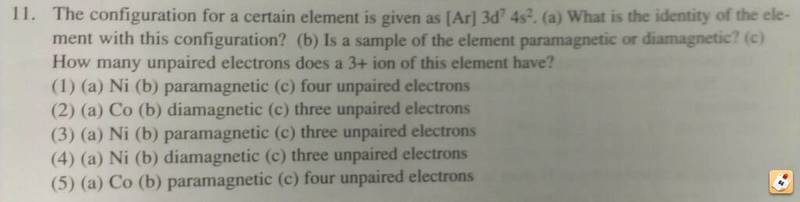
The discussion centers on the electron configuration of cobalt, specifically its 3d7 configuration, which results in three unpaired electrons. Participants assert that cobalt is paramagnetic due to its odd number of unpaired electrons. The Aufbau principle is referenced to explain the filling of d orbitals, confirming that cobalt has two fully filled d electron pairs and three half-filled ones. The conclusion reached is that cobalt has three unpaired electrons, making it paramagnetic.
PREREQUISITES
- Understanding of electron configurations and the Aufbau principle
- Knowledge of magnetic properties related to electron pairing
- Familiarity with the periodic table and transition metals
- Basic principles of quantum mechanics related to electron behavior
NEXT STEPS
- Study the Aufbau principle in detail, focusing on transition metals
- Research the concept of paramagnetism and its relation to unpaired electrons
- Explore the electron configurations of other transition metals for comparison
- Learn about the implications of electron configurations in chemical bonding and reactivity
USEFUL FOR
Chemistry students, educators, and professionals interested in understanding electron configurations, magnetic properties of elements, and the behavior of transition metals.