Electron Gun Design - Can Positive Voltage Work?

Click For Summary
SUMMARY

This discussion centers on the design of electron guns, specifically the feasibility of using high positive voltage instead of the conventional high negative voltage. It is established that commercial CRTs utilize a high positive voltage of approximately +25kV at the anode, while the electron gun operates at low voltages near ground. The key takeaway is that using a high positive voltage for the electron gun is ineffective due to the electric field dynamics between the anode and chamber walls, which must be grounded for safety and efficiency in electron acceleration.

PREREQUISITES
  • Understanding of electron gun design principles
  • Knowledge of CRT (Cathode Ray Tube) technology
  • Familiarity with high voltage safety protocols
  • Basic concepts of electric fields and electron acceleration
NEXT STEPS
  • Research the principles of electron acceleration in vacuum systems
  • Study the design and operation of CRTs, focusing on anode voltage requirements
  • Explore high voltage power supply design for electron guns
  • Investigate safety measures for handling high voltage in electronic devices
USEFUL FOR

Engineers and physicists involved in electron optics, CRT technology, and high voltage applications, as well as safety professionals working with high voltage systems.

chucrut
Messages
1
Reaction score
0
Hello,
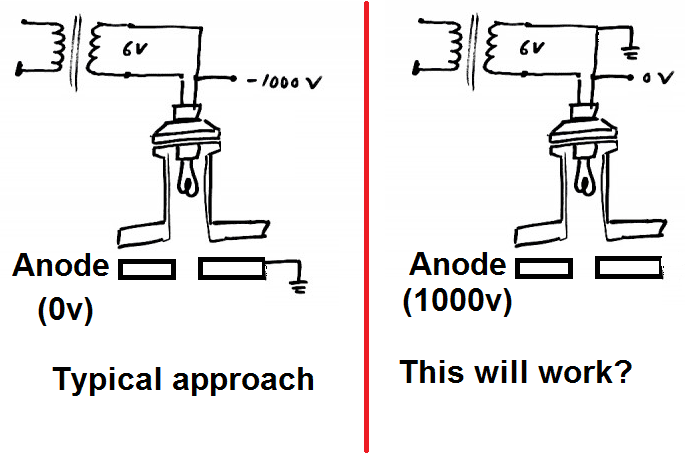
I have a question about electron guns. I have read a lot, and all designs use high NEGATIVE voltage (-1000v for example). Is possible to use high POSITIVE voltage like this drawing?. Or do you think it will not work this way?
Considering that all the chamber walls are at ground voltage (0v) in both cases
lvhZ2R3.png
 
Last edited by a moderator:
Physics news on Phys.org
No, your way will not work very well. The electrons in the chamber will see the electric field between the anode at 1kV and the chamber walls at ground. The entire reason for setting it up with the cathode/filament at negative high voltage is so that the electrons see the field inside the gun and get accelerated into a field free region.

Note that for the purpose of accelerating the electrons it doesn't matter which way you do it. What you are going to do with the electrons and how efficiently you can do it after leaving the electron gun is what matters. In this case you definitely want the chamber walls tied to ground for saftey reasons if nothing else (or a short to floating chamber walls could be lethal). Since the chamber walls are at ground, you want the anode that way too.

In a crt, the situation is reversed. The "walls" of the crt are glass and therefore an insulator. You don't want to float the filament supply to -50kV just to hold the anode at ground when the anode is totally enclosed in glass. That would be dangerous.
 
  • Skeptical
Likes   Reactions: davenn

Similar threads

  • · Replies 26 ·
Replies
26
Views
3K
Replies
3
Views
3K
  • · Replies 2 ·
Replies
2
Views
3K
  • · Replies 2 ·
Replies
2
Views
2K
Replies
12
Views
2K
  • · Replies 10 ·
Replies
10
Views
2K
  • · Replies 5 ·
Replies
5
Views
2K
  • · Replies 5 ·
Replies
5
Views
5K
  • · Replies 15 ·
Replies
15
Views
2K
  • · Replies 1 ·
Replies
1
Views
2K