Electrostatic Force on b: Positive & Negative?

Click For Summary
SUMMARY

The discussion centers on the electrostatic forces acting on charge b (2 × 10-19 C) due to charges a and c (both 1 × 10-19 C) positioned 0.1 m away. The forces exerted by charges a and c on b are equal in magnitude but opposite in direction, resulting in a net electrostatic force of zero on charge b. The formula used to calculate the forces is F = k(|q1||q2|/r2), confirming that the squared distance negates the sign of the charges, leading to cancellation of forces.

PREREQUISITES
  • Understanding of Coulomb's Law and electrostatic forces
  • Familiarity with vector addition in physics
  • Knowledge of charge properties (positive and negative)
  • Basic algebra for manipulating equations
NEXT STEPS
  • Review Coulomb's Law applications in electrostatics
  • Study vector addition and equilibrium in forces
  • Explore the concept of electric field and potential
  • Learn about the implications of charge distribution in electrostatic systems
USEFUL FOR

Students studying physics, particularly those focusing on electrostatics, as well as educators seeking to clarify concepts related to electrostatic forces and charge interactions.

Air
Messages
202
Reaction score
0
1. All variables and given/known data:
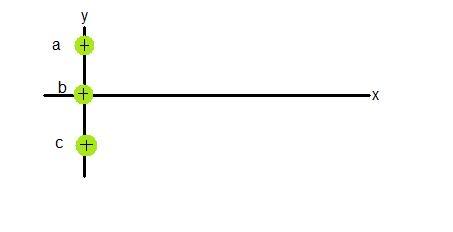
Diagram-1.jpg

a = c = 1 \times 10^{-19} C
b = 2 \times 10^{-19} C
Distance between a&b = b&c = 0.1m (b at origin, a at (0, 0.1) and c at (0, -0.1))


2. Homework Equations :

F = k\frac{|q_1||q_2|}{r^2}


3. The problem that I'm having:

Am I correct to think that the electrostatic force on b from other charges is at a minimum because the Force will be positive and negative (due to the nature of r (\pm 0.1)) cancelling each other out? :confused:
 
Physics news on Phys.org
Air said:
1. All variables and given/known data:

Diagram-1.jpg

a = c = 1 \times 10^{-19} C
b = 2 \times 10^{-19} C
Distance between a&b = b&c = 0.1m (b at origin, a at (0, 0.1) and c at (0, -0.1))


2. Homework Equations :

F = k\frac{|q_1||q_2|}{r^2}


3. The problem that I'm having:

Am I correct to think that the electrostatic force on b from other charges is at a minimum because the Force will be positive and negative (due to the nature of r (\pm 0.1)) cancelling each other out? :confused:

Yes, the force on b due to a is "pointing down", and the force on b due to c is "pointing up", and the magnitudes of those forces are equal (from your equation). And so the vector sum of all the forces on b is zero in the situation shown.
 
olgranpappy said:
Yes, the force on b due to a is "pointing down", and the force on b due to c is "pointing up", and the magnitudes of those forces are equal (from your equation). And so the vector sum of all the forces on b is zero in the situation shown.

I just realized that the radius will be squared hence the negative will also produce a positive force. How does it equal zero then (Surely, it will just equal 2F)? Am I to use another formula or is the electrostatic formula correct to use?
 

Similar threads

Replies
3
Views
2K
  • · Replies 69 ·
3
Replies
69
Views
7K
  • · Replies 10 ·
Replies
10
Views
2K
  • · Replies 4 ·
Replies
4
Views
2K
Replies
5
Views
2K
  • · Replies 19 ·
Replies
19
Views
3K
Replies
2
Views
2K
  • · Replies 19 ·
Replies
19
Views
2K
Replies
2
Views
2K
Replies
1
Views
2K