Electrostatic levitation of hair

Click For Summary

Discussion Overview

This discussion revolves around the phenomenon of electrostatic levitation of hair when exposed to a Van de Graaff generator. Participants explore the mechanisms of charge transfer, the properties of hair as an insulator versus a conductor, and the experimental observations related to static electricity. The conversation includes theoretical considerations, experimental setups, and questions about the behavior of charged materials.

Discussion Character

  • Exploratory
  • Technical explanation
  • Debate/contested
  • Experimental/applied

Main Points Raised

  • One participant describes a video demonstrating hair levitation using a charged cardboard and a fun fly stick, raising questions about charge transfer and distribution.
  • There is a clarification about the terminology used, with some participants correcting the use of "isolator" to "insulator" while discussing the conductive properties of hair.
  • Another participant suggests that hair, while generally considered an insulator, can conduct charge over time, albeit slowly compared to metals.
  • Questions are raised about why only the edge of the thread levitates and not the entire length, indicating a lack of understanding of electrostatics in insulators.
  • One participant shares experimental results indicating that the moisture content of the thread may affect its conductivity, leading to different outcomes in charge transfer tests.
  • Another participant mentions that static generators produce charged ions that may adhere to hair, contrasting this with the operation of the fun fly stick, which does not release significant ions into the air unless contact is made.

Areas of Agreement / Disagreement

Participants express differing views on the conductive properties of hair and the mechanisms of charge transfer. There is no consensus on whether hair should be classified strictly as an insulator or if it can behave as a conductor under certain conditions. The discussion remains unresolved regarding the specific dynamics of charge distribution and levitation.

Contextual Notes

Participants note that the behavior of hair in electrostatic contexts may depend on factors such as moisture content and environmental conditions, which could influence conductivity and charge transfer rates.

Who May Find This Useful

This discussion may be of interest to those studying electrostatics, materials science, or experimental physics, particularly in understanding the behavior of insulators and conductors in static electricity experiments.

spareine
Messages
129
Reaction score
39
If a person with long thin hair touches a Van de Graaff generator, his hair will begin to levitate by electrostatic repulsion. The body is a conductor. Hair is an isolator, so the charge cannot flow through the shaft from root to end. To me it is unclear whether the hair is charged triboelectrically, as the hair is not forcefully rubbed against the skin. A person's hair only partially touches his head.

I made this video last winter, using woolen thread as a model of single hair, on a piece of cardboard. Initially, the hair is lying flat on a piece of cardboard. Cardboard is a conductor for static electricity, and it is lying on a plastic bucket for isolation from ground. The cardboard is charged by a "fun fly stick" (a toy version of the Van de Graaff generator). No force is applied. The thread begins to levitate.


Questions:
1) In what way is the charge transferred to the thread
2) how is the charge distributed over the thread: like in drawing A or B?
3) how much charge will be transferred to the thread, after charging for a few minutes. (I am interested in predicting the charge from the electric properties, not in using gravity for a reverse calculation)
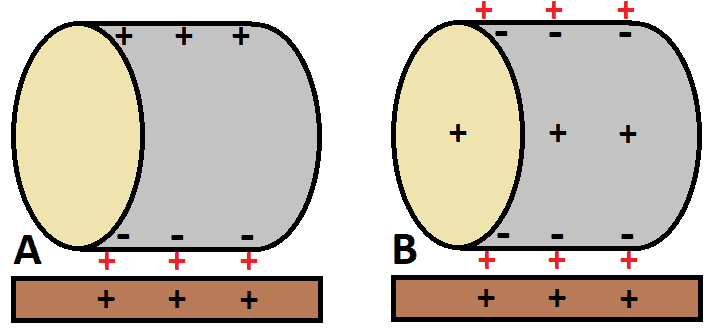
Haar2.png

Brown: conducting surface at voltage V. Blue: dielectric cylinder
 

Attachments

  • Haar2.png
    Haar2.png
    2.6 KB · Views: 1,075
Last edited:
  • Like
Likes   Reactions: Dadface
Physics news on Phys.org
spareine said:
Hair is an isolator

I think you mean "insulator" but every material will conduct with some, perhaps high, resistance.
 
I think you mean "insulator"
I see, it looks like a confusing translation problem. English has two words: isolation and insulation. My language (as well as German and French) has only one word: isolation, which translates in English to insulation. The English word isolation has no single word translation in other languages, it is equivalent to a multi word description like 'separating by a large air gap or vacuum', I guess.

... but every material will conduct with some, perhaps high, resistance.
I suppose you are not implying that my original questions are solved by considering hair as a conductor instead of an insulator?
 
Last edited:
Interesting Video, I have a fourth question
4) Why only the edge of the thread is levitated and not the whole thread levitate. Why not the other edge of the thread?

I got no clue about the electrostatics for insulators and what exactly sort of insulator is wool.
 
Last edited:
spareine said:
I suppose you are not implying that my original questions are solved by considering hair as a conductor instead of an insulator?

Sure. Your question boils down to "how does the charge get on hair"? The answer is that there is no such thing as a perfect insulator and hair is a good enough conductor to eventually move the charge. Note that it takes seconds to build up the charge, not nanoseconds like it would with metals.
 
I agree conductance of the thread would explain the levitation of the thread in the video. However when I made the video, I tested the conductance of the thread by trying to discharge a charged electroscope through the thread. As the deflection of the electroscope did not change, I considered the thread to be an insulator on the timescale of the experiment (1 minute).

On the other hand, I repeated that test today, and now the electroscope was discharged in about a minute. Presumably the increased conductance is caused by the moisture content of the fibers being higher on this warm summer day. The conductance of a thread is inversely proportional to its length. In the video the thread had many points of contact with the cardboard, so the segments between points of contact would be short, and flowing charge would experience a higher conductance than in the entire length of the thread.

"No deflection" of the electroscope can be translated into a resistance value of the entire thread. The electroscope has a capacitance of 5 pF . RC >> T means R >> 60 s / 5 pF = 1013 Ω.
 
Last edited:
The static generator produces charged ions in the air. These ions stick to the hair. Some static generators produce static electricity by rubbing two insulaters together like wool and glass. For an experiment try lighting a cigarette lighter next to the charged hair. The new ions in the air will discharge the hair.
 
Unlike a flame, the fun fly stick (or a Van de Graaff generator) does not release a large amount of ions into the air. When holding the fun fly stick close to the thread, no significant quantity of charge is transferred through the air. However, when the fun fly stick actually touches the thread, the transfer of charge occurs.


1-2: polyester thread; 3-4 pith ball (just for comparison )
 
  • Like
Likes   Reactions: Delta2

Similar threads

  • · Replies 10 ·
Replies
10
Views
5K
  • · Replies 20 ·
Replies
20
Views
2K
  • · Replies 1 ·
Replies
1
Views
2K
  • · Replies 4 ·
Replies
4
Views
3K
  • · Replies 4 ·
Replies
4
Views
2K
  • · Replies 6 ·
Replies
6
Views
3K
  • · Replies 16 ·
Replies
16
Views
9K
Replies
5
Views
2K
  • · Replies 13 ·
Replies
13
Views
3K
  • · Replies 1 ·
Replies
1
Views
3K