jdinatale
- 153
- 0
I'm having difficulty deducing that Re z = 0.
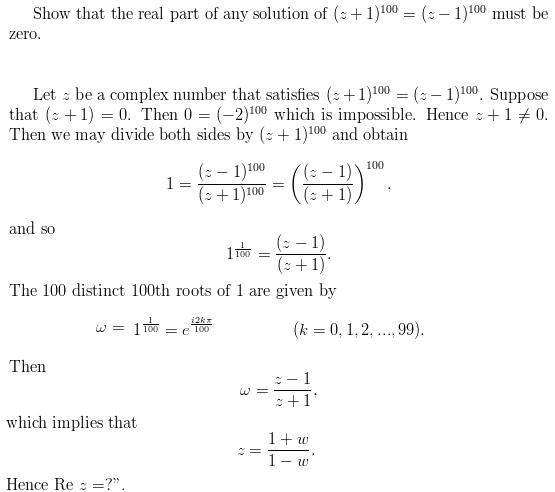
vela said:Try multiplying the top and bottom by (1-w*).
oay said:Sorry for butting in, but although I can see where jdinatale went wrong in his last post, I still can't see how Re(z) can be proved to be zero.
Of course it's correct, but I can't quite see it.
How does it?Dick said:The calculation shows z is pure imaginary
oay said:How does it?
Sorry, I'm probably being very thick here and will live to regret it.
How does
[tex]z = (1 + \omega) / (1 - \omega)[/tex]
where [itex]\omega = e^{ik\pi/50}[/itex]
imply that [itex]z[/itex] is purely imaginary?
Like I say, I know it's correct to say so, but I'm lost on how to prove it - even after trying using the conjugate method as offered above.
It'll probably be a face-palm moment when I find out...
Ha-ha! I was right!Dick said:Look at what happens when jdinatale multiplies by (1+w*). The results has w-w* (which is pure imaginary) in the numerator and w+w* (which is pure real) in the denominator. What kind of a number is imaginary/real?
