Energy of parallel plate capacitor

Click For Summary
SUMMARY

The energy of a parallel plate capacitor can be calculated using two methods, both leading to the conclusion that the energy stored is W = (1/2)Q²/C. The first method involves calculating the work done in bringing charge dq from infinity to the capacitor, while the second method utilizes equation (2.43) from Griffith's "Introduction to Electrodynamics, 3rd Edition." A key point of discussion is the factor of (1/2) in the energy equation, which arises from the integration of charge density and potential over the volume of the capacitor, emphasizing that the potential V varies with charge q during the charging process.

PREREQUISITES
  • Understanding of capacitor fundamentals, specifically parallel plate capacitors.
  • Familiarity with electrostatics concepts, including charge density (ρ) and electric potential (V).
  • Knowledge of integration techniques in the context of physics equations.
  • Access to Griffith's "Introduction to Electrodynamics, 3rd Edition" for reference to equation (2.43).
NEXT STEPS
  • Study the derivation of energy stored in capacitors using different methods.
  • Learn about the implications of varying electric potential during the charging of capacitors.
  • Explore the relationship between charge density and electric field in capacitors.
  • Review advanced integration techniques in electromagnetism for better understanding of energy calculations.
USEFUL FOR

Physics students, electrical engineers, and anyone interested in understanding the principles of energy storage in capacitors and the mathematical derivations involved.

Pushoam
Messages
961
Reaction score
53
Energy of a parallel plate capacitor with charge Q and potential difference V can be calculated in two ways:
1)Work done in bringing charge dq from infinty to the capacitor when there is potential V= q/C on the positive plate and V= 0 on the negative plate is dW = (q/C)dq
integrrating from 0 to Q gives W = (1/2)Q2/C

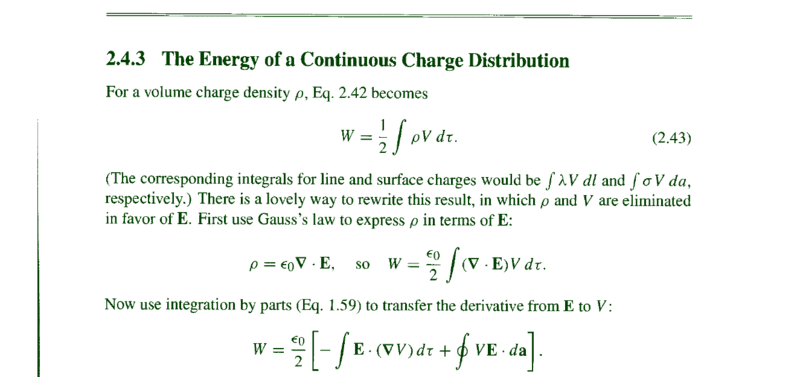
2)Using eqn.(2.43) of Griffith's Introduction to electrodynamics , 3 ed.,
W= ## \frac 1 2\int_Γ ρV \, dΓ =\frac 1 2 \int_{q=0}^Q V \, dq = \frac 1 2 \int \frac q C \, dq = \frac 1 2 \frac {Q^2} {2C} = \frac 1 4 \frac {Q^2} {C}##,
where Γ is the volume over which the integration has to be done
How to decide which method is right?
Can anyone tell me why there is a factor of (1/2) in the above equation?
upload_2017-5-26_21-40-44.png
 
Last edited:
Physics news on Phys.org
You are applying 2.43 wrongly. It is not considering adding charge to the capacitor, and changing V; it is considering the fully charged state, and integrating ρV over the volume. Therefore ∫ρVdΓ is not equal to ∫Vdq; q is constant. Assuming V is constant over the volume, ∫ρVdΓ = QV = Q2/C, so W is the same as for method 1.
 
  • Like
Likes   Reactions: Chandra Prayaga
Thanks for reply,
mjc123 said:
Assuming V is constant over the volume, ∫ρVdΓ = QV = Q2/C, so W is the same as for method 1.
V is not constant over the volume.It is E which is constant.
dW = ρV dΓ is the work done by me when I bring a charge dq = ρ dΓ from a point where potential is zero to the point where potential is V.
In case of a capacitor, I am bringing a charge dq from negative plate where potential is V= q/C, where q is charge of the capacitor at this time.
Hence, ρV dΓ = q/C dq .
What is wrong with this argument?

According to what you said is,
ρ = Qδ(y)δ(z)[ δ(x-d) - δ(x)],
where the positive plate is at (d,0,0) and negative plate is (0,0,0).
Now
##\frac 1 2\int_Γ ρV \, dΓ =\frac 1 2 \int_Γ Qδ(y)δ(z)[ δ(x-d) - δ(x)] V \, d Γ= \frac 1 2 QV##
 
Last edited:
Integrating over the volume (where ρ and V are the final charge density and potential) is not equivalent to integrating over the charge as you charge up. (And V is constant over the volume of a conductor, E is zero.)
Pushoam said:
In case of a capacitor, I am bringing a charge dq from negative plate where potential is V= q/C, where q is charge of the capacitor at this time.
Hence, ρV dΓ = q/C dq .
What is wrong with this argument?
I think what is wrong with it is that V varies with q during charging. But V is constant (the final potential) in 2.43. Perhaps it would be clearer if you used, say, v and V analogously to q and Q. So V = Q/C is the final potential at final charge Q, and v = q/C is the instantaneous potential at charge level q. Hence your equation would be ρv dΓ = q/C dq, whereas the integral in 2.43 is ρV dΓ, which is not the same thing. The factor of 1/2 arises in exactly the same way as in method 1, where ∫v(q)dq = 1/2 QV. Since ∫ρdΓ = Q, W = 1/2 ∫ρVdΓ.
 
  • Like
Likes   Reactions: Pushoam
Now, I got it.
Thank you.
I was mistaking V for v.
 

Similar threads

  • · Replies 9 ·
Replies
9
Views
2K
  • · Replies 1 ·
Replies
1
Views
1K
  • · Replies 9 ·
Replies
9
Views
2K
  • · Replies 7 ·
Replies
7
Views
2K
  • · Replies 7 ·
Replies
7
Views
2K
  • · Replies 1 ·
Replies
1
Views
2K
  • · Replies 1 ·
Replies
1
Views
2K
  • · Replies 7 ·
Replies
7
Views
20K
  • · Replies 14 ·
Replies
14
Views
6K
Replies
8
Views
2K