Equation for trapzoidal motion in motors

  • Context: Undergrad 
  • Thread starter Thread starter baby_1
  • Start date Start date
  • Tags Tags
    Motion Motors
Click For Summary
SUMMARY

The discussion focuses on calculating the timing and distance traveled by a motor using trapezoidal motion equations. The key formula derived is t1 = √(ΘT / 3a), where ΘT represents the total angle traveled and a is the acceleration. For a target of 20 degrees in 2 seconds, the calculations yield t1 = 0.49 seconds and t2 = 0.99 seconds. However, discrepancies arise when calculating for a 90-degree rotation, leading to confusion regarding the interpretation of the velocity vs. time graph and the actual motion of the motor.

PREREQUISITES
  • Understanding of trapezoidal motion in motors
  • Familiarity with kinematic equations
  • Knowledge of velocity vs. time graphs
  • Basic grasp of angular motion and acceleration
NEXT STEPS
  • Study the derivation of kinematic equations for rotational motion
  • Learn about velocity vs. time graph interpretation
  • Explore the implications of constant vs. variable acceleration in motor control
  • Investigate practical applications of trapezoidal motion profiles in motor design
USEFUL FOR

Engineers, motor control specialists, and students studying dynamics and motion analysis will benefit from this discussion, particularly those interested in optimizing motor performance and understanding motion profiles.

baby_1
Messages
159
Reaction score
16
Hello,
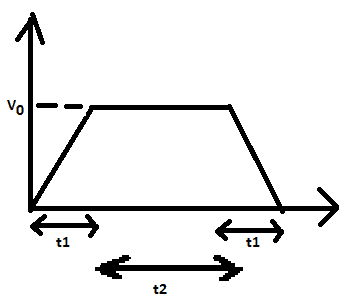
For a motor, we need to calculate the traveled distance and proper timing for its motion. Here is the trapzodial motion of our motor( we need that our motor traveled 20 degree in 2 seconds). (where t2=2t1)
77.png


we know that the traveled distance is surface of our velocity diagram. So:

\frac{1}{2}at_{1}+V_{0}t_{2}+\frac{1}{2}at_{1}=\Theta_{T}=>(V_{0}=at_{1},t_{2}=2t_{1} )=>t_{1}=\sqrt{\frac{\Theta_{T}}{3a}}
for having t1=.5s @ theta=20 degree-> a=27.
by solving this equation we find t1=.49 and t2=.99 which seems be correct.

However, By calculating this equation for theta=90 degree (a=27) =>t1=1.29, t2=2.58. I calculated traveled distance:
\Theta_{1}=\frac{1}{2}at_{1}=22.46 degree
V=at=>V_{0}=at_{1}=> \Theta_{2}=V_{0}t_{2}=at_{1}t_{2}=89.9 degree
\Theta_{3}=\frac{1}{2}at_{1}=22.46 degree
\Theta_{1}+\Theta_{2}+\Theta_{3}>90

what is my mistake?
 
Physics news on Phys.org
I believe your post has some typos but anyway:
$$t_1=\sqrt{\frac{\Theta_T}{3a}}$$ looks correct to me. But when I apply it for ##\Theta_T=90## and ##a=27## I get ##t_1=1.05##. ##t_2=2.1##
 
Last edited:
  • Like
Likes   Reactions: baby_1
baby_1 said:
Summary:: Trapzoidal motion

Hello,
For a motor, we need to calculate the traveled distance and proper timing for its motion. Here is the trapzodial motion of our motor( we need that our motor traveled 20 degree in 2 seconds). (where t2=2t1)
Do you mean that the motor rotated 20 degrees in 2 seconds?
Your problem description is very confusing. The motor is not traveling on a trapezoidal path. This is a graph of velocity vs. time.
baby_1 said:
View attachment 263146

we know that the traveled distance is surface of our velocity diagram. So:

\frac{1}{2}at_{1}+V_{0}t_{2}+\frac{1}{2}at_{1}=\Theta_{T}=>(V_{0}=at_{1},t_{2}=2t_{1} )=>t_{1}=\sqrt{\frac{\Theta_{T}}{3a}}
for having t1=.5s @ theta=20 degree-> a=27.
by solving this equation we find t1=.49 and t2=.99 which seems be correct.
From what you already said, total time is 2 seconds, and t2 = 2t1, so t1 = 0.5 sec. and t2 = 1.0 sec.
baby_1 said:
However, By calculating this equation for theta=90 degree (a=27) =>t1=1.29, t2=2.58. I calculated traveled distance:
\Theta_{1}=\frac{1}{2}at_{1}=22.46 degree
V=at=>V_{0}=at_{1}=> \Theta_{2}=V_{0}t_{2}=at_{1}t_{2}=89.9 degree
\Theta_{3}=\frac{1}{2}at_{1}=22.46 degree
\Theta_{1}+\Theta_{2}+\Theta_{3}>90

what is my mistake?
From your graph, at the start acceleration a is constant and positive, reaching a maximum velocity of v0 in the first 1/2 second. Velocity v is constant for the next full second. At t = 1.5 second, the motor decelerates from v0 to 0, so a is negative.
 
I am really appreciative of your response.
Thanks Delta2 , I see that I calculated wrongly and it works fine.
Thanks Mark44 , but I didn't calculate the traveled distance via velocity equation I calculated the traveled distance via surface of the diagram where the value is positive every where.
 
baby_1 said:
Thanks Mark44 , but I didn't calculate the traveled distance via velocity equation I calculated the traveled distance via surface of the diagram where the value is positive every where.
What does the diagram represent? You didn't label the axes, but the horizontal axis is time, and the vertical axis appears to be velocity (##v_0## is marked on it).

If this is a graph of velocity vs. time, it doesn't make any sense to calculate the total distance traveled base on the length of the three segments that make up the graph.

As I mentioned before, in the first half second, velocity appears to be increasing from 0 to ##v_0##. In the next second, velocity is constant, and in the last half second, velocity is decreasing from ##v_0## back to 0. This means that that acceleration a is negative in the last half second.

Also, the motor is not moving trapezoidally, at least if I understand what your graph is supposed to represent.
 

Similar threads

  • · Replies 1 ·
Replies
1
Views
2K
  • · Replies 2 ·
Replies
2
Views
2K
Replies
5
Views
3K
  • · Replies 19 ·
Replies
19
Views
2K
Replies
6
Views
2K
Replies
13
Views
2K
  • · Replies 3 ·
Replies
3
Views
2K
  • · Replies 21 ·
Replies
21
Views
2K
  • · Replies 2 ·
Replies
2
Views
2K
  • · Replies 32 ·
2
Replies
32
Views
3K