Equation of motion and normal modes of a coupled oscillator

Click For Summary
SUMMARY

The discussion centers on the equation of motion for a simple oscillator, represented by the differential equation mx''(t) = -kx(t) + mg. The frequency is determined as ω = √(k/m), with the gravitational term mg being constant. The participant expresses confusion regarding the amplitude of the motion, having identified the equation of motion as x(t) = Acos(ωt + φ). Clarification is provided that the equation represents Newton's second law rather than a direct expression for displacement over time.

PREREQUISITES
  • Understanding of Newton's second law of motion
  • Familiarity with differential equations
  • Knowledge of harmonic motion and oscillators
  • Basic concepts of amplitude and frequency in physics
NEXT STEPS
  • Study the derivation of the equation of motion for coupled oscillators
  • Learn about the concept of normal modes in oscillatory systems
  • Explore the effects of damping on oscillatory motion
  • Investigate the role of initial conditions in determining amplitude
USEFUL FOR

Students of physics, particularly those studying mechanics and oscillatory systems, as well as educators seeking to clarify concepts related to coupled oscillators and their equations of motion.

VapeL
Messages
1
Reaction score
0
Homework Statement
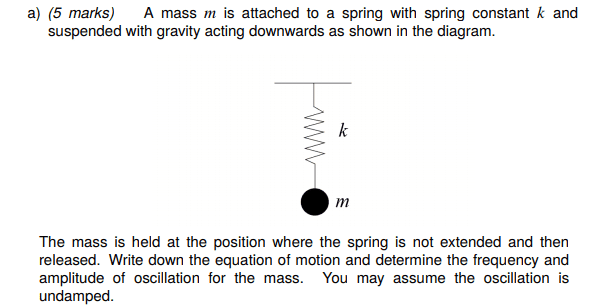
Find the equation of motion of a mass on a spring
Relevant Equations
x(t) = Acos(ωt + φ)
This is a question from an exercise I don't have the answers to.

I have been trying to figure this out for a long time and don't know what to do after writing

mx''¨(t)=−kx(t)+mg
I figure that the frequency ω=√(k/m) since the mg term is constant and the kx term is the only term that changes.

I have the equation of motion written as x(t) = Acos(ωt + φ) but do not know how to go about finding the amplitude either.

Any help would be great thanks!
ePwCA.png
 
Physics news on Phys.org
It looks like this is a simple (not coupled) oscillator.

It also looks like you have this backwards, in a sense. The equation of motion is not the expression for ##x## as a function of time, but rather it is Newton's second law, involving gravity and the restoring force that the spring exerts on the mass. In other words: It is a differential equation.
 

Similar threads

Replies
4
Views
2K
  • · Replies 11 ·
Replies
11
Views
2K
  • · Replies 16 ·
Replies
16
Views
2K
Replies
25
Views
1K
Replies
39
Views
3K
  • · Replies 8 ·
Replies
8
Views
2K
  • · Replies 5 ·
Replies
5
Views
5K
Replies
1
Views
3K
Replies
1
Views
1K
Replies
9
Views
2K