Equations of relative motion with respect to a rotating reference frame

Click For Summary

Homework Help Overview

The discussion revolves around the equations of relative motion in a rotating reference frame, particularly focusing on the complexities introduced when both a body rotates around a fixed point and experiences additional rotation. The original poster seeks clarification on how to apply the derived equations of motion in this context, specifically regarding the absolute velocity and acceleration of a point in the system.

Discussion Character

  • Mixed

Approaches and Questions Raised

  • The original poster attempts to clarify the definitions of various terms in the equations of motion, questioning how the rotation of point A around O affects the terms for velocity and acceleration. They explore the relationships between angular velocities and the terms in the equations, expressing confusion about the inclusion of certain rotational components.
  • Some participants suggest simplifying the problem by focusing on one rotation at a time, while others provide diagrams to illustrate the relationships between different points and their respective motions.
  • There are inquiries about the physical interpretation of specific terms, such as the centripetal-type acceleration term, and how these relate to the overall motion of the system.

Discussion Status

The discussion is ongoing, with participants providing insights and diagrams to aid understanding. There is a recognition of the complexity involved in combining multiple rotations, and some guidance has been offered regarding the interpretation of terms in the equations. However, there is no explicit consensus on the best approach to take or the correct application of the equations.

Contextual Notes

Participants note that previous examples in lecture materials only involved simpler cases with no additional rotations, highlighting the novelty and complexity of the current problem. The discussion also reflects a need for clarification on the assumptions underlying the equations being used.

Master1022
Messages
590
Reaction score
116
Homework Statement
How to use these equations of motion
Relevant Equations
## r = R + \rho ##
## \dot r = \dot R + (\Omega \times \rho) + \dot \rho ##
## \ddot r = \ddot R + \ddot \rho + 2(\Omega \times \dot \rho) + \dot \Omega \times \rho + \Omega \times (\Omega \times \rho) ##
Hi,

I am just writing a post to follow up on a previous thread I made which I don't think was very clear. The question is mainly about how to use the below equations when there is also a rotation of the body around the fixed reference point.

Please see the diagram here to see how the vectors have been defined:
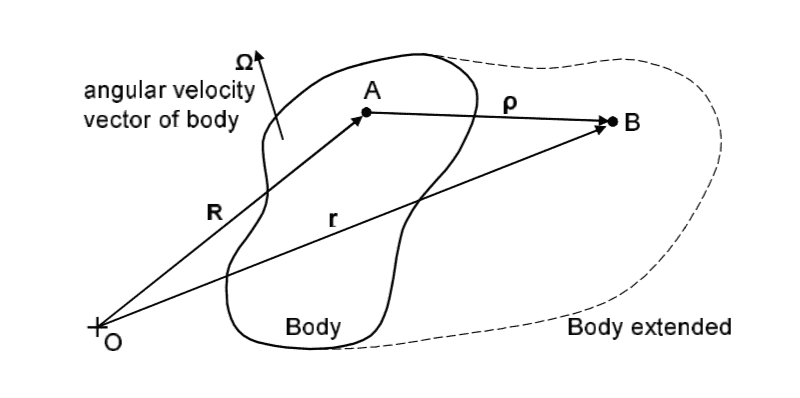
Screen Shot 2020-09-23 at 12.50.32.png


We can then derive the following equations of motion:
$$ r = R + \rho $$
$$ \dot r = \dot R + (\Omega \times \rho) + \dot \rho $$
$$ \ddot r = \ddot R + \ddot \rho + 2(\Omega \times \dot \rho) + \dot \Omega \times \rho + \Omega \times (\Omega \times \rho) $$

However, what happens if there is also a rotation of A around O (lets say that the angular velocity is ## \omega ##)? How do we now use the equations to find the absolute velocity and acceleration of B?

My approach:
In an attempt to be clear and not keep re-using terms, let us define ## \alpha ## to be the rotation of the body (about A) relative to the the rotation of A around O and ## \omega ## is defined above.

Velocity:
The equation is:
$$ \dot r = \dot R + (\Omega \times \rho) + \dot \rho $$
Does ## \dot R ## include the rotation of point A around O and therefore become ## \dot R = (\omega \times R)##? I originally thought that vector only included a linear translational velocity...

Now for the other two terms, one problem I was working seems to suggest that the rotation of B around point A is included in the ## \dot \rho ## term and not the ## (\Omega \times \rho) ## term. Therefore, it suggests that ## \dot \rho = (\alpha \times \rho) ## where ## \alpha ## is defined as above. It also suggests that ## (\Omega \times \rho) = (\omega \times \rho) ##. I am struggling to understand why this is the case.

Acceleration:
The equation is:
$$ \ddot r = \ddot R + \ddot \rho + 2(\Omega \times \dot \rho) + \dot \Omega \times \rho + \Omega \times (\Omega \times \rho) $$

the ## \ddot R ## term contains ## \omega \times (\omega \times R) + \dot \omega \times R ## (it would also contain any linear relative acceleration but there is none).

the ## 2(\Omega \times \dot \rho) ## is the Coriolis term which is ## 2(\omega \times \dot \rho) ## where ## \dot \rho ## has been calculated above. This term makes sense to me.

the ## \ddot \rho ## term contains the ## \alpha \times (\alpha \times \rho) + \dot \alpha \times \rho ##

the ## \dot \Omega \times \rho ## term is ## \dot \omega \times \rho ##

the ## \Omega \times (\Omega \times \rho) = \omega \times (\omega \times \rho) ##

I am also struggling to see why the last two terms relate ## \omega ## and ## \rho ##.

Any correction/ clarification is greatly appreciated. In the lecture notes, we only saw situations with ## R = 0 ## and body just rotating around a fixed point, so this is new to me.

Thanks
 
Physics news on Phys.org
I recommend that you only worry about one rotation and coordinate change at a time. If you understand each one, keep it simple. There are situations that require one coordinate transformation after another, after another,... IMO, the combination of them all would be very complicated and virtually incomprehensible.
 
FactChecker said:
I recommend that you only worry about one rotation and coordinate change at a time. If you understand each one, keep it simple. There are situations that require one coordinate transformation after another, after another,... IMO, the combination of them all would be very complicated and virtually incomprehensible.
Thanks for your response @FactChecker . However, I found a diagram for these types of problems:

Screen Shot 2020-09-23 at 15.34.45.png


and this question asks us to find the absolute velocity and acceleration of A. We are given the distances, ## \theta##, ## \dot \theta ##, ## \ddot \theta ##, ## \alpha ##, ## \dot \alpha ##, and ## \ddot \alpha ##. In this situation we need to consider both rotations together and the solution uses the same method as above.

For example, the acceleration is equation is turned from

$$ \ddot r = \ddot R + \ddot \rho + 2(\Omega \times \dot \rho) + \dot \Omega \times \rho + \Omega \times (\Omega \times \rho) $$
into
$$ a_A = a_o + 2 \dot \theta \times v_{A/o} + \ddot \theta \times r_{A/o} + a_{A/o} + \dot \theta \times \dot \theta \times r_{A/o} $$
and am confused why ## \dot \theta \times \dot \theta \times r_{A/o} ## appears in the equation. The terms like ## \dot \alpha \times \dot \alpha \times r_{A/o} ## are contained within ## a_{A/o} ##
 
Master1022 said:
For example, the acceleration is equation is turned from

$$ \ddot r = \ddot R + \ddot \rho + 2(\Omega \times \dot \rho) + \dot \Omega \times \rho + \Omega \times (\Omega \times \rho) $$
into
$$ a_A = a_o + 2 \dot \theta \times v_{A/o} + \ddot \theta \times r_{A/o} + a_{A/o} + \dot \theta \times \dot \theta \times r_{A/o} $$
and am confused why ## \dot \theta \times \dot \theta \times r_{A/o} ## appears in the equation.
If you rearrange the term ##a_{A_0}## in the second equation, then the two equations are$$\ddot r = \ddot R + \ddot \rho + 2(\Omega \times \dot \rho) + \dot \Omega \times \rho + \Omega \times (\Omega \times \rho) $$

$$ a_A = a_o + a_{A/o} + 2 \dot \theta \times v_{A/o} + \ddot \theta \times r_{A/o} + \dot \theta \times \dot \theta \times r_{A/o} $$

Each term in the second equation equals the corresponding term in the first equation.

Note that ##\Omega## in this picture
1600897789274.png


corresponds to ##\dot \theta## in this picture
1600897850578.png

The square plate corresponds to the "body" in the first picture. The angular velocity of the square plate relative to the inertial frame XOY is ##\dot \theta##, and this corresponds to ##\Omega## in the first picture. The particle A in the second picture corresponds to the particle B in the first picture. The point o in the second picture corresponds to point A (fixed in the body) in the first picture. Point O in the second picture corresponds to point O in the first picture.
 
  • Like
  • Informative
Likes   Reactions: Abhishek11235 and Master1022
TSny said:
If you rearrange the term ##a_{A_0}## in the second equation, then the two equations are$$\ddot r = \ddot R + \ddot \rho + 2(\Omega \times \dot \rho) + \dot \Omega \times \rho + \Omega \times (\Omega \times \rho) $$

$$ a_A = a_o + a_{A/o} + 2 \dot \theta \times v_{A/o} + \ddot \theta \times r_{A/o} + \dot \theta \times \dot \theta \times r_{A/o} $$

Each term in the second equation equals the corresponding term in the first equation.

Note that ##\Omega## in this picture
View attachment 269948

corresponds to ##\dot \theta## in this picture
View attachment 269949
The square plate corresponds to the "body" in the first picture. The angular velocity of the square plate relative to the inertial frame XOY is ##\dot \theta##, and this corresponds to ##\Omega## in the first picture. The particle A in the second picture corresponds to the particle B in the first picture. The point o in the second picture corresponds to point A (fixed in the body) in the first picture. Point O in the second picture corresponds to point O in the first picture.

Thank you @TSny very much for the explanation! Can you explain what the physical interpretation of the ##\dot \theta \times \dot \theta \times r_{A/o} ## term is? It looks like a centripetal-type of acceleration term, but I am not really sure how to explain it in words.
 
Can you explain what the physical interpretation of the ##\dot \theta \times \dot \theta \times r_{A/o} ## term is? It looks like a centripetal-type of acceleration term, but I am not really sure how to explain it in words.
Yes, this term is a centripetal-type acceleration. Suppose the particle A is not moving relative to the plate, so A is at a fixed location on the circular track and ##\alpha## is not changing. The particle will still experience acceleration due to the rotation of the plate about the corner O. The centripetal part of this acceleration is ##\dot \theta \times ( \dot \theta \times r_{A/O} )##. Write ##r_{A/O}## as ##r_{A/O} = r_{o/O}+r_{A/o}##. The acceleration is then

##\dot \theta \times \left( \dot \theta \times ( r_{o/O}+r_{A/o}) \right) = \dot \theta \times ( \dot \theta \times r_{o/O} ) + \dot \theta \times ( \dot \theta \times r_{A/0} ) ##

The last term on the right is the term you are asking about. The first term on the right is contained in ##a_o## in the overall expression

$$ a_A = a_o + a_{A/o} + 2 \dot \theta \times v_{A/o} + \ddot \theta \times r_{A/o} + \dot \theta \times (\dot \theta \times r_{A/o} )$$
 
  • Like
  • Informative
Likes   Reactions: Abhishek11235 and Master1022
TSny said:
Yes, this term is a centripetal-type acceleration. Suppose the particle A is not moving relative to the plate, so A is at a fixed location on the circular track and ##\alpha## is not changing. The particle will still experience acceleration due to the rotation of the plate about the corner O. The centripetal part of this acceleration is ##\dot \theta \times ( \dot \theta \times r_{A/O} )##. Write ##r_{A/O}## as ##r_{A/O} = r_{o/O}+r_{A/o}##. The acceleration is then

##\dot \theta \times \left( \dot \theta \times ( r_{o/O}+r_{A/o}) \right) = \dot \theta \times ( \dot \theta \times r_{o/O} ) + \dot \theta \times ( \dot \theta \times r_{A/0} ) ##

The last term on the right is the term you are asking about. The first term on the right is contained in ##a_o## in the overall expression

$$ a_A = a_o + a_{A/o} + 2 \dot \theta \times v_{A/o} + \ddot \theta \times r_{A/o} + \dot \theta \times (\dot \theta \times r_{A/o} )$$

@TSny - thank you once again, that makes much more sense now! I haven't been able to find such a clear explanation anywhere else.

Thanks
 
Ok. Glad I could help.
 

Similar threads

  • · Replies 6 ·
Replies
6
Views
3K
Replies
2
Views
2K
  • · Replies 9 ·
Replies
9
Views
2K
Replies
2
Views
2K
  • · Replies 11 ·
Replies
11
Views
4K
Replies
4
Views
2K
Replies
25
Views
4K
  • · Replies 5 ·
Replies
5
Views
3K
Replies
14
Views
4K
  • · Replies 5 ·
Replies
5
Views
3K