Equivalent capacitance, circular arrangement

Click For Summary
SUMMARY

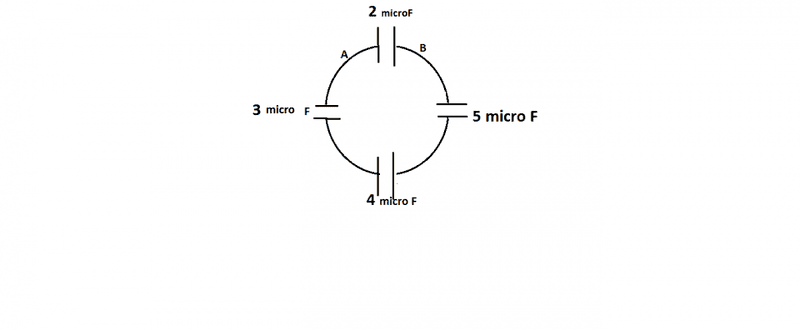
The discussion focuses on determining the equivalent capacitance between two points, A and B, in a circuit with capacitors arranged in a circular configuration. Participants clarify that while some capacitors appear in series, the arrangement can also be interpreted as a mirrored layout, leading to confusion about the connections. The key takeaway is that the equivalent capacitance can be simplified to a single capacitor that represents the entire network between points A and B, regardless of the physical arrangement of the capacitors.

PREREQUISITES
  • Understanding of capacitor configurations: series and parallel connections
  • Familiarity with the concept of equivalent capacitance
  • Basic knowledge of circuit diagrams and their representations
  • Ability to interpret electrical circuit problems and apply relevant equations
NEXT STEPS
  • Study the derivation of formulas for equivalent capacitance in series and parallel configurations
  • Learn how to analyze complex circuits using Kirchhoff's laws
  • Explore practical applications of capacitors in electronic circuits
  • Investigate the impact of capacitor arrangement on overall circuit behavior
USEFUL FOR

Students studying electrical engineering, educators teaching circuit analysis, and hobbyists interested in electronics who want to deepen their understanding of capacitor arrangements and equivalent capacitance calculations.
gracy
Messages
2,486
Reaction score
83
Mentor's note: Post moved to new thread since it's a new problem.

One more problem

Homework Statement


CAJ.png


Find the equivalent capacitance between A and B.

Homework Equations


The Attempt at a Solution


I think all the Capacitors are in series but according to my book only three capacitors are in series.How?
 
Last edited by a moderator:
Physics news on Phys.org
When the problem named and labelled the two nodes A and B between which you are to determine the capacitance, it effectively implied connection terminals for the circuit. These terminals provide a favored point of view for you to interpret the circuit.

Fig1.png
 
Last edited:
  • Like
Likes gracy
How did you switch from one figure to the other,wire A and wire B seems flipped and how you decided that 2 μF location?
 
Your original figure is just rotated to bring the terminal leads horizontal. The two circuits are mirrored about the center where the arrow is. Follow outwards from the center and confirm that you find the corresponding components in the same (mirrored) locations.
 
  • Like
Likes gracy
gneill said:
The two circuits are mirrored about the center where the arrow is
When it is mirrored, left would come in right one's place and right would go in left one's place.Similarly, the vertical flip would occur, right?
 
gneill said:
Follow outwards from the center and confirm that you find the corresponding components in the same (mirrored) locations.
Sorry, I did not understand.
 
gracy said:
When it is mirrored, left would come in right one's place and right would go in left one's place.Similarly, the vertical flip would occur, right?

That's not important ... the point is the circular and square arrangements are the same circuit layouts
and it is now easier to visualise and to solve the problem

so now have a go at solving the total capacitance value between points A and BDave
 
Mirrors reverse front to back, not top to bottom. Otherwise you'd be looking at your feet in the mirror rather than your eyes :smile:

Surely you can see the symmetry between the two circuits? Confirm that all the components of both circuits make the same connections to each other.
 
  • Like
Likes gracy
Gracy if you don't mind, from yr many questions I have got the impression you are working hard and putting pressure on yourself but it feels like you have your eyes frowning four inches (10 cm) from the book. And that you need to relax, take somehow a cool distant look at these problems (and no doubt the texts of the corresponding books) and ask yourself what is this about? What does the question mean? What principles/equations do I have to use? (They are probably in the text preceding the exercise)... etc.

Questions are made for verification of understanding but not usually intended to be fiendish.

You're asked the capacitance between A and B. What is there between A and B? One way there is one capacitor, the other way there are three capacitors in series. No big deal to alternatively draw them as in #2.
 
  • Like
Likes SammyS
  • #10
If the question would have asked just equivalent capacitance of the circuit rather than the equivalent capacitance between A and B then all the capacitors would be in parallel, Right?
 
  • #11
gneill said:
Follow outwards from the center
Which center?
 
  • #12
gracy said:
If the question would have asked just equivalent capacitance of the circuit rather than the equivalent capacitance between A and B then all the capacitors would be in parallel, Right?
For the most part such a question does not make sense if it's not specified how the group of capacitors are to connected to some external circuit,

They definitely can;t be considered to all be in parallel. That would require having only two nodes, which you should know. In some sense they are all in series, if taken in isolation from any other circuit, but then equivalent capacitance makes no sense.

gracy said:
Which center?
gneill meant: from the center of the figure, outward, i.e. from a point between the two circuit diagrams.
 
  • #13
SammyS said:
In some sense they are all in series,
gracy said:
I think all the Capacitors are in series
I knew it, I don't know what happened to me as I wrote in parallel.
 
  • #14
SammyS said:
but then equivalent capacitance makes no sense.
What does equivalent capacitance mean?
 
  • #15
gracy said:
What does equivalent capacitance mean?
What do you suppose it (equivalent capacitance) means? After all, this whole thread has to do with finding the equivalent capacitance.

Does your textbook or do your notes show how the formulas for equivalent capacitance are derived for capacitors in parallel and those in series?
 
Last edited:
  • #16
gracy said:
What does equivalent capacitance mean?
The original network of capacitors are connected into a circuit, or to a battery.
Equivalent capacitance between point A and B is the capacitance of the single capacitor you replace the whole network between A and B with, so as nothing changes in the voltages and charges in the external network.
 
  • #17
@gracy, have you seen real capacitiors and resistors? Such things like in the picture? I guess, you have seen batteries.

http://getmfg.com/wp-content/uploads/2014/10/rsz_eck-10pct20leanpct20electronicspct20componentspct20-960x650.jpg

You can make a network/circuit from these components by joining the terminals and connect it to a battery,
It is as making a necklace from beads. You need a thread to connect the beads and enclosures at the ends.
In A, the beads are connected in series. In B, the beads are parallel. How are the beads of different color connected in C?
Here you can see real necklaces. Can you see, where are only series and where are both series and parallel connections? http://www.fortheloveof.net/how-to-make-an-earthy-beaded-necklace/
 

Attachments

  • necklace.jpg
    necklace.jpg
    16.1 KB · Views: 438
Last edited by a moderator:
  • Like
Likes gracy
  • #18
ehild said:
How are the beads of different color connected in C?
Both series and parallel connections.
 
  • #19
gracy said:
Both series and parallel connections.
Yes!
 
  • Like
Likes gracy
  • #20
But why gneill rotated my diagram in OP 90 degrees to the right?
 
  • #21
It does not matter. I guess, you have a necklace. Is it the same necklace if you rotate it, turn it over, make the threads differently curved, fold it? Throw it up into the air, or hold it in your hand or around your neck?

People working with electric circuits like to draw the terminal points vertically, one below the other.
 
  • Like
Likes gracy
  • #22
gracy said:
But why gneill rotated my diagram in OP 90 degrees to the right?

Why do you care? You are obsessing on things that do not matter, and doing that is interfering with your ability to learn and understand!. All that matters is the "topology", not the shape or the orientation.
 
  • #23
And what about mirror image,is it necessary?
 
  • #24
gracy said:
And what about mirror image,is it necessary?

What do YOU think? Do you think it matters? If you do, why do you think it?
 
  • #25
Ray Vickson said:
What do YOU think? Do you think it matters? If you do, why do you think it?
I don't know.But if I'll take example of necklace,I would say No!
 
  • #26
I think the only thing that's important to do here is showing connection terminals A and B.Is converting this circular arrangement into normal circuit like arrangement necessary?
 
  • #27
gracy said:
I think the only thing that's important to do here is showing connection terminals A and B.Is converting this circular arrangement into normal circuit like arrangement necessary?
No, it is not necessary. But makes it easier to handle for those, who usually draw circuits that way.
 
  • Like
Likes gracy
  • #28
gracy said:
I think the only thing that's important to do here is showing connection terminals A and B
Right?
 
  • #29
gracy said:
Right?
showing connections between components and connections to the terminals.
 
  • Like
Likes gracy
  • #30
gracy said:
But why gneill rotated my diagram in OP 90 degrees to the right?

Because he thought nothing of it, because it was so obvious to him he didn't need to think about it, because he thought only of the essential of the situation which is represented by a diagram you can draw in various equivalent ways, because he is not glued to the page like a liferaft, relax, do the same yourself on occasion. :oldsmile:
 

Similar threads

  • · Replies 4 ·
Replies
4
Views
5K
  • · Replies 15 ·
Replies
15
Views
3K
  • · Replies 67 ·
3
Replies
67
Views
11K
Replies
4
Views
3K
  • · Replies 12 ·
Replies
12
Views
2K
Replies
4
Views
1K
  • · Replies 5 ·
Replies
5
Views
2K
  • · Replies 3 ·
Replies
3
Views
3K
  • · Replies 12 ·
Replies
12
Views
8K
Replies
4
Views
2K