Error When Deriving the Rocket Equation

Click For Summary

Discussion Overview

The discussion revolves around the derivation of the rocket equation, with participants exploring the effects of momentum conservation and the relative velocities of the rocket and exhaust. The scope includes theoretical derivation, conceptual clarification, and mathematical reasoning related to the rocket's motion and forces acting on it.

Discussion Character

  • Exploratory
  • Technical explanation
  • Conceptual clarification
  • Debate/contested
  • Mathematical reasoning

Main Points Raised

  • Some participants express confusion about the correct formulation of the momentum equations, particularly regarding the sign and terms used for the exhaust velocity.
  • There is a discussion on whether the exhaust velocity should be considered as positive or negative based on the reference frame of the observer.
  • One participant proposes that the speed of the exhaust should be expressed as the rocket's speed plus the exhaust speed, while others suggest it should be the rocket's speed minus the exhaust speed.
  • Several participants attempt to derive the rocket equation using different approaches, leading to variations in the final expressions and interpretations of terms.
  • There is mention of integrating the equations to arrive at the final form of the rocket equation, with some participants questioning the assumptions made during integration.
  • One participant highlights the importance of distinguishing between the velocity of the exhaust relative to the rocket and its absolute velocity in an inertial frame.
  • Some participants clarify that the change in mass during the rocket's operation is negative, which affects the signs in the equations.
  • There is an inquiry about deriving thrust from the change in velocity, indicating a potential application of the derived equation.

Areas of Agreement / Disagreement

Participants do not reach a consensus on the correct formulation of the rocket equation, with multiple competing views on the treatment of exhaust velocity and the signs in the equations. The discussion remains unresolved regarding the best approach to derive the equation accurately.

Contextual Notes

Limitations include varying assumptions about reference frames, the treatment of relative velocities, and the integration steps that have not been fully resolved. Participants express uncertainty about the implications of these assumptions on the final equation.

Who May Find This Useful

This discussion may be useful for students and enthusiasts interested in rocket dynamics, momentum conservation, and the mathematical derivation of physical equations in a theoretical context.

bob14
Messages
11
Reaction score
1

Homework Statement


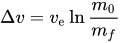
I want to try to derive the rocket equation and then add additional effects like gravity, air resistance, etc. Here's the equation that I found online:
9db5b4589ff9a385687c2474c5aef823eeece133

Homework Equations


p (momentum) = mass * velocity
F (force) = Δp / Δt

The Attempt at a Solution


[/B]
Picture1.png


pi = mv

Here is where the problem is. I do this:
pfinal = (m - dm)(v + dv) - dm(v - ve)

But online solutions show that it is either (m + dm) OR + dm(v - ve), not minus.

Anyways, continuing to solve with my equation gets:
pi = pfinal (conservation of momentum)
mv = (m - dm)(v + dv) - dm(v - ve)
mv = mv + mdv - vdm - dmdv - vdm + vedm

Again, here the vdm should cancel, but they dont't.

mdv - dmdv = 2*vdm - vedm

Here, I read that dmdv is considered a higher order term so it is negligible.

mdv = dm(2v - ve)

So I got to this point but the equation is wrong. It is obvious that the mass of the rocket time dv (i.e. its change in momentum) doesn't equal the mass of the exhaust times 2v - ve, it should just be v - ve. But even that is wrong since it is just dm times ve. So my question is what am I missing?
 

Attachments

  • Picture1.png
    Picture1.png
    5 KB · Views: 789
Physics news on Phys.org
bob14 said:
pi = pfinal (conservation of momentum)
mv = (m - dm)(v + dv) - dm(v - ve)
This is where it went wrong. You're in an inertial frame, so the momentum of the exhaust ejected is ve)dm. I don't know why you took the relative velocity in the original equation but it will present itself in the later steps. (when you calculate the change in momentum)
∴ mv = (m - dm)(v + dv) - dm(ve)
⇒ mv = mv + mdv - vdm - dmdv + vedm (Im neglecting dmdv)
⇒ mdv - vdm + vedm = 0
⇒ dm(v- ve) = mdv

I guess you should integrate it although I can't be sure since the initial conditions aren't really mentioned.
 
TachyonLord said:
This is where it went wrong. You're in an inertial frame, so the momentum of the exhaust ejected is ve)dm.

I think that the meaning of ##v_e## is that it is the speed of the exhaust relative to the rocket. So the velocity of the exhaust is not ##v_e## but ##v - v_e##. The point is that the speed of the exhaust is not constant, but the relative velocity is (approximately).
 
stevendaryl said:
I think that the meaning of ##v_e## is that it is the speed of the exhaust relative to the rocket. So the velocity of the exhaust is not ##v_e## but ##v - v_e##. The point is that the speed of the exhaust is not constant, but the relative velocity is (approximately).
Oh, I wrote my solution w.r.t. the diagram. If its the relative velocity, then momentum of the ejected mass would be dm(##v + v_e##)
##v_e = v_{exhaust} - v## Because, ##v_e## is the velocity of the ejected mass w.r.t. the rocket.
And i guess, then the cancellation takes place.
 
TachyonLord said:
the ejected mass would be dm(v + ve)

Ok, if I use that equation and solve, I would get:

∴ mv = (m - dm)(v + dv) + dm(v + ve)
⇒ mv = mv + mdv - vdm - dmdv + vdm + vedm
⇒ mdv + vedm = 0
⇒ dm(-ve) = mdvIntegrating would get:
-vedm = mdv
⇒ -vedm / m = dv
⇒ -ve * ∫ dm / m = ∫ dv
⇒ -ve * [ln (mf) - ln (m0)] = vf - v0 (Integrating from final to inital mass and final to initial velocity).
⇒ Δv = -ve * ln (mf / m0)
⇒ Δv = ve * ln (m0 / mf)

That's basically the equation that was online but I still don't get why we had to do dm(v + ve) instead of dm(v - ve). Doesn't the relative exhaust velocity subtract from the velocity that the rocket gave the fuel? I'm assuming that we're in the inertial reference frame of the ground, watching the rocket go up.
 
bob14 said:
That's basically the equation that was online but I still don't get why we had to do dm(v + ve) instead of dm(v - ve). Doesn't the relative exhaust velocity subtract from the velocity that the rocket gave the fuel? I'm assuming that we're in the inertial reference frame of the ground, watching the rocket go up.
Relative velocity of the mass wrt to the rocket is ##v_{mass}(inertial frame) - v_{rocket}(inertial frame)## Right ?
⇒ ##v_e = v_{mass} - v##
As a result,
##v_{mass} = v_e + v##
∴ ##p_{dm} = (dm)v_{mass}##
⇒ ##p_{dm} = (dm)(v_e + v)##

Hope you got it ! Feel free to reply :)
 
TachyonLord said:
Relative velocity of the mass wrt to the rocket is ##v_{mass}(inertial frame) - v_{rocket}(inertial frame)## Right ?

That part makes sense, it's just that vmass = ve + v doesn't. I understand its just moving the terms around but how does ve + v work? If ve is already negative can't we write it as v - ve? I guess I'm looking for an intuitive way to understand it.
 
bob14 said:
That part makes sense, it's just that vmass = ve + v doesn't. I understand its just moving the terms around but how does ve + v work? If ve is already negative can't we write it as v - ve? I guess I'm looking for an intuitive way to understand it.
How do you say that ve is negative ? ve is the velocity that I measure(of the ejected mass) if I'm sitting on the rocket, so in order to actually state if its positive/negative, you need to tell me where your origin is.

Well, It'll be ten times easier to understand if you just do it normally, I mean without bringing relative velocit into the equation first and deriving the equation with ##v_{mass}## in general.

Ill try to explain physically. Okay so like I'm already moving to the left right? Let's say that the mass is stationary(I know it isn't but let's say it is.) I'm moving with speed ##v## to the left wrt observer A. But since I'm on the rocket. I don't feel/see it. Because for me, its the mass that is moving with velocity v(or minus v whatever you want to call it).
Untitled.png

Now, in reality the mass also has some velocity(lets say v' wrt observer A), and in fact, it is moving to the right of A. Now as the mass was stationary wrt A, I "felt" that it was already moving with velocity ##v## RELATIVE TO ME. Now when it actually starts moving with velocity ##v'##, I see it moving to the right even faster, because there's an "apparent" velocity due to my movement and another velocity due to the mass itself.

As a result, it moves away faster as compared to case one. Thats why the velocities get added. Hope you get me. Again, feel free to reply !.
 

Attachments

  • Untitled.png
    Untitled.png
    10.9 KB · Views: 660
I agree with the final equation, but I'm a little confused by the derivation, too, because of the signs.

Suppose we pick a small interval of time, ##\Delta t##. Let ##m_e## be the amount of exhaust expelled during that time. Let ##v_e## be the speed of the rocket minus the speed of the exhaust. Since the exhaust is traveling backwards relative to the rocket, the rocket's speed is greater, so ##v_e## is positive.

Then conservation of momentum tells us: ##m v = (m - m_e) (v + dv) + m_e (v - v_e)##. This leads to: ##dv = v_e \frac{m_e}{m - m_e} \approx v_e \frac{m_e}{m}## (since ##m \gg m_e##). At this point, we use ##dm = -m_e## to get:

##dv = - v_e \frac{dm}{m} \Rightarrow v = v_0 - v_e (log(m) - log(m_0)) = v_0 + v_e (log(m_0) - log(m)) = v_0 + v_e log(\frac{m_0}{m})##

If the acceleration is from rest, ##v_0 = 0##, so we get the answer.

However, in this derivation ##v_e## is the rocket's speed minus the exhaust's speed.
 
  • #10
TachyonLord said:
Now, in reality the mass also has some velocity(lets say v' wrt observer A), and in fact, it is moving to the right of A.
But with the rocket, the mass is moving to the left of A since it moves with the rocket. So wouldn't we subtract? Here's how I saw the situation (pretend I'm the stationary observer).
Picture1.png
 

Attachments

  • Picture1.png
    Picture1.png
    17.7 KB · Views: 841
  • #11
stevendaryl said:
At this point, we use dm=−medm=−medm = -m_e to get:
Ohh, so the change in mass is negative. So that makes the ve negative in the end. Ok, thank you so much!
 
  • #12
Is it ok if I ask one more question?

Now that I have ##Δv = v_e * ln ( \frac {m_0} {m_f}) ## can I just divide by dt and multiply by m to get the force?
Like this: ##m\frac {Δv} {Δt} = \frac {m * v_e * ln ( \frac {m_0} {m_f})} {Δt} = F_{thrust}##
 
  • #13
bob14 said:
Ohh, so the change in mass is negative. So that makes the ve negative in the end. Ok, thank you so much!

No, ##v_e## as I defined it is the rocket's speed minus the exhaust speed. Since the rocket is traveling faster than its exhaust, this is positive.
 
  • #14
Sorry, I think I misspoke. I meant that dm is negative so the whole equation gets a negative sign in front of it.

## v_e \frac {-dm} {m}## becomes ##-v_e \frac {dm} {m}##

I didn't mean to say that ve is negative.
 
  • #15
bob14 said:
Is it ok if I ask one more question?

Now that I have ##Δv = v_e * ln ( \frac {m_0} {m_f}) ## can I just divide by dt and multiply by m to get the force?
Like this: ##m\frac {Δv} {Δt} = \frac {m * v_e * ln ( \frac {m_0} {m_f})} {Δt} = F_{thrust}##

There is a little controversy over what "force" means for an object that is changing its mass. But using ##F = m \frac{dv}{dt}##, you get:

##dv = - v_e \frac{dm}{m}## so ##m \frac{dv}{dt} = - v_e \frac{dm}{dt}##
 
  • #16
bob14 said:
But with the rocket, the mass is moving to the left of A since it moves with the rocket. So wouldn't we subtract? Here's how I saw the situation (pretend I'm the stationary observer).
View attachment 237593

There is a trick. As acceleration is independent of inertial reference frame, you can always analyse the change in velocity of the rocket in the inertial reference frame where is it instantaneously at rest. In which case, conservation of momentum gives:

##m \Delta v = m_ev_e = -\Delta m v_e##

And this leads directly to the differential equation.
 
  • Like
Likes   Reactions: TachyonLord
  • #17
Ok thank you so much for all the help.
 
  • Like
Likes   Reactions: TachyonLord

Similar threads

Replies
6
Views
1K
  • · Replies 47 ·
2
Replies
47
Views
5K
  • · Replies 1 ·
Replies
1
Views
2K
Replies
14
Views
2K
Replies
4
Views
3K
  • · Replies 2 ·
Replies
2
Views
2K
  • · Replies 14 ·
Replies
14
Views
2K
  • · Replies 2 ·
Replies
2
Views
2K
  • · Replies 1 ·
Replies
1
Views
1K
  • · Replies 42 ·
2
Replies
42
Views
6K