Estimation of E-field strength at a distance from dipole antenna

Click For Summary

Discussion Overview

The discussion revolves around the estimation of electric field strength at a distance from a half wave dipole antenna, particularly focusing on the behavior of the electric field in relation to distance and the effects of antenna type. Participants explore theoretical models, practical observations, and conflicting information regarding field strength decay in different regions (near field vs. far field).

Discussion Character

  • Exploratory
  • Technical explanation
  • Debate/contested
  • Mathematical reasoning

Main Points Raised

  • One participant questions the expected behavior of electric field strength, suggesting it should decrease with the square of the distance in the far field and cube in the near field.
  • Another participant asserts that the electric field strength falls off inversely with distance in free space, citing the inverse square law for power density and a specific formula for electric field strength.
  • Discussion includes the concept of induction fields and the Near Radiation Zone, with one participant noting that these factors may contribute to observed variations in electric field strength at certain distances.
  • There is a query about whether the decay law for electric field strength varies with different types of antennas while remaining in the maximum directivity axis.
  • Another participant emphasizes that the near field from a dipole antenna has both 1/r² and 1/r³ terms, while the far field is characterized by a 1/r term, referencing standard textbooks.
  • One participant mentions that electric and magnetic fields behave differently near the ends and center of the dipole, with electric fields near the ends decreasing with 1/D² and magnetic fields near the center increasing with 1/D.

Areas of Agreement / Disagreement

Participants express differing views on the behavior of electric field strength with distance, particularly regarding the applicability of the inverse square law and the effects of antenna type. The discussion remains unresolved with multiple competing perspectives on the topic.

Contextual Notes

Participants reference various approximations and conditions under which different decay laws apply, indicating that the understanding of electric field strength is dependent on distance from the antenna and the specific antenna configuration.

Bobymayor
Messages
4
Reaction score
2
Hello everyone,

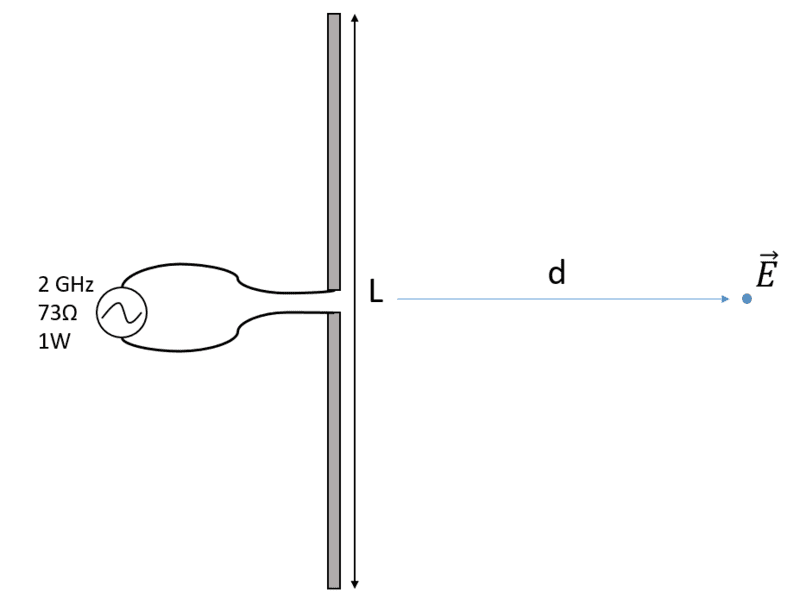
I was asking myself about electric field strength estimation at a distance d from - in my case - a half wave dipole antenna.
There are pretty much a lot of information about this on internet or in books but still, there are a few things that are confusing to me that I would like you guys to help me out !

"Settings" :
- Frequency F = 2GHz
- wavelength Wv = 150 mm
- Length of antenna L = 71,25 mm (0.475*Wv)
- Feeder impedance 73 ohms
- Power input = 1W
1643791115974.png


It is said that for a halfwave dipole antenna, Electric field strength can be calculated from an approximation (in the case where d is orthogonal to L) which is :I already have a problem here, isn't the electric field strengh supposed to decrease with square distance in far field, (and cube distance in near field) ??
Another source here (okay I admit, Wiki but I guess it's reliable sometimes) gives the following equation regarding radiated power :
1643791778057.png

Which again is decreasing proportionaly !

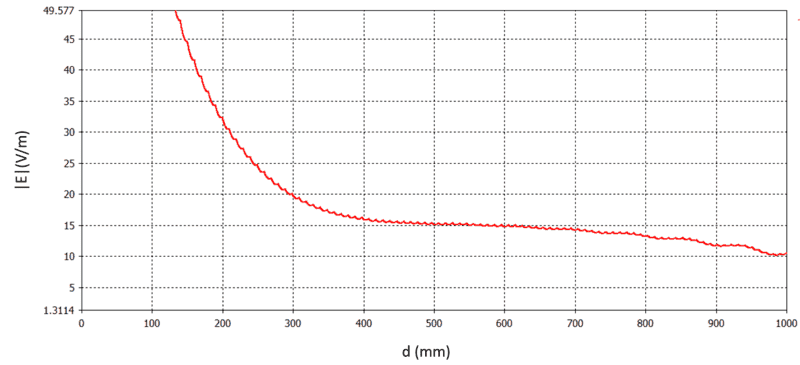
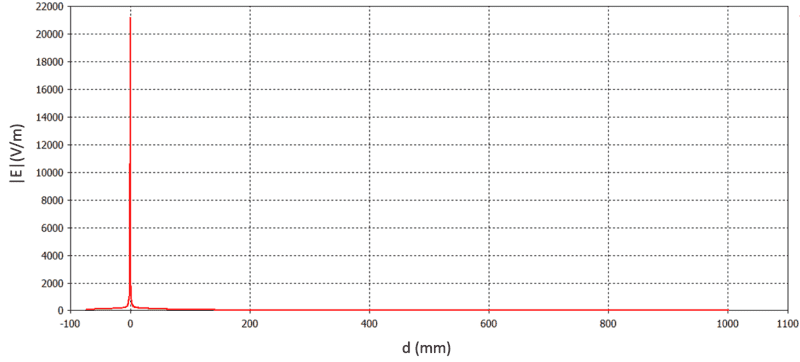
I simulated in an EM analysis software (CST) this half wave dipole antenna following standard design rules and same parameters (and in the void) and it works pretty accurately at 2 GHz. Plotting the E strength along the distance, from the antenna to 1000 mm (several times Wv), we can see the shape here :
1643793559281.png

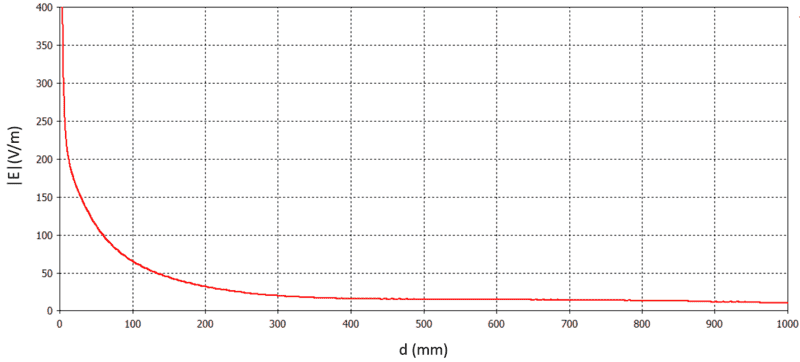
If we zoom into remove the peak around 0 :
1643793854652.png

And even more :
1643793880153.png

I don't even know what to think about this shape anymore... !

There may be something obvious I missed ? These formulas are very big approximation because it's impossible to estimate it ? If you could enlighten me I would be very glad !
 

Attachments

  • 1643791401037.png
    1643791401037.png
    914 bytes · Views: 165
  • Like
Likes   Reactions: Delta2
Physics news on Phys.org
The dipole in free space (no ground anywhere) radiates waves which fall in intensity with the inverse square law. By this I mean that the power/sq metre falls off with 1/D^2. The field components of this wave, electric and magnetic, fall inversely with distance, so for instance, E falls off with 1/D.

The formula you quote is correct for distances greater than about a sixth of a wavelength. E = (7x sqrt P)/D in Volts, metres and Watts. So the electric field strength falls off inversely with distance.

Now some more difficult information. At distances closer than about a sixth of a wavelength, we see some intense additional fields known as induction fields. Further, large antennas also have a region called the Near Radiation Zone where the pattern is distorted and it is possible for hot spots to occur. I think a dipole has a slight Near Radiation Zone and this may account for the slight hump seen around 600 mm. The distant pattern of a dipole resembles a ring doughnut, but is different when measured close up. Then we see a Near Radiation Zone, and the hole in the centre disappears.

If we approach the antenna in its equatorial plane, the electric field increases with 1/D until a distance of, say, lambda/2 from the antenna, then remains constant. As we almost touch the antenna we see an intense local field from the voltage across the feedpoint. If we similarly measure the magnetic field starting at D=lambda/2, it does not level off but continues upwards, following 1/D, until we touch the antenna conductor.
 
  • Informative
Likes   Reactions: DaveE
Thank you for your answer, does this law differs depending on the antenna type (horn, V, tulip, monopolar,...) , if we consider always being in the maximum directivity axis for each of them ? What you explained is very clear and I understand that there are many parameters to consider, but I am sure somewhere, someday, I was taught that electric field decreases in D² in some case ! Maybe it is for static E-field..?
 
The near field from a dipole antenna has ##\frac{1}{r^2}## and ##\frac{1}{r^3}## terms while the far field has ##\frac{1}{r}## term. This is demonstrated in any standard textbook about dipole antennas.
 
Bobymayor said:
Thank you for your answer, does this law differs depending on the antenna type (horn, V, tulip, monopolar,...) , if we consider always being in the maximum directivity axis for each of them ? What you explained is very clear and I understand that there are many parameters to consider, but I am sure somewhere, someday, I was taught that electric field decreases in D² in some case ! Maybe it is for static E-field..?
Assuming we are in free space and at some distance from the antenna, as mentioned before, the E and H radiation fields (not induction fields) decrease with 1/distance irrespective of the type of antenna.
If we look at the induction fields close to the antenna, I have found in measurements that for a dipole we mostly see the electric field concentrated near the ends. We see a magnetic field mostly near the centre. I believe the electric field will fall with 1/D^2 near the ends and the magnetic field near the centre will increase with 1/D right up to the conductor.
I agree textbooks say other exponents of D, but we need to know where in space this relates to. For greater distances we will see the contribution of E-field from both ends of the antenna, for instance, giving a more rapid fall off.
For a slot antenna I found that the situation regarding the fields is approximately reversed.
 

Similar threads

  • · Replies 1 ·
Replies
1
Views
1K
  • · Replies 41 ·
2
Replies
41
Views
6K
  • · Replies 24 ·
Replies
24
Views
4K
  • · Replies 1 ·
Replies
1
Views
2K
  • · Replies 2 ·
Replies
2
Views
2K
  • · Replies 5 ·
Replies
5
Views
2K
  • · Replies 2 ·
Replies
2
Views
2K
  • · Replies 1 ·
Replies
1
Views
2K
  • · Replies 3 ·
Replies
3
Views
4K
Replies
8
Views
3K