MHB Evaluating $\iint\limits_{\sum} f \cdot d\sigma $ on Cube S

  • Thread starter Thread starter WMDhamnekar
  • Start date Start date
  • Tags Tags
    Cube
Click For Summary
SUMMARY

The surface integral $\iint\limits_{\sum} f \cdot d\sigma$ for the vector field $f(x,y,z) = xi + yj + zk$ over the boundary of the solid cube $S = \{(x,y,z) | 0 \leq x,y,z \leq 1\}$ evaluates to 3. Each face of the cube contributes to the total integral, with the bottom face (z=0) yielding 0 and the top face (z=1) contributing 1. The process involves parameterizing each face and calculating the integral using the appropriate outward normal vectors. The final result is derived from summing contributions from all six faces of the cube.

PREREQUISITES
  • Understanding of vector fields and surface integrals
  • Familiarity with parameterization techniques in multivariable calculus
  • Knowledge of outward normal vectors for surface integrals
  • Experience with calculating double integrals
NEXT STEPS
  • Study the definition and properties of surface integrals of vector fields
  • Learn about parameterization of surfaces in three-dimensional space
  • Explore the Divergence Theorem and its applications in vector calculus
  • Practice calculating surface integrals over various geometric shapes
USEFUL FOR

Students and professionals in mathematics, particularly those focusing on multivariable calculus, vector calculus, and applied mathematics. This discussion is beneficial for anyone looking to deepen their understanding of surface integrals and vector fields.

WMDhamnekar
MHB
Messages
378
Reaction score
30
Without using the Divergence Theorem Evaluate the surface integral $\iint\limits_{\sum} f \cdot d\sigma $ of $f(x,y,z) = xi+ yj + zk , \sum: $ boundary of the solid cube S= $\{(x,y,z) = 0\leq x,y,z \leq 1)\}$

My attempt:
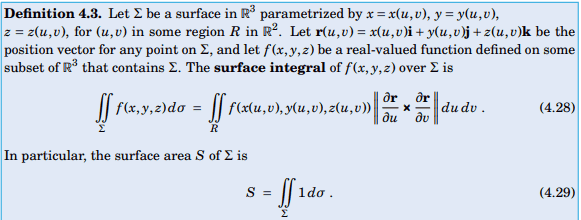
Here we have to use the following definition of surface integral.
1657809382885.png


Note that there will be a different outward unit normal vector to each of the six faces of the cube.
 
Last edited:
Physics news on Phys.org
Hi Dhamnekar Winod,

The formula you posted is for a real-valued function, but the function $f$ you provided is a vector field. You will need to use the formula for a surface integral of a vector field: $$\iint\limits_{R}f(x(u,v), y(u,v), z(u,v))\cdot \left(\frac{\partial\mathbf{r}}{\partial u}\times \frac{\partial\mathbf{r}}{\partial v} \right)du\,dv \qquad(*)$$ See the Wikipedia - Surface Integrals of Vector Fields.

After that, think about how to parameterize each of the six faces of $\Sigma$. For example, the "bottom" face can be parameterized as $x(u,v) = u$, $y(u,v) = v$, and $z(u,v) = 0$, where $0\leq u, v\leq 1$; i.e., $\mathbf{r}(u,v)= u\mathbf{i} + v\mathbf{j} + 0\mathbf{k}$ for $0\leq u, v\leq 1$. Using this parameterization, calculate the integral in $(*)$. Note: You will need to use the negative of the cross product $\frac{\partial\mathbf{r}}{\partial u}\times \frac{\partial\mathbf{r}}{\partial v}$ to ensure you get an outward pointing normal vector to the "bottom" of $\Sigma$. Then repeat the process for each of the other 5 faces of $\Sigma$.
 
Last edited:
This integral will be over the 6 faces of the cube. Do each separately. One face is z= 0 for x and y each from 0 to 1. On z= 0, the vector field zk= 0k so the integral is 0. That is also true on the faces x= 0 and y= 0. On z= 1 we integrate zk= 1k so we are integrating 1 for both x and y from 0 to 1. That is 1 times the area of the square, which is also 1, so the integral is 1. This is also true on the faces x= 1 and y= 1 so the entire surface integral is 3.
 
HallsofIvy said:
This integral will be over the 6 faces of the cube. Do each separately. One face is z= 0 for x and y each from 0 to 1. On z= 0, the vector field zk= 0k so the integral is 0. That is also true on the faces x= 0 and y= 0. On z= 1 we integrate zk= 1k so we are integrating 1 for both x and y from 0 to 1. That is 1 times the area of the square, which is also 1, so the integral is 1. This is also true on the faces x= 1 and y= 1 so the entire surface integral is 3.
f(x,y,z) = xi + yj + zk , $ \vert \frac{dr}{du} \times \frac{dr}{dv} \vert =1$ So, $ \iint\limits_{\sum} = f\cdot d\sigma =\displaystyle\int_0^1 \displaystyle\int_0^{1-x} (x+y+1-(x+y))\cdot (1)dydx=\frac12$

This surface integral is for one face of the cube. So entire surface integral will be $\frac12 \times 6 =3 $
 
Last edited:
Relativistic Momentum, Mass, and Energy Momentum and mass (...), the classic equations for conserving momentum and energy are not adequate for the analysis of high-speed collisions. (...) The momentum of a particle moving with velocity ##v## is given by $$p=\cfrac{mv}{\sqrt{1-(v^2/c^2)}}\qquad{R-10}$$ ENERGY In relativistic mechanics, as in classic mechanics, the net force on a particle is equal to the time rate of change of the momentum of the particle. Considering one-dimensional...

Similar threads

  • · Replies 1 ·
Replies
1
Views
3K
  • · Replies 1 ·
Replies
1
Views
3K
  • · Replies 8 ·
Replies
8
Views
2K
  • · Replies 3 ·
Replies
3
Views
2K
  • · Replies 1 ·
Replies
1
Views
2K
  • · Replies 11 ·
Replies
11
Views
3K
  • · Replies 3 ·
Replies
3
Views
1K
  • · Replies 4 ·
Replies
4
Views
4K
  • · Replies 2 ·
Replies
2
Views
905
Replies
12
Views
3K