WMDhamnekar
MHB
- 382
- 31
- TL;DR
- Stokes’ theorem translates between the flux integral of surface S ##\displaystyle\iint\limits_{\Sigma} f \cdot d\sigma ## to ## \displaystyle\int\limits_C f\cdot dr## a line integral around the boundary of S. Therefore, the theorem allows us to compute surface integrals or line integrals that would ordinarily be quite difficult by translating the line integral into a surface integral or vice versa.
Calculating a surface integral
Calculate surface integral ## \displaystyle\iint\limits_S curl F \cdot dS ## where S is the surface, oriented outward in below given figure and F = [ z,2xy,x+y].
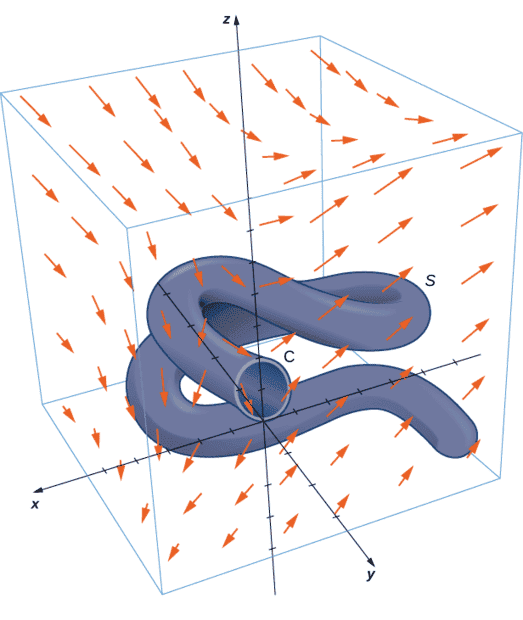
How can we answer this question?
How can we answer this question?