Evaluating a cycle [Thermodynamics]

Click For Summary
SUMMARY

This discussion focuses on the evaluation of work done during a thermodynamic cycle, specifically analyzing the fourth stage of the cycle. The participants confirm that for a cycle, the relationship Q + W = 0 holds true, indicating that the system remains unchanged. The heat absorbed in the first stage is 943.036J, and the heat expelled in the third stage is -418.6J, leading to a net change of ΔQ = 527.436J. The work done at the fourth stage is calculated as W4 = -527.436J, confirming that work is done by the system during this stage.

PREREQUISITES
  • Understanding of thermodynamic cycles
  • Familiarity with the first law of thermodynamics
  • Knowledge of adiabatic processes
  • Ability to interpret thermodynamic equations and signs
NEXT STEPS
  • Study the implications of adiabatic processes in thermodynamics
  • Learn about the first law of thermodynamics and its applications
  • Explore the concept of work done on/by a system in thermodynamic cycles
  • Investigate the differences in sign conventions for work in thermodynamics
USEFUL FOR

Students and professionals in physics and engineering, particularly those specializing in thermodynamics, heat transfer, and energy systems.

guyvsdcsniper
Messages
264
Reaction score
37
Homework Statement
Cycle. A system undergoes the following four- stage cyclic process:
In stage (1) the system absorbs 226 cal of heat and does 50 J of work; in
(2) the system adiabatically does 30 J of work; and in (3) the system rejects
100 cal of heat while the environment does 80 J of work on the system.
Stage (4) is also adiabatic. Is work done on or by the system in stage (4)?
How many joules of work?
Relevant Equations
Q+W=0
Since this is a cycle, there should leave the system unchanged, hence Q+W = 0.

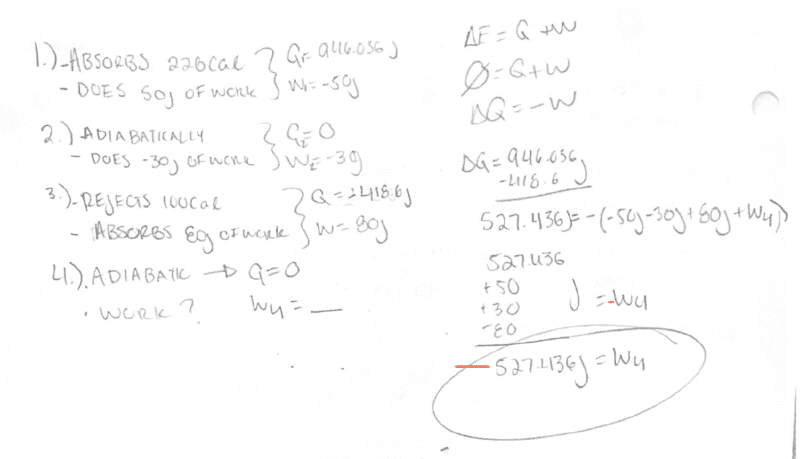
I wrote evaluated the heat and work done on/by the system at each cycle as shown in my work.

The first question ask is work done at the fourth stage. Since this a cycle and again the system she remain unchanged, and assuming the fourth stage is the last stage I can try to determine this by analyzing each cycle. The first stage absorbs 943.036J of heat. At the third stage, -418.6J of heat is expelled. That makes ΔQ = 527.436.

If the fourth stage is adiabatic, no heat can transfer at this stage. But since this is a cycle, the system must remain unchanged at the end. So that means there must be work done at the fourth stage in order to return back to the overall energy we started with.

We can say ΔQ=-W with W being each work done at each stage, -(W1+W2+W3+W4)

By algebra W4 = -527.436J.

So the system does work at this stage.

Is my approach correct?
Screen Shot 2022-02-05 at 1.32.53 PM.png
 
Physics news on Phys.org
Your approach is correct and your numbers match mine.
 
  • Like
Likes   Reactions: guyvsdcsniper
kuruman said:
Your approach is correct and your numbers match mine.
The end result should be negative right? I forgot to carry the negative in my original solution and had to add it in the red.
 
quittingthecult said:
The end result should be negative right? I forgot to carry the negative in my original solution and had to add it in the red.
You got a negative value for ##W_4##. But now you have to interpret this to decide if 527 J of work was done on or by the system during step 4.
 
TSny said:
You got a negative value for ##W_4##. But now you have to interpret this to decide if 527 J of work was done on or by the system during step 4.
It should be done by the system on step 4 correct?
 
quittingthecult said:
It should be done by the system on step 4 correct?
Yes, that's right. Can you give the reason for this?
 
TSny said:
Yes, that's right. Can you give the reason for this?
So if the fourth stage is adiabatic, this means that no heat can transfer at this stage. And this is also a cycle so the system must remain unchanged at the end. So Q+W=0.

Up until stage 4 all the work done on/by the system has canceled out and we only have a change of heat remaining. The heat was positve and when Q > 0 heat is absorbed by the system. Since W < 0, Work is done by the system in order to expell that internal energy/heat?

Is that correct?
 
quittingthecult said:
So if the fourth stage is adiabatic, this means that no heat can transfer at this stage. And this is also a cycle so the system must remain unchanged at the end. So Q+W=0.

Up until stage 4 all the work done on/by the system has canceled out and we only have a change of heat remaining. The heat was positve and when Q > 0 heat is absorbed by the system. Since W < 0, Work is done by the system in order to expell that internal energy/heat?

Is that correct?
Yes. Good.

As you stated in your first post, ##Q+W = 0## for any cycle. This assumes that ##W## is defined as work done on the system. Since you found ##W_4 =## -527 J, it means that -527 J was done on the system in step 4. This is equivalent to saying +527 J was done by the system in step 4.

You were probably already clear on this, but I just wanted to make sure. Signs can sometimes be tricky. You will find some books writing ##Q-W = 0## for a cycle because they define ##W## as work done by the system.
 
  • Like
Likes   Reactions: vela and guyvsdcsniper
I see now that you already dealt with the signs in this thread. :oldsmile:
 
  • #10
quittingthecult said:
Since W < 0, Work is done by the system in order to expell that internal energy/heat?
Are you really saying that the system must do work in order to expel heat? What if I have an ideal gas at temperature ##T_1## in a rigid box and place the box in good thermal contact with a reservoir at a lower temperature ##T_2##? The gas will expel heat without exchanging any work with the environment because its volume does not change. The expelled heat comes entirely at the expense of the internal energy.
 

Similar threads

Replies
14
Views
2K
  • · Replies 2 ·
Replies
2
Views
1K
Replies
3
Views
2K
  • · Replies 3 ·
Replies
3
Views
1K
Replies
3
Views
3K
  • · Replies 1 ·
Replies
1
Views
3K
  • · Replies 4 ·
Replies
4
Views
2K
  • · Replies 5 ·
Replies
5
Views
2K
Replies
1
Views
2K
  • · Replies 2 ·
Replies
2
Views
2K