JD_PM
- 1,125
- 156
- Homework Statement
- Show that the momentum operator ##\hat{\vec P}## yields
$$\hat{\vec P} = \int d^3 \vec x \frac{1}{c^2} \mathcal{N} \left( \dot A_{\mu} \nabla A^{\mu} \right) = \sum_{\vec k} \hbar \vec k N( \vec k)$$
Where ##\mathcal{N}## stands for normal-ordering and ##N( \vec k)## is the number operator
##N( \vec k) = \sum_{r=0}^3 \zeta_r a_r^{\dagger} (\vec k) a_r^{\dagger} (\vec k)## (for instance, EQ ##5.33## Mandl & Shaw)
- Relevant Equations
- Please see below
I think I get the approach. We first need to evaluate the term ##\dot A_{\mu} \nabla A^{\mu}## and then evaluate the 3D space integral; we may need to take the limit ##V \rightarrow \infty## (i.e ##\sum_{\vec k} (2 \pi)^3/V \rightarrow \int d^3 \vec k##) at some point.
The mode expansions of the vector potential ##A^{\mu}=A_{+}^{\mu} + A_{-}^{\mu}## are
$$A_{-}^{\mu}=\sum_{r=0}^3 \sum_{\vec k} \left[ \Big(\frac{\hbar c^2}{2V \omega_{\vec k}} \Big)^{1/2} \epsilon_r^{\mu} a_r^{\dagger}(\vec k) e^{ik \cdot x} \right] \tag{1.1}$$
$$A_{+}^{\mu}=\sum_{r=0}^3 \sum_{\vec k} \left[ \Big(\frac{\hbar c^2}{2V \omega_{\vec k}} \Big)^{1/2} \epsilon_r^{\mu} a_r(\vec k) e^{-i \vec k \cdot \vec x} \right] \tag{1.2}$$
The time-derivatives of ##(1.1)## and ##(1.2)## are
$$\dot A_{-}^{\mu} = ik^0 e^{ik^0 x^0}\sum_{r=0}^3 \sum_{\vec k} \left[ \Big(\frac{\hbar c^2}{2V \omega_{\vec k}} \Big)^{1/2} \epsilon_r^{\mu} a_r^{\dagger}(\vec k) e^{-i \vec k \cdot \vec x} \right]$$
$$\dot A_{+}^{\mu} = -ik^0 e^{-ik^0 x^0}\sum_{r=0}^3 \sum_{\vec k} \left[ \Big(\frac{\hbar c^2}{2V \omega_{\vec k}} \Big)^{1/2} \epsilon_r^{\mu} a_r(\vec k) e^{i \vec k \cdot \vec x} \right]$$
The spatial-derivatives of ##(1.1)## and ##(1.2)## are
$$ \nabla A_-^{\mu} = -i e^{ik^0 x^0}\sum_{r=0}^3 \sum_{\vec k} \left[ \vec k \Big(\frac{\hbar c^2}{2V \omega_{\vec k}} \Big)^{1/2} \epsilon_r^{\mu} a_r^{\dagger}(\vec k) e^{-i \vec k \cdot \vec x} \right]$$
$$ \nabla A_+^{\mu} = i e^{-ik^0 x^0}\sum_{r=0}^3 \sum_{\vec k} \left[ \vec k \Big(\frac{\hbar c^2}{2V \omega_{\vec k}} \Big)^{1/2} \epsilon_r^{\mu} a_r(\vec k) e^{i \vec k \cdot \vec x} \right]$$
We evaluate ##\dot A_{\mu} \nabla A^{\mu}##
$$\dot A_{\mu} \nabla A^{\mu}=(\dot A^{+}_{\mu}+ \dot A^{-}_{\mu})(\nabla A_+^{\mu} +\nabla A_-^{\mu})=\dot A^{+}_{\mu}\nabla A_+^{\mu} + \dot A^{-}_{\mu}\nabla A_-^{\mu} + \dot A^{+}_{\mu}\nabla A_-^{\mu}+\dot A^{+}_{\mu}\nabla A_+^{\mu}$$
Let's evaluate ##\dot A^{+}_{\mu}\nabla A_+^{\mu}## explicitly
$$\dot A^{+}_{\mu}\nabla A_+^{\mu}=-ik^0 e^{-ik^0 x^0}\sum_{r=0}^3 \sum_{\vec k} \left[ \Big(\frac{\hbar c^2}{2V \omega_{\vec k}} \Big)^{1/2} \eta_{\mu \nu} \epsilon_r^{\nu} a_r(\vec k) e^{i \vec k \cdot \vec x} \right]i e^{-ik^0 x^0} \sum_{r=0}^3 \sum_{\vec k} \left[ \vec k \Big(\frac{\hbar c^2}{2V \omega_{\vec k}} \Big)^{1/2} \epsilon_r^{\mu} a_r(\vec k) e^{i \vec k \cdot \vec x} \right] \tag{*}$$
OK ##(*)## looks messy; let's focus on relevant terms
$$\dot A^{+}_{\mu}\nabla A_+^{\mu} \sim \eta_{\mu \nu} \epsilon_r^{\nu} a_r(\vec k) \vec k \epsilon_r^{\mu} a_r(\vec k)= \eta_{\mu \nu} \epsilon_r^{\nu} \vec k \epsilon_r^{\mu} a_r(\vec k) a_r(\vec k)\tag{**}$$
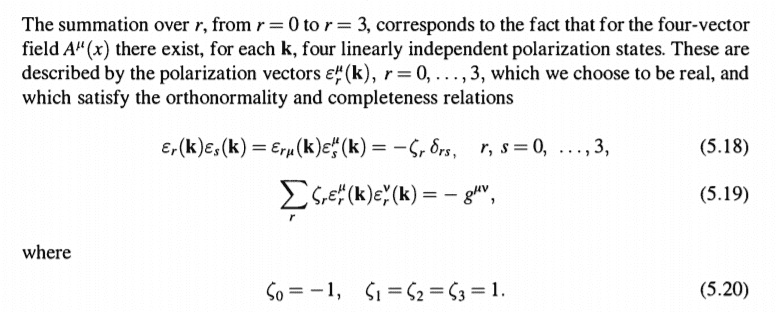
Once here, based on the orthonormality and completeness of the polarization vectors
And the customary choice of polarization vectors
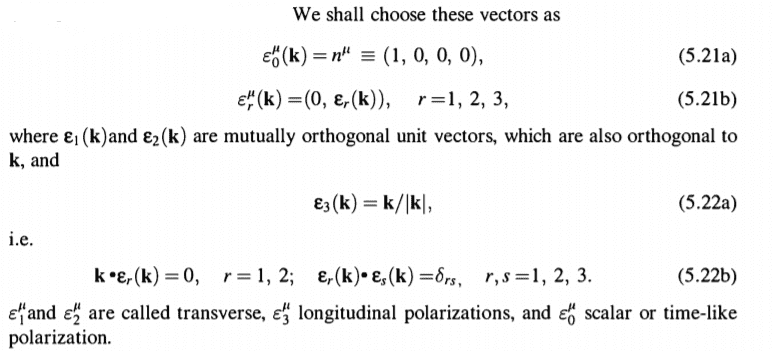
So the idea would be using ##(5.19)## but we do not have the ##\zeta_r## factor. Besides, the 3-vector ##\vec k## suggests we may have to use the orthogonal conditions ##(5.22b)##.
How could we evaluate ##(*), (**)## then?
Thank you
The mode expansions of the vector potential ##A^{\mu}=A_{+}^{\mu} + A_{-}^{\mu}## are
$$A_{-}^{\mu}=\sum_{r=0}^3 \sum_{\vec k} \left[ \Big(\frac{\hbar c^2}{2V \omega_{\vec k}} \Big)^{1/2} \epsilon_r^{\mu} a_r^{\dagger}(\vec k) e^{ik \cdot x} \right] \tag{1.1}$$
$$A_{+}^{\mu}=\sum_{r=0}^3 \sum_{\vec k} \left[ \Big(\frac{\hbar c^2}{2V \omega_{\vec k}} \Big)^{1/2} \epsilon_r^{\mu} a_r(\vec k) e^{-i \vec k \cdot \vec x} \right] \tag{1.2}$$
The time-derivatives of ##(1.1)## and ##(1.2)## are
$$\dot A_{-}^{\mu} = ik^0 e^{ik^0 x^0}\sum_{r=0}^3 \sum_{\vec k} \left[ \Big(\frac{\hbar c^2}{2V \omega_{\vec k}} \Big)^{1/2} \epsilon_r^{\mu} a_r^{\dagger}(\vec k) e^{-i \vec k \cdot \vec x} \right]$$
$$\dot A_{+}^{\mu} = -ik^0 e^{-ik^0 x^0}\sum_{r=0}^3 \sum_{\vec k} \left[ \Big(\frac{\hbar c^2}{2V \omega_{\vec k}} \Big)^{1/2} \epsilon_r^{\mu} a_r(\vec k) e^{i \vec k \cdot \vec x} \right]$$
The spatial-derivatives of ##(1.1)## and ##(1.2)## are
$$ \nabla A_-^{\mu} = -i e^{ik^0 x^0}\sum_{r=0}^3 \sum_{\vec k} \left[ \vec k \Big(\frac{\hbar c^2}{2V \omega_{\vec k}} \Big)^{1/2} \epsilon_r^{\mu} a_r^{\dagger}(\vec k) e^{-i \vec k \cdot \vec x} \right]$$
$$ \nabla A_+^{\mu} = i e^{-ik^0 x^0}\sum_{r=0}^3 \sum_{\vec k} \left[ \vec k \Big(\frac{\hbar c^2}{2V \omega_{\vec k}} \Big)^{1/2} \epsilon_r^{\mu} a_r(\vec k) e^{i \vec k \cdot \vec x} \right]$$
We evaluate ##\dot A_{\mu} \nabla A^{\mu}##
$$\dot A_{\mu} \nabla A^{\mu}=(\dot A^{+}_{\mu}+ \dot A^{-}_{\mu})(\nabla A_+^{\mu} +\nabla A_-^{\mu})=\dot A^{+}_{\mu}\nabla A_+^{\mu} + \dot A^{-}_{\mu}\nabla A_-^{\mu} + \dot A^{+}_{\mu}\nabla A_-^{\mu}+\dot A^{+}_{\mu}\nabla A_+^{\mu}$$
Let's evaluate ##\dot A^{+}_{\mu}\nabla A_+^{\mu}## explicitly
$$\dot A^{+}_{\mu}\nabla A_+^{\mu}=-ik^0 e^{-ik^0 x^0}\sum_{r=0}^3 \sum_{\vec k} \left[ \Big(\frac{\hbar c^2}{2V \omega_{\vec k}} \Big)^{1/2} \eta_{\mu \nu} \epsilon_r^{\nu} a_r(\vec k) e^{i \vec k \cdot \vec x} \right]i e^{-ik^0 x^0} \sum_{r=0}^3 \sum_{\vec k} \left[ \vec k \Big(\frac{\hbar c^2}{2V \omega_{\vec k}} \Big)^{1/2} \epsilon_r^{\mu} a_r(\vec k) e^{i \vec k \cdot \vec x} \right] \tag{*}$$
OK ##(*)## looks messy; let's focus on relevant terms
$$\dot A^{+}_{\mu}\nabla A_+^{\mu} \sim \eta_{\mu \nu} \epsilon_r^{\nu} a_r(\vec k) \vec k \epsilon_r^{\mu} a_r(\vec k)= \eta_{\mu \nu} \epsilon_r^{\nu} \vec k \epsilon_r^{\mu} a_r(\vec k) a_r(\vec k)\tag{**}$$
Once here, based on the orthonormality and completeness of the polarization vectors
And the customary choice of polarization vectors
So the idea would be using ##(5.19)## but we do not have the ##\zeta_r## factor. Besides, the 3-vector ##\vec k## suggests we may have to use the orthogonal conditions ##(5.22b)##.
How could we evaluate ##(*), (**)## then?
Thank you
