Evaluation of integral having trigonometric functions

Join the discussion
Ask a follow-up here, or get your own question answered by working scientists, mathematicians and engineers — people, not an autocomplete.
Real named experts · corrections over time · the nuance an AI answer skips
3 replies · 1K views
WMDhamnekar
MHB
Messages
382
Reaction score
31
Homework Statement
Evaluate ## \displaystyle\iint\limits_R \sin{(\frac{x+y}{2})} \cos{(\frac{x-y}{2})}dA,## where R is the triangle with vertices (0,0), (2,0) and (1,1).
Relevant Equations
Hint: Use the change of variables ##u=\frac{x+y}{2}, v= \frac{x-y}{2}##
R is the triangle which area is enclosed by the line x=2, y=0 and y=x.
Let us try the substitution ##u = \frac{x+y}{2}, v=\frac{x-y}{2}, \rightarrow x=2u-y , y= x-2v \rightarrow x= 2u-x + 2v \therefore x= u +v##
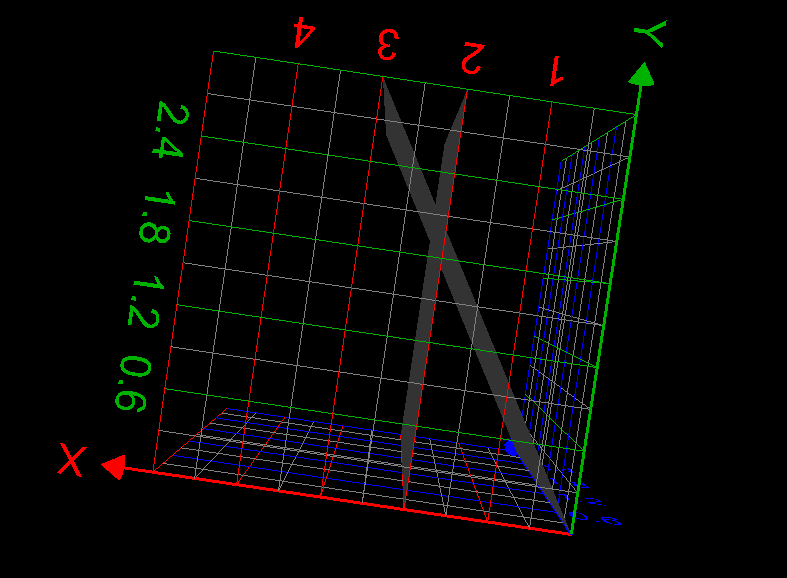
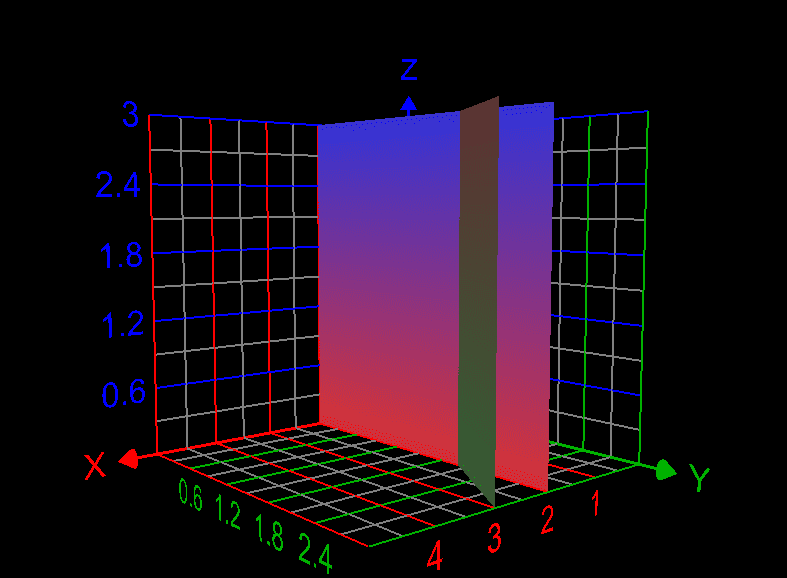
## y=x-2v \rightarrow y=2u-y-2v, \therefore y=u- v## The sketch of triangle is as follows:
1654415829519.png


1654415851473.png


But when we plot sin((x + y)/2)*cos((x-y)/2), we get the below graph:
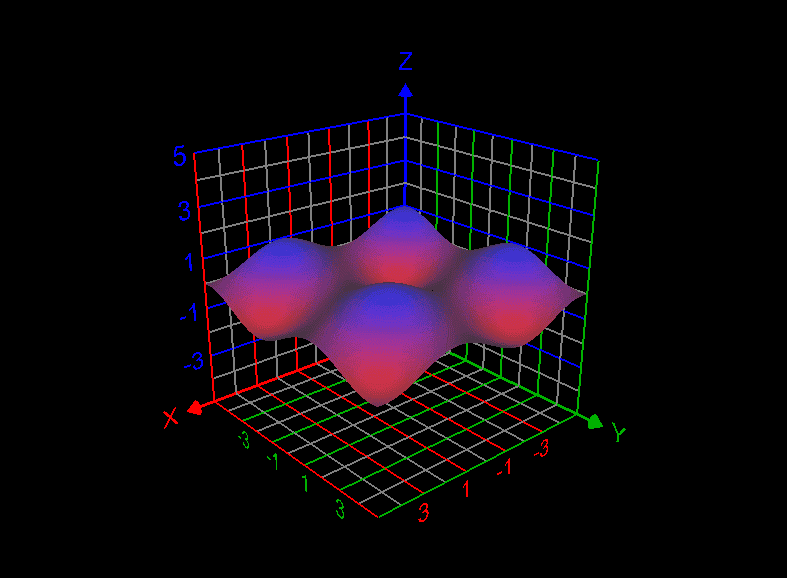
1654416090367.png

J(u,v)=|-2| = 2, So, now how to compute integration limits?
 
Reply
  • Like
Likes   Reactions: Delta2
Physics news on Phys.org
I computed the answer as ## \displaystyle\int_0^{0.5}\displaystyle\int_0^{1.5} 2*sin(u)*cos(v)du dv = 0.891024635191 ## . But it is wrong. Correct answer provided is ## 1- \frac{sin(2)}{2} = 0.545351286587##

How is that? What is wrong with my answer?
 
WMDhamnekar said:
I computed the answer as ## \displaystyle\int_0^{0.5}\displaystyle\int_0^{1.5} 2*sin(u)*cos(v)du dv = 0.891024635191 ## . But it is wrong. Correct answer provided is ## 1- \frac{sin(2)}{2} = 0.545351286587##

How is that? What is wrong with my answer?

How did you arrive at those limits? You started with a triangle in the [itex](x,y)[/itex] plane. Does it seem sensible that you would end up with a rectangle in the [itex](u,v)[/itex] plane?
 
Reply
  • Like
  • Informative
Likes   Reactions: WMDhamnekar and Delta2
pasmith said:
How did you arrive at those limits? You started with a triangle in the [itex](x,y)[/itex] plane. Does it seem sensible that you would end up with a rectangle in the [itex](u,v)[/itex] plane?
1654443340888.png