Evanescent waves at change of cross section

Click For Summary
SUMMARY

The discussion centers on the propagation of evanescent waves in a Bernoulli-Beam with a constant jump in cross-section. Jens presents a scenario involving a traveling wave described by the equation w_incident = C*cos(k_1*x - ωt) and seeks to understand the transient behavior of evanescent waves, which are characterized by exponential decay. The conversation highlights the confusion surrounding the propagation of these waves, particularly in systems where energy is not absorbed, leading to the formation of standing waves instead of traveling waves.

PREREQUISITES
  • Understanding of Bernoulli-Beam theory
  • Familiarity with wave equations and their solutions
  • Knowledge of evanescent waves and their properties
  • Basic concepts of wave propagation and standing waves
NEXT STEPS
  • Study the mathematical derivation of wave equations in Bernoulli-Beams
  • Explore the characteristics and applications of evanescent waves in engineering
  • Investigate the relationship between standing waves and energy absorption in mechanical systems
  • Learn about transient analysis techniques in wave propagation
USEFUL FOR

Mechanical engineers, physicists, and students studying wave mechanics, particularly those interested in the behavior of waves in structural applications.

snejburg
Messages
3
Reaction score
0
Hey guys,

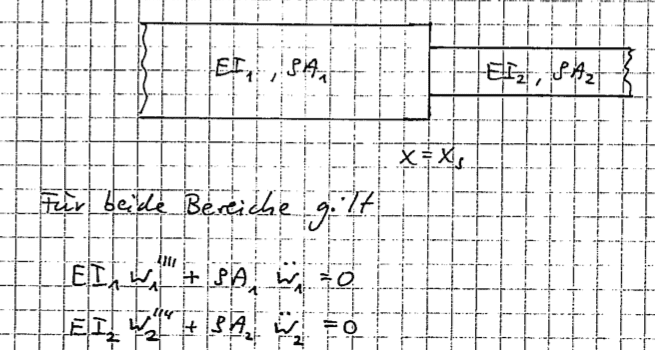
if I consider a Bernoulli-Beam with a constant jump in cross- section as shown below
picture1.png

Then I get the two differential equations for the bending mentioned above.

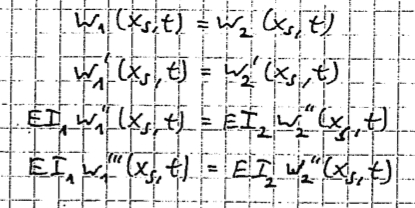
Let us now assume that a traveling wave from the left w_incident = C*cos(k_1*x - ωt) arrives at t = 0 at the jump of cross section. If I know claim the following transition conditions:
Screen Shot 2017-08-03 at 00.33.39.png

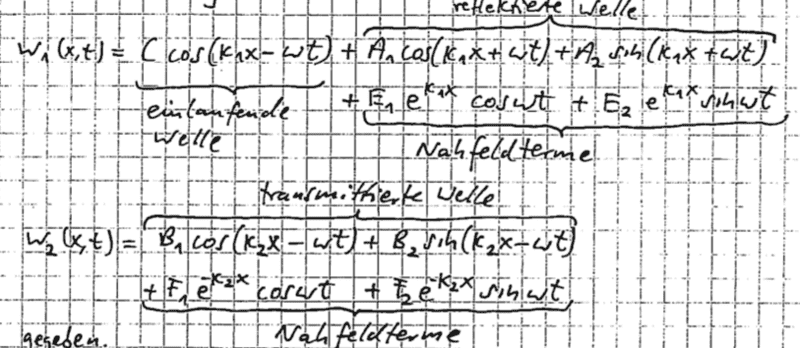
I get the following results for w_1 and w2:
Screen Shot 2017-08-03 at 00.34.44.png


The question is: How do the evanescent waves (exponential decaying waves) propagate? The formula says, that every point x of w_2 already has a displacement so that might be the steady state solution. But how can I get the transient behaviour? Therefore I need to know how the evanescent wave propagates. But I often read that evanescent waves do not propagate...But they cannot just be there all of a sudden, can they?

Your help is much appreciated,
Jens
 
Engineering news on Phys.org
snejburg said:
Hey guys,

if I consider a Bernoulli-Beam with a constant jump in cross- section as shown below View attachment 208206
Then I get the two differential equations for the bending mentioned above.

Let us now assume that a traveling wave from the left w_incident = C*cos(k_1*x - ωt) arrives at t = 0 at the jump of cross section. If I know claim the following transition conditions:
View attachment 208207
I get the following results for w_1 and w2:
View attachment 208209

The question is: How do the evanescent waves (exponential decaying waves) propagate? The formula says, that every point x of w_2 already has a displacement so that might be the steady state solution. But how can I get the transient behaviour? Therefore I need to know how the evanescent wave propagates. But I often read that evanescent waves do not propagate...But they cannot just be there all of a sudden, can they?

Your help is much appreciated,
Jens
I can only look at the beam as an electrical analogy.
How can you have a traveling wave if the end of the system is free and does not absorb the energy? With your system, all energy is trapped and will appear as standing waves.
 

Similar threads

Replies
11
Views
2K
  • · Replies 2 ·
Replies
2
Views
2K
Replies
1
Views
2K
  • · Replies 8 ·
Replies
8
Views
2K
  • · Replies 3 ·
Replies
3
Views
2K
Replies
50
Views
6K
Replies
1
Views
3K
Replies
5
Views
5K
  • · Replies 4 ·
Replies
4
Views
33K
  • · Replies 1 ·
Replies
1
Views
1K