Evaporation of a mostly sealed erlenmeyer flask

  • Context: Undergrad 
  • Thread starter Thread starter Slimjimi
  • Start date Start date
  • Tags Tags
    Evaporation flask
Click For Summary
SUMMARY

The discussion centers on evaluating the evaporation rate of a 3L Erlenmeyer flask equipped with a rubber stopper featuring a 1mm radius hole for a steel drip line. The user anticipates nearly 100% relative humidity inside the flask and acknowledges that the air movement both inside and outside the flask significantly influences evaporation. The user plans to experimentally determine the difference between static and dynamic evaporation rates by minimizing the gap and measuring mass changes over time as water is added at a rate of less than 1mL/min.

PREREQUISITES
  • Understanding of fluid dynamics and mass transfer principles
  • Familiarity with experimental design and measurement techniques
  • Knowledge of humidity effects on evaporation rates
  • Experience with Erlenmeyer flasks and laboratory equipment
NEXT STEPS
  • Research methods for measuring evaporation rates in closed systems
  • Learn about the relationship between volumetric flow rates and evaporation rates
  • Investigate techniques for minimizing air gaps in sealed containers
  • Explore the effects of temperature on water density and evaporation
USEFUL FOR

Researchers, laboratory technicians, and anyone involved in experimental fluid dynamics or evaporation studies will benefit from this discussion.

Slimjimi
Messages
5
Reaction score
0
I am trying to determine whether the evaporation rate of a 3L erlenmeyer flask would be negligible given the following circumstances. The flask would have a rubber stopper in it, with a hole approximately 1mm in radius greater than the steel drip line feeding into it (leaving an open ring that has an outer diameter of ~8mm and an inner diameter of ~6mm). I would like to take realtime mass measurements as the drip line does it's thing. The process would span several days, so evaporation has to be taken into account. The process is drawn roughly here:
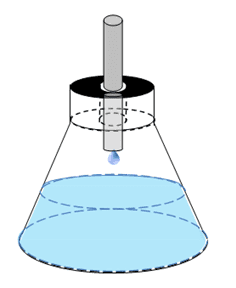
H2OCollection.png


Thanks a lot!
 
Science news on Phys.org
I would expect ~100% relative humidity inside, with a water density depending on the temperature of the environment. If you add a volume of X, the same volume of (humid) air leaves the flask and takes away some mass.

Apart from that, it is probably hard to evaluate, as the air movement inside+outside is important. Can you reduce the gap somehow? If you do not have to measure the weight continuously, maybe you can close it most of the time.
Can you determine it experimentally? Just fill it with your fluid, wait one day and compare the mass?
 
Ahh, yes, I was thinking of the evaporation rate in a static system. But since we'll be adding water to the flask (at a rate less than 1mL/min), each drop will push out a corresponding amount of humid vapor. Good point mfb. I worked on minimizing the gap yesterday, once I've completed that, I will experimentally determine the difference between static and dynamic evaporation. Furthermore, I'll have to find the function that relates the volumetric flow rate in and the evaporation rate.

Thanks!
 

Similar threads

  • · Replies 21 ·
Replies
21
Views
6K