Excess pressure inside a Liquid drop

  • Context: Undergrad 
  • Thread starter Thread starter Vivek98phyboy
  • Start date Start date
  • Tags Tags
    Drop Liquid Pressure
Click For Summary

Discussion Overview

The discussion revolves around the concept of excess pressure inside a liquid drop, particularly focusing on the role of surface tension in maintaining equilibrium within a hemispherical drop. Participants explore theoretical aspects, mathematical formulations, and implications of varying surface tension, including the hypothetical scenario of zero surface tension.

Discussion Character

  • Exploratory
  • Technical explanation
  • Conceptual clarification
  • Debate/contested

Main Points Raised

  • One participant questions the necessity of surface tension in balancing the pressures inside and outside the hemispherical drop, suggesting that atmospheric pressure and internal pressure might suffice for equilibrium.
  • Another participant explains that surface tension arises from molecular attraction, which causes the surface area to shrink and increases internal pressure until equilibrium is reached. They present a mathematical relationship involving external pressure, internal pressure, and surface tension.
  • A similar point is reiterated by another participant, emphasizing the constant pressure within the bubble and the simplification achieved by analyzing it as two hemispheres.
  • One participant raises a hypothetical question about the behavior of the drop if surface tension were zero, prompting further inquiry into the implications of such a scenario.
  • Another participant references a previous discussion about zero surface tension, questioning whether an ideal fluid would exhibit this property and how it would affect molecular behavior at the surface.
  • A later reply cites a comment regarding zero surface tension, suggesting that it would indicate equal attraction between fluid molecules and atmospheric molecules at the surface.

Areas of Agreement / Disagreement

Participants express differing views on the necessity and implications of surface tension in the context of liquid drops. The discussion includes multiple competing perspectives, particularly regarding the effects of zero surface tension, and remains unresolved.

Contextual Notes

Participants explore the implications of surface tension and its absence, but the discussion does not resolve the assumptions or conditions under which these effects are analyzed. The mathematical relationships presented depend on specific definitions and conditions that are not fully clarified.

Vivek98phyboy
Messages
34
Reaction score
5
While studying about the effects of surface tension i came across the excess pressure inside a liquid drop.
Here they considered a hemisphere ABCDE from the drop and listed out the conditions for it to be in equilibrium.
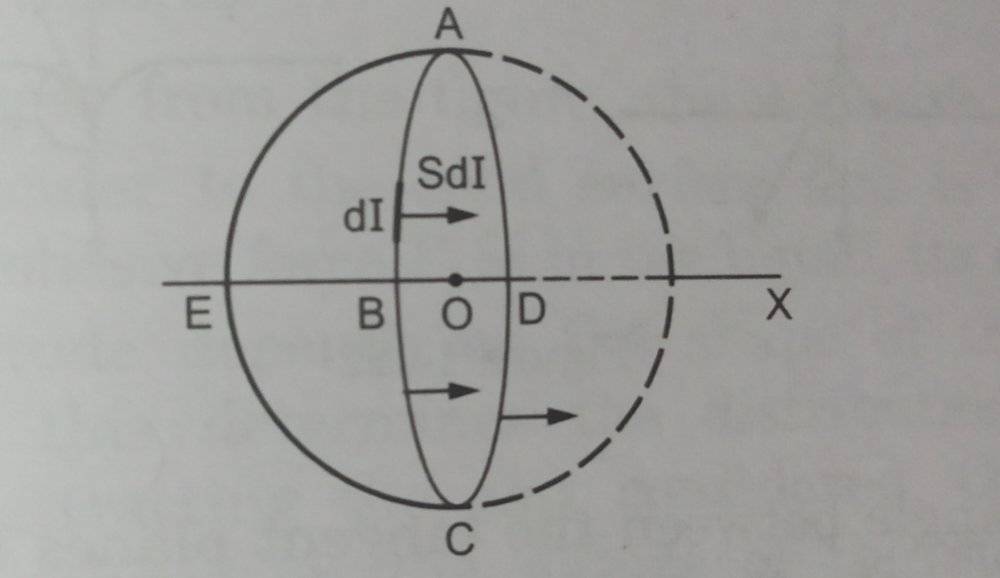
IMG_20191217_192915.jpg

The forces acting on them are taken as
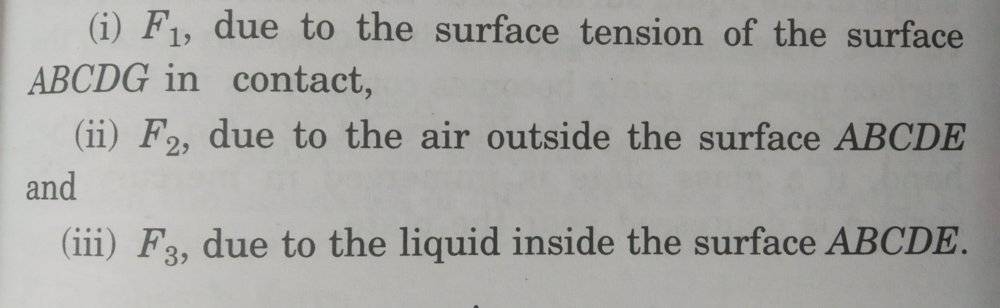
IMG_20191217_193416.jpg


F1= 2πRS
F2= P1×(Projection of hemispherical surface on ABCD)
=>F2=P1×πR²
F3=P2×πR²


For equilibrium we take
F1+F2=F3

But what role does the surface tension (T) has in maintaining the equilibrium for a hemisphere.
My doubts are:
1. Isn't the pressure due to Atmosphere and the pressure inside the hemispherical drop enough to balance each other. Why do we need a surface tension here?
2. When i referred some other sources, it said that the surface tension holds the drop from bursting. If it is so, the force due to T we calculates here acts only along the base periphery of the hemisphere. What effect would it have on the curved surface?


Hope this won't come under Homework help
 
Physics news on Phys.org
The surface tension of the bubble is due to the attraction of molecules with their neighbors thus pulling them closer and causing the surface area to shrink. This naturally will increase the pressure inside until an equilibrium situation is produced.

In the analysis three forces are identified. That due to the outside pressure pushing on the surface (P0πr2) that due to the surface tension acting in the surface on the circumference (2π rσ) which act together and that due to the inside pressure (P πr2) countering the other two to produce the equilibrium situation. where r is the radius and σ is the surface tension

The pressure in the bubble is constant throughout . The splitting of the bubble into two hemispheres simplifies the analysis.

thus

P πr2 = P0πr2 + 2π rσ

or P = P0+ 2σ/r
 
gleem said:
The surface tension of the bubble is due to the attraction of molecules with their neighbors thus pulling them closer and causing the surface area to shrink. This naturally will increase the pressure inside until an equilibrium situation is produced.

In the analysis three forces are identified. That due to the outside pressure pushing on the surface (P0πr2) that due to the surface tension acting in the surface on the circumference (2π rσ) which act together and that due to the inside pressure (P πr2) countering the other two to produce the equilibrium situation. where r is the radius and σ is the surface tension

The pressure in the bubble is constant throughout . The splitting of the bubble into two hemispheres simplifies the analysis.

thus

P πr2 = P0πr2 + 2π rσ

or P = P0+ 2σ/r
What if the surface tension is zero?
How would the hemispherical part of the drop behave?
 
See comment #2 by @.Scott in the thread:

Zero surface tension: "It would signify that the molecules within the fluid have the same attraction to each other as to the atmosphere at the surface."
 
Last edited:

Similar threads

  • · Replies 8 ·
Replies
8
Views
2K
  • · Replies 8 ·
Replies
8
Views
2K
  • · Replies 6 ·
Replies
6
Views
1K
Replies
2
Views
2K
  • · Replies 3 ·
Replies
3
Views
1K
  • · Replies 15 ·
Replies
15
Views
2K
  • · Replies 2 ·
Replies
2
Views
3K
  • · Replies 38 ·
2
Replies
38
Views
6K
  • · Replies 1 ·
Replies
1
Views
3K
  • · Replies 15 ·
Replies
15
Views
6K