Explaining a Conceptual Physics Problem with Free Body Diagrams

Join the discussion
Registration is free. Ask a follow-up in this thread, or start your own.
7 replies · 3K views
cowmoo32
Messages
121
Reaction score
0
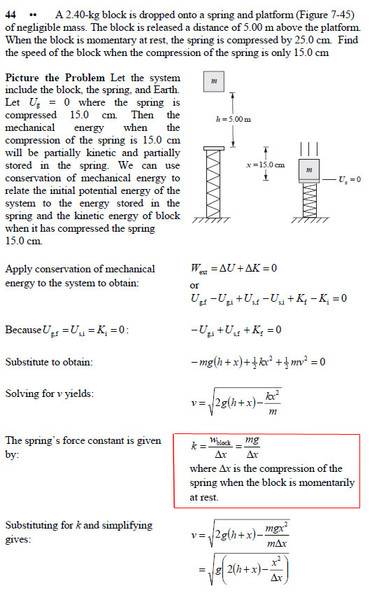
I'm reviewing some problems from a few months ago and I remember getting hung on this before. A mass is dropped from a height h above a spring. I am given the deflection of the spring when the mass stops moving momentarily. The spring constant in the solution is given by mg/x. I understand how that works if the mass is placed on a spring, but why is the extra force of the mass falling not accounted for? Why am I incorrect in saying that all of the kinetic energy of the mass falling is converted into potential energy for the spring? I tried the latter and came up with a close answer, but not the same as the solution. The mass is momentarily at rest. This isn't after the spring has damped out and stopped moving. The end goal of the problem is to find the velocity of the mass at some smaller x once the spring starts pushing it back up during the first oscillation.

Drawing a free body diagram of the mass just above the spring and after it hits, F = mg for both of them, but in the second one the spring is pushing back. I know F=ma=kx and a is constant, but if a mass is dropped on a spring, the spring will compress more than it would if the mass was gently placed on top.

edit:
aNb6M.jpg
 
Last edited:
Physics news on Phys.org


Initially the mass is not moving, so it has only PE. When the mass is falling before it hits the spring, it has a combination of PE and KE. When the mass is falling after hitting the spring, it has a combination of PE and KE, and the spring also has a combination of PE and KE. When the mass stops at the bottom of its travel momentarily, it has only PE, and the spring only has PE.

So what can you say about the sums of PE and KE at any particular moment in this sequence? Does that help answer your question?


berkeman said:
Initially the mass is not moving, so it has only PE. When the mass is falling before it hits the spring, it has a combination of PE and KE. When the mass is falling after hitting the spring, it has a combination of PE and KE, and the spring also has a combination of PE and KE. When the mass stops at the bottom of its travel momentarily, it has only PE, and the spring only has PE.

So what can you say about the sums of PE and KE at any particular moment in this sequence? Does that help answer your question?
The sums should be the same, correct? When the mass has fallen the initial h + deflection, all of the energy in the system is now PEspring, at least that makes sense in my head. Why, then, do I get an incorrect value when I set mg(h + delta) = 1/2kx2?

haruspex said:
I agree with you (cowmoo32). k should have been determined by setting v = 0 in the energy equation.
Someone in my class clarified why F=mg=kx, but I still don't see why what I said above doesn't yield the right value for k.


I just re-read the question, and it asks about a point in the spring compression before it reaches full compression. That means that there are all PEheight+PEspring+KEmass. Did you account for that in your work?


berkeman said:
I just re-read the question, and it asks about a point in the spring compression before it reaches full compression.
Yes, but before that you are required to deduce the spring constant from the compression extent when the mass is momentarily at rest. This is the bit that seems wrong in the embedded text. It says mg = kx there, which is wrong.


I emailed my professor and the solution is wrong. You cannot say F=mg=kx because the system is not in equilibrium. I was correct in saying that at the point of maximum compression the energy of the system is mgh=1/2kx2 where h is the distance the mass fell + the compression.

The steps in the red box in the solution you sent are not correct. I think the mistake they made is that they used the sum of the forces = 0 at the maximum compression: kx - mg = 0. The problem is that even though the velocity is zero, the acceleration is not zero at this point. It's not in equilibrium.