Free body diagrams, coordinate systems origin/orientation

Click For Summary

Discussion Overview

The discussion revolves around the use of coordinate systems in solving dynamics problems, particularly focusing on free body diagrams (FBDs) and the implications of choosing different origins and orientations for these systems. Participants explore various coordinate systems, including inertial and non-inertial frames, and their mathematical convenience in different contexts.

Discussion Character

  • Exploratory
  • Technical explanation
  • Debate/contested
  • Mathematical reasoning

Main Points Raised

  • One participant suggests that placing the origin at the center of mass or the point mass is a common practice, while also discussing the benefits of aligning axes with the net force direction.
  • Another participant argues that the local moving coordinate system is not always the most suitable choice, emphasizing that inertial coordinates are often more convenient.
  • Concerns are raised about the necessity of fictitious forces in non-inertial systems, with some participants questioning when such systems are useful.
  • Examples of non-inertial systems being useful include naval gunnery, orbital mechanics, and weather models, as mentioned by various participants.
  • Discussion includes a historical anecdote about the Coriolis effect in naval battles, with some participants expressing skepticism about the accuracy of the details.
  • Participants explore the idea that non-inertial frames can simplify boundary conditions in certain problems, such as rigid-body motion or movement along a rotating platform.
  • One participant poses a question regarding the advantages of using a non-inertial perspective in orbital mechanics, prompting further inquiry into specific calculations.

Areas of Agreement / Disagreement

Participants express differing views on the suitability of various coordinate systems, particularly between inertial and non-inertial frames. There is no consensus on the best approach, and multiple competing perspectives remain throughout the discussion.

Contextual Notes

Participants highlight limitations in the discussion, such as the dependence on specific definitions of inertial and non-inertial systems, as well as the unresolved nature of certain historical claims regarding naval gunnery.

fog37
Messages
1,566
Reaction score
108
Hello,
When solving statics or dynamics problems, one important step is to draw the free body diagram (FBD) with all the external forces acting ON the system. The "chosen" system may be composed of a single or multiple entities. The external forces have components that must be projects on the coordinate system which can be polar, Cartesian, etc.

My question is about the location of the origin ##O## and the orientation of the axes. In general, one rule of thumb is to place the origin ##O## where the point mass is or where the ##CM## of the system is. As far the system axes' orientation, it is mathematically convenient to align one of the axes with the net force direction. In this case, the axes are fixed in direction. In other situations, I have seen the origin ##O## being fixed at a specific spatial point with the two axes also fixed in direction.

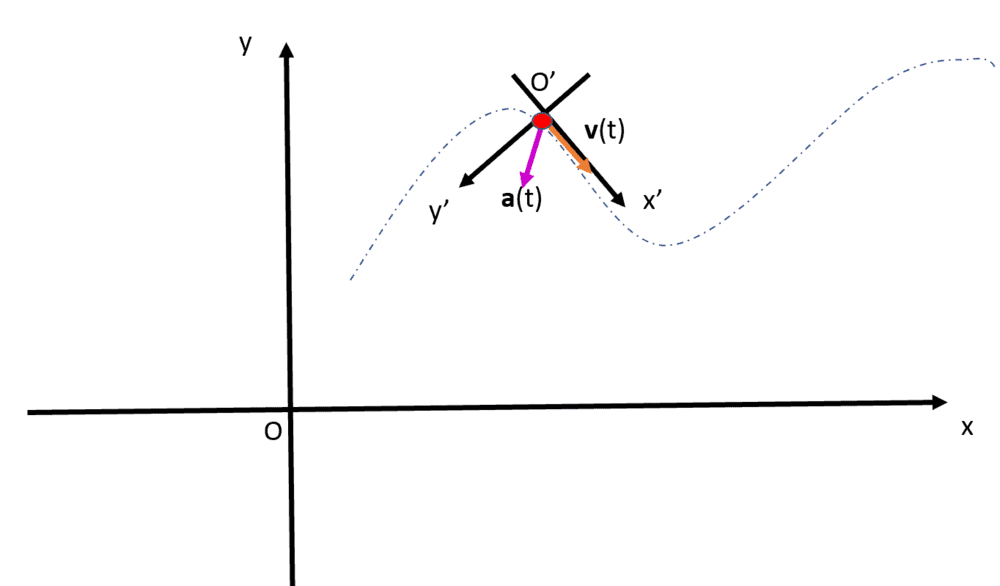
The third option, which is also very common, is to choose a local coordinate system ##O′x′y′## with origin ##O′## centered on the particle and moving with the particle itself. It is effectively a local and moving Cartesian system. In the 2D case, one of the axis is parallel to the tangent to the trajectory and always aligned with the instantaneous velocity vector ##\vec{v}(t)## with the other axis is automatically perpendicular to the first axis. The acceleration vector ##\vec{a}(t)## is then decomposed into two components: the tangential component ##a_{tan}## and the radial or centripetal component ##a_{centr}##.
Is this coordinate system choice ##O'x'y'## (local and moving with the particle, with one axis parallel to the direction of motion) always the most suitable and mathematically convenient choice? It looks like.
1604755900038.png

I struggle to see situations in which we would pick a coord. system ##Oxy## with origin ##O## not centered on the moving particle and with its axes in fixed directions instead of changing direction. It looks like the description of motion and the resolution of dynamics problems would be always more complicated.

On the other hand, the polar coordinate system has a fixed origin but its unit vectors change directions as the particle occupies different spatial positions...

Thanks!
 

Attachments

  • 1604755816144.png
    1604755816144.png
    7.2 KB · Views: 211
Last edited:
  • Like
Likes   Reactions: Delta2
Physics news on Phys.org
fog37 said:
Summary:: understand how to correctly use coord. systems when solving dynamics problems

Is this coordinate system choice O′x′y′ (local and moving with the particle, with one axis parallel to the direction of motion) always the most suitable and mathematically convenient choice?
No. In particular this coordinate system is non inertial. Often inertial coordinates are more convenient.
 
  • Like
Likes   Reactions: fog37
We always tend to use inertial systems because they only include and address only "real" forces, correct?
Noninertial systems always require real forces AND fictitious forces. When are noninertial systems useful then?

When solving basic dynamic problems involving rotation and centripetal force, the local coordinate system I describe above, with origin at the particle, is used but we don't include fictitious forces which means that the coord. system, at that moment and position in time, is not considered noninertial. I guess it is just the fixed Cartesian system conveniently positioned and oriented where the particle is. It is not a body-centered and moving coord. system then...
 
fog37 said:
When are noninertial systems useful then?

I imagine it'd pretty useful if you want to play basketball on a merry-go-round
 
  • Like
Likes   Reactions: Vanadium 50 and Ibix
fog37 said:
When are noninertial systems useful then?
Naval gunnery is a textbook example. I believe there has been a recorded instance of a gunnery officer putting in the Coriolis effect with the wrong sign and therefore consistently missing the enemy.
 
  • Like
Likes   Reactions: etotheipi and Dale
fog37 said:
Noninertial systems always require real forces AND fictitious forces. When are noninertial systems useful then?
Orbital mechanics is often done in non-inertial coordinates, as are weather models. Stress analysis for turbine blades. Magnetic resonance imaging. I am sure there are many more examples, those are the ones that come to mind for me.
 
  • Like
Likes   Reactions: etotheipi and Ibix
Ibix said:
I believe there has been a recorded instance of a gunnery officer putting in the Coriolis effect with the wrong sign and therefore consistently missing the enemy.

Legend is that this was the first Battle of the Falkland Islands, said to be the first major naval battle of the southern hemisphere. That part is not exactly true (Battle of Coronel was held at 38 degrees S five weeks earlier) and I have been unable to find any evidence for this outside of physics texts.
 
Vanadium 50 said:
I have been unable to find any evidence for this outside of physics texts.
Hm. I'm trying to track down where I read it - will let you know if I find it.
 
Thanks - if it helps, part of the legend is that the Germans had the right tables and the British the wrong ones, but they won anyway.
 
  • #10
Last edited:
  • #11
fog37 said:
We always tend to use inertial systems because they only include and address only "real" forces, correct?
Noninertial systems always require real forces AND fictitious forces. When are noninertial systems useful then?
One example is rigid-body motion, which leads to equations of motion that look much simpler in the body-fixed reference frame.
 
  • Like
Likes   Reactions: etotheipi
  • #12
fog37 said:
When are noninertial systems useful then?
For example, when your boundary conditions are easier to describe in the non-inertial frame. Like movement along a rail that is fixed to a rotating platform.
 
  • Like
Likes   Reactions: fog37
  • #13
I see. Thanks. So we can just introduce the fictious forces in case boundary conditions and/or are mathematically simpler in the noninertial frame.

I am thinking about orbital mechanics, moving planets and noninertial frames: why would it be easier to describe what is going on from the noninertial perspective of an observer on one of the rotating planets instead of from the perspective of an observer in an inertial system?
 
  • #14
fog37 said:
why would it be easier to describe what is going on from the noninertial perspective
I don’t know “why”, but have you ever tried to calculate the location of the Earth moon Lagrange points in an inertial frame?
 
  • Like
Likes   Reactions: vanhees71
  • #15
fog37 said:
I am thinking about orbital mechanics,...
Try to calculate something specific, instead of just thinking about broad topics.
 
  • Like
Likes   Reactions: jbriggs444

Similar threads

  • · Replies 1 ·
Replies
1
Views
2K
  • · Replies 30 ·
2
Replies
30
Views
3K
  • · Replies 31 ·
2
Replies
31
Views
5K
  • · Replies 4 ·
Replies
4
Views
3K
  • · Replies 1 ·
Replies
1
Views
1K
  • · Replies 7 ·
Replies
7
Views
2K
  • · Replies 8 ·
Replies
8
Views
2K
  • · Replies 5 ·
Replies
5
Views
8K
  • · Replies 25 ·
Replies
25
Views
2K
  • · Replies 2 ·
Replies
2
Views
2K