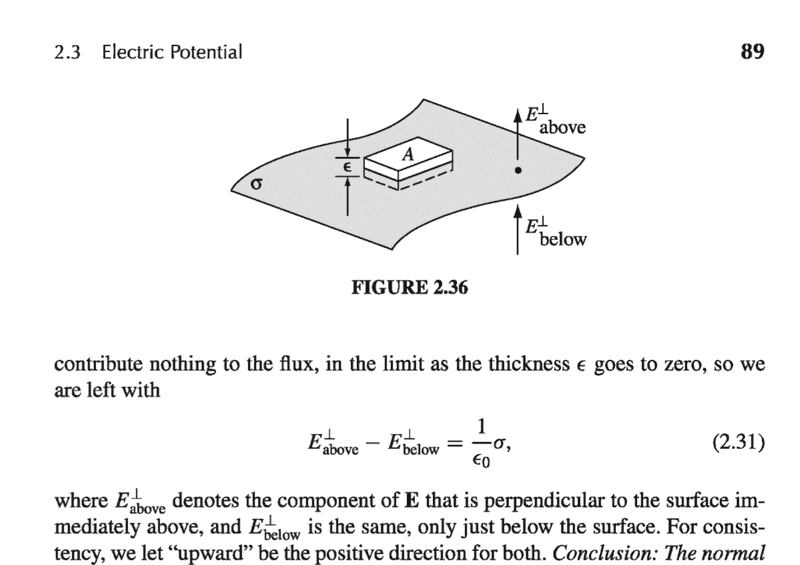
I think he does it that way to indicate or emphasize that you need to use the same sign convention on both sides of the surface, which leads to eq. (2.31) having a minus sign, i.e. that you have to use the difference between the two fields. Also, it's actually possible for the field to be in the same direction on both sides of the surface, depending on the situation.
Example #1: if the surface is the only charged object, then the field points upwards above the surface and downwards below it. Using the sign convention with +/- meaning up/down, this might give us something like $$(+5~\rm{N/C}) - (-5~\rm{N/C}) = \frac {\sigma} {\epsilon_0} \\ +10~\rm{N/C} = \frac {\sigma} {\epsilon_0}$$ Example #2: if we place the surface from example #1 between the plates of a large capactor that by itself produces a uniform field of 20 N/C upwards, the net fieid is now upwards on both sides of the surface, and we have $$(+25~\rm{N/C}) - (+15~\rm{N/C}) = \frac {\sigma} {\epsilon_0} \\ +10~\rm{N/C} = \frac {\sigma} {\epsilon_0}$$