s_hy
- 57
- 0
hi all...
I have written codes for 2d fdtd tfsf with berenger's pml absorbing boundary. But I have serious leakage at front and right boundary. At the first place I think the problem is because the pml, but pml is working perfectly in the left and bottom boundary. I need an advice whether the problem is coming from tfsf boundary or absorbing boundary condition. Attached here is my code as well as output produced.
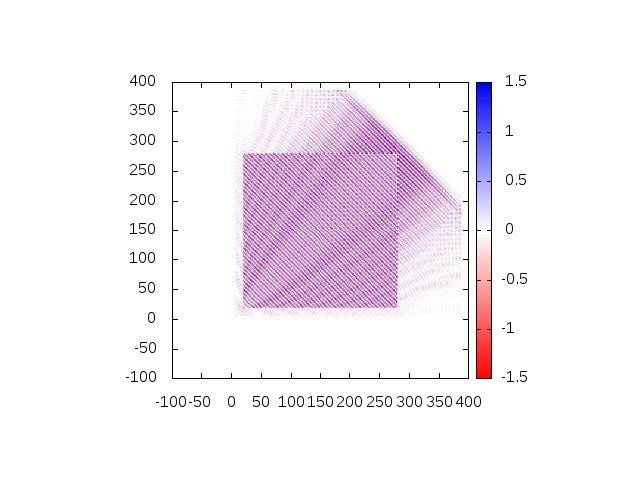
I have written codes for 2d fdtd tfsf with berenger's pml absorbing boundary. But I have serious leakage at front and right boundary. At the first place I think the problem is because the pml, but pml is working perfectly in the left and bottom boundary. I need an advice whether the problem is coming from tfsf boundary or absorbing boundary condition. Attached here is my code as well as output produced.
Code:
module data_module
implicit none

integer                                         :: i,j,k,ie,je,ia,ib,ja,jb,hinit,hlast, n,nt,m0,iinit,jinit
double precision,parameter     :: f0 = 3.0e7,c = 3.e8,eps0 = 8.8e-12,pi  = 3.14159,miu0 = 4*pi*1e-7
double precision,parameter     :: s = -0.477369,p = -1.0/3.0,q = -miu0*c/6,r = -miu0*c/2               ! mur absorbing boundary condition
double precision,parameter     :: lamda = c/f0,dx = lamda/10,dt = dx/(6e8)
double precision,parameter     :: A0 = 1.0
double precision,parameter     :: Cb = 1/(2*eps0*c),Db = 1/(2*miu0*c)
double precision                        :: epsr,miur,phi,cosphi,sinphi
double precision,dimension(-10:1000)               :: Einc0,Einc1,Hinc0
double precision,dimension(1000,1000)             :: Ez,Hy,Hx
double precision,dimension(1000,1000)             :: Ez1,Ez2,Ez3,Ez4,Ez0
double precision,dimension(-10:1000,-10:1000) :: Ezinc,Hxinc,Hyinc
double precision,dimension(1000,1000)             :: Cax,Cbx,Dax,Dbx
double precision,dimension(1000,1000)             :: miu,eps,sigma, sigmat
character(len=20)                                                 :: filename

 end module data_module

! #################################################################################################
subroutine  tfsfpml
use data_module
implicit none


integer                    :: npml,m,ip,jp
double precision    :: smax,rmax,imp               ! sigma max, rho max, impedance
double precision    :: t,d,dp
double precision    :: re,rm
double precision,dimension (500)    :: ga,gb,ha,hb,sig,rho

 phi = pi/4
 cosphi = cos(phi)
 sinphi = sin(phi)
 m0 = 1

! model size
 ie = 400
 je = 400
 hinit = -10
 hlast = 500
 iinit = 1
 jinit = 1

 ! tfsf boundary
 !ia = ie/4
 !ja = je/4
 !ib = ie*3/4
 !jb = ib
 ia = 20
 ja = 20
 ib = 280
 jb = 280

! initialization for incident wave
  Hinc0 = 0
  Einc0 = 0

! initialization for field evolution
   Hx = 0
   Hy = 0
   Ez = 0
   Ez1 = 0
   Ez2 = 0
   Ez3 = complex(0.0,0.0)
   Ez4 = 0

! :::::::::::::::::BERENGER'S ABC PML:::::::::::::::::::::::::::::::::::::::::::
! set up for berenger pml abc material
 npml = 10
 ip = ie - npml
 jp = je - npml

 imp = sqrt(miu0/eps0)
 smax = -3.0*eps0*c*log(1e-5)/(2.0*dx*npml)
 rmax = smax*(imp**2)

 do m = 1,npml
   sig(m)=smax*((m-0.5)/(npml+0.5))**2
   rho(m)=rmax*(m/(npml+0.5))**2
 end do

 ! set up constant needed in fdtd equations
 do m = 1,npml+5
   re = sig(m)*dt/eps0
   rm = rho(m)*dt/miu0
   ga(m) = exp(-re)
   gb(m) = -(exp(-re)-1.0)/sig(m)/dx
   ha(m) = exp(-rm)
   hb(m) = -(exp(-rm)-1.0)/rho(m)/dx
 end do

! medium's properties
 miur = 1.0
 epsr = 1.0

! initialize permittivity and permeability
  do i = 1,ie
   do j = 1,je
     eps(i,j) = epsr*eps0
     miu(i,j) = miur*miu0
   end do
  end do

! initialize electric conductivity & magnetic conductivity
  do i = 1,ie
   do j = 1,je
     sigma(i,j) = 0.0
     sigmat(i,j) = 0.0
     Cax(i,j) = (1.- sigma(i,j)*dt/(2.*eps(i,j)))/(1. + (sigma(i, j)*dt)/(2.*eps(i,j)))
     Cbx(i,j) = (dt/(eps(i,j)*dx))/(1.+sigma(i,j)*dt/(2.*eps(i,j)))
     Dax(i,j) = (1.-sigmat(i,j)*dt/(2.*miu(i,j)))/(1. +(sigmat(i,j)*dt)/(2.*miu(i,j)))
     Dbx(i,j) = (dt/(miu(i,j)*dx))/(1. + sigmat(i,j)*dt/(2.*miu(i,j)))
     !print*, 'Cax(i,j)=',Cax(i,j),'Cbx(i,j)=',Cbx(i,j),'Dax(i,j)=',Dax(i,j),'Dbx(i,j)=',Dbx(i,j)
   end do
  end do

!::::: initialize all of the matrices for the Berenger pml absorbing boundaries ::::::::::::::
! Ez field - left and right pml regions
 do i = 2,ie+50
   do  j = 2,npml
      m = npml + 2 - j
      Cax(i,j) = ga(m)
      Cbx(i,j) = gb(m)
   end do
   do j = jp-1,je+5
      m = j-jp
      Cax(i,j) = ga(m)
      Cbx(i,j) = gb(m)
    end do
  end do

! Ez field - back and front pml regions
 do j = 2,je+50
   do i = 2,npml
      m = npml + 2 - i
      Cax(i,j) = ga(m)
      Cbx(i,j) = gb(m)
   end do
   do i = ip-1,ie+5
      m = i-ip
      Cax(i,j) = ga(m)
      Cbx(i,j) = gb(m)
  end do
 end do

! Hx field - left and right pml regions
 do i = 2,ie+50
   do j = 1,npml
      m = npml + 1-j
      Dax(i,j) = ha(m)
      Dbx(i,j) = hb(m)
   end do
   do j = jp-1,je+5
      m = j-jp
      Dax(i,j) = ha(m)
      Dbx(i,j) = hb(m)
    end do
 end do

! Hy field - back and front pml regions
 do j = 2,je+50
   do i =1,npml
      m = npml+1-i
      Dax(i,j) = ha(m)
      Dbx(i,j) = hb(m)
    end do
    do i = ip-1,ie+5
      m = i-ip
      Dax(i,j) = ha(m)
      Dbx(i,j) = hb(m)
    end do
 end do
!-------------------------------------------------------------------------------------------------------------

! time steps start
do n = 1,1000

  write (filename, "('data',I5.4,'.dat')") n
  open (unit=31,file=filename)

! incident wave
  t = n*dt
  Einc1 = Einc0

  do k = hinit,hlast
     Hinc0(k) = Hinc0(k) - Db*(Einc1(k+1)-Einc1(k))
  end do

  do k = hinit+1,hlast-1
    Einc0(k) = Einc1(k) - Cb*(Hinc0(k)-Hinc0(k-1))
  end do

  do i = ia,ib
   do j = ja,jb
    d = cosphi*(i - ia) + sinphi*(j - ja)
    dp = d - int(d)
    Ezinc(i,j) = (1-dp)*Einc0(m0+int(d))+dp*Einc0(m0+int(d+1))
   end do
  end do

  Einc0(2) = A0*sin (2*pi*f0*n*dt)

  k = hlast
  Einc0(k) = Einc1(k-1)-1.0/3.0*(Einc0(k-1)-Einc1(k))

  k = hinit
  Einc0(k) = Einc1(k+1)-1.0/3.0*(Einc0(k+1)-Einc1(k))

! Hxincident field
  do i = ia,ib
     j = ja
    d = cosphi*(i-ia)+sinphi*(j-0.5-ja)+0.5
    dp = d - int(d)
    Hxinc(i,j-1) = (dp*Hinc0(m0-1+int(d)+1)+(1-dp)*Hinc0(m0-1+int(d)))*sinphi
  end do

  do i = ia,ib
    j = jb
    d = cosphi*(i-ia)+sinphi*(j+0.5-ja)+0.5
    dp = d - int(d)
    Hxinc(i,j) = (dp*Hinc0(m0-1+int(d)+1)+(1-dp)*Hinc0(m0-1+int(d)))*sinphi
  end do

! Hyincident field
 do j = ja,jb
   i = ia
   d = cosphi*(i-0.5-ia) + sinphi*(j-ja)+0.5
   dp = d - int(d)
   Hyinc(i-1,j) = ((dp*Hinc0(m0-1+int(d)+1)) + (1-dp)*Hinc0(m0-1+int(d)))*(-cosphi)
 end do

 do j = ja,jb
   i = ib
   d = cosphi*(i+0.5-ia) + sinphi*(j-ja)+0.5
   dp = d - int(d)
   Hyinc(i,j) = ((dp*Hinc0(m0-1+int(d)+1))+(1-dp)*Hinc0(m0-1+int(d)))*(-cosphi)
 end do

! update Hx field-------------------------------------------------------------------------------------------------------
 do i = 1,ie
   do j = 1,je-1
      Hx(i,j) = Hx(i,j) - Dbx(i,jb)*(Ez(i,j+1)-Ez(i,j))
   end do
 end do

! tfsf for hx
  do i = ia,ib
    Hx(i,ja-1) = Hx(i,ja-1) + Dbx(i,ja-1)*Ezinc(i,ja)
  end do

  do i = ia,ib
    Hx(i,jb+1) = Hx(i,jb+1) - Dbx(i,jb+1)*Ezinc(i,jb)
  end do

! update Hy field-----------------------------------------------------------------------------------------------------
  do i = 1,ie-1
    do j = 1,je
      Hy(i,j) = Hy(i,j) + Dbx(i,j)*(Ez(i+1,j)-Ez(i,j))
    end do
  end do

! tfsf for hy
 do j = ja,jb
   Hy(ia-1,j) = Hy(ia-1,j) - Dbx(ia-1,j)*Ezinc(ia,j)
 end do

 do j = ja,jb
   Hy(ib+1,j) = Hy(ib+1,j) + Dbx(ib+1,j)*Ezinc(ib,j)
  end do

!  update for Ez-----------------------------------------------------------------------------------------------------------
 do i = 2, ie-1
   do j = 2,je-1
     Ez(i,j) = Cax(i,j)*Ez(i,j) + Cbx(i,j)*(Hy(i,j) - Hy(i-1,j) - Hx(i,j) + Hx(i,j-1))
     write (31,*) i,j,Ez(i,j)
     if (j == 399) write (31,*) ' '
   end do
 end do

! update tfsf for Ez
 do j = ja+1,jb-1
   Ez(ia,j) = Ez(ia,j) - Cbx(ia,j)*Hyinc(ia-1,j)
 end do

 do j = ja+1,jb-1
   Ez(ib,j) = Ez(ib,j) + Cbx(ib,j)*Hyinc(ib,j)
 end do

 do i = ia+1,ib-1
   Ez(i,ja) = Ez(i,ja) + Cbx(i,ja)*Hxinc(i,ja-1)
 end do

 do i = ia+1,ib-1
   Ez(i,jb) = Ez(i,jb) - Cbx(i,jb)*Hxinc(i,jb)
 end do

 close (unit=31)

 end do

end subroutine  tfsfpml