FEA question (stuck): Stress analysis on this Connecting Rod

Click For Summary
SUMMARY

The forum discussion centers on Finite Element Analysis (FEA) of a connecting rod, specifically addressing stress analysis and the interpretation of stress diagrams. Users clarify that high compressive strains are indicated by blue, while high tensile strains are shown in red, and low strains are represented in light blue/green/yellow. The primary point of failure is identified at the small end due to high tensile stress, which can lead to deformation and fatigue fractures. Suggestions for improving accuracy include comparing results with past simulations and incorporating additional stress data.

PREREQUISITES
  • Understanding of Finite Element Analysis (FEA)
  • Knowledge of stress-strain relationships in materials
  • Familiarity with connecting rod design and mechanics
  • Experience with interpreting stress distribution diagrams
NEXT STEPS
  • Research advanced techniques in FEA for accurate stress analysis
  • Learn about material yield stress and its implications in design
  • Explore methods for validating FEA results against experimental data
  • Investigate lubrication methods for connecting rod applications
USEFUL FOR

Mechanical engineers, FEA analysts, and students studying structural mechanics or automotive engineering will benefit from this discussion, particularly those focused on stress analysis and design optimization of connecting rods.

Smushiehippo
Messages
10
Reaction score
0
Homework Statement
1) Explain where the first point of failure is likely to originate, and why.
2) An analysis of the studies, do you think that they will be an accurate representation of what will
happen in practice? how would you improve it.
Relevant Equations
none
Hey

Im doing FEA and got stuck on question. The diagram go me stuck, because looking through the workbook it says high stresses are in red and low in blue, whereas they included both different kind of stresses on the same diagram and no data.
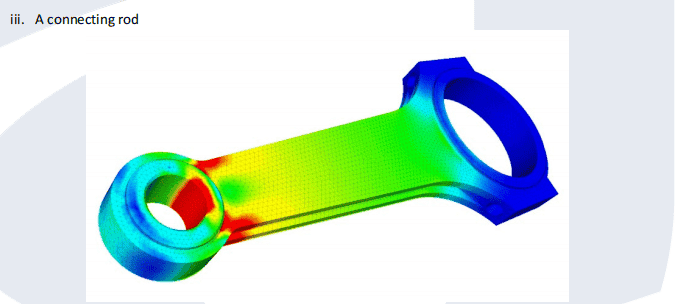
Screenshot (1319).png

Note: High Compressive strains are noted by blue, high tensile strains are noted in red, low strains are noted as light
blue/green/yellow.

What I Put
I think first point of failure would be located at the small end, where there is high tensile stress. the high tensile stress would cause deformation and fatigue fractures leading to failure.

For part 2 of the question - I layed out how FEA works, what the accuracy of the data depended on. i stated different methrod of checking (check with other collugues, past results, rerun simulations).

I believe comparing this result with past results ran the diagrams show a high level of accuracy, but cannot be 100% certain of accuracy. I do believe areas on the diagram may give errors in results, big end due to zero radius omitting tensiles stress. Ways to improve to include data on the stress to see if it exceeds yeild stress and put different stress on different diagrams.
cheers for reading
 
Physics news on Phys.org
Smushiehippo said:
Note: High Compressive strains are noted by blue, high tensile strains are noted in red, low strains are noted as light
blue/green/yellow.
I think that is incorrect.
I believe the connecting rod is shown under compression only. The highest pressure is where the gudgeon = piston pin, presses against the inside of the small end, shown as red. The big end has a greater area on the crank, so less stress. The blue is zero or neutral. The outer ends of the rod carry no load when under compression.

As the tapered rod is compressed, the narrower sections have greater stresses. That explains the colours changing along the length of the rod. The rod must be tapered to connect the small piston pin to the crank bearing.

The piston pin bearing has a low surface speed, and only swings through a small angle. It may have only splash lubrication. The big end has a higher bearing surface velocity, but also has forced lubrication. Red is an obvious problem.
 
  • Like
Likes   Reactions: DeBangis21 and Lnewqban
Baluncore said:
I think that is incorrect.
I believe the connecting rod is shown under compression only. The highest pressure is where the gudgeon = piston pin, presses against the inside of the small end, shown as red. The big end has a greater area on the crank, so less stress. The blue is zero or neutral. The outer ends of the rod carry no load when under compression.

As the tapered rod is compressed, the narrower sections have greater stresses. That explains the colours changing along the length of the rod. The rod must be tapered to connect the small piston pin to the crank bearing.

The piston pin bearing has a low surface speed, and only swings through a small angle. It may have only splash lubrication. The big end has a higher bearing surface velocity, but also has forced lubrication. Red is an obvious problem.
That's what I thought about the diagram and notes being wrong. But unicourse only gave me the diagrams with those notes and won't respond to my emails about it being potential wrong so kind of stuck
 
1682713060385.png
This looks like an old design of an equal-space lattice truss whose strains are not supported to equalize the strain. Especially the outer triangles are the weakest.
More like this
1682714163377.png

1682713676121.png
The Red zone has the highest pressure but this needs pressurized oil on the sleeve bearing during the low pressure up stoke to fill the red zone. I added two gray oil holes on the opposite side of the high force bearings which will allow oil to be pumped and forced down to the red zone.
 

Similar threads

  • · Replies 8 ·
Replies
8
Views
2K
  • · Replies 9 ·
Replies
9
Views
3K
Replies
6
Views
3K
  • · Replies 14 ·
Replies
14
Views
2K
  • · Replies 4 ·
Replies
4
Views
17K
  • · Replies 16 ·
Replies
16
Views
5K
  • · Replies 6 ·
Replies
6
Views
3K
  • · Replies 9 ·
Replies
9
Views
4K
  • · Replies 13 ·
Replies
13
Views
6K
  • · Replies 0 ·
Replies
0
Views
2K