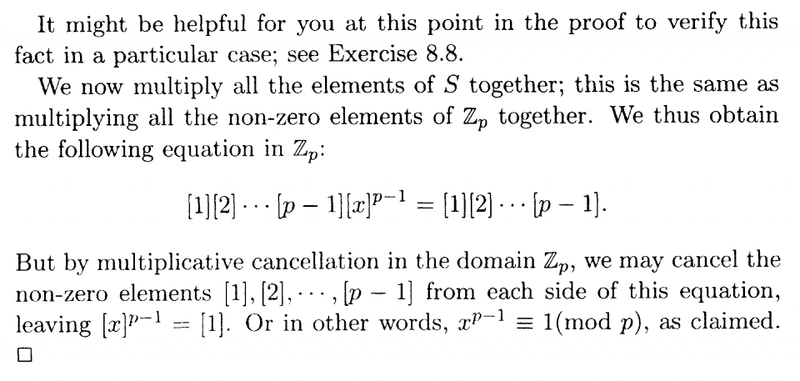
Fermat's Little Theorem .... Anderson and Feil, Theorem 8.7 .

  • Context: Undergrad 
  • Thread starter Thread starter Math Amateur
  • Start date Start date
  • Tags Tags
    Theorem
Click For Summary

Discussion Overview

The discussion centers on understanding aspects of the proof of Theorem 8.7 (Fermat's Little Theorem) from Anderson and Feil's "A First Course in Abstract Algebra," specifically focusing on properties of fields related to zero divisors and multiplicative cancellation.

Discussion Character

  • Technical explanation
  • Conceptual clarification
  • Debate/contested

Main Points Raised

  • One participant questions why the absence of zero divisors in a field implies that each element of a certain set ##S## is non-zero.
  • Another participant acknowledges that the answer to the first question is obvious and relates it to the definition of zero divisors.
  • A participant seeks clarification on why multiplicative cancellation in fields ensures that no two elements of set ##S## are the same, proposing that if ##[x \cdot n] = [x \cdot m]##, then cancellation leads to ##n = m##.
  • It is noted that cancellation works in fields because every element has an inverse, allowing the manipulation of equations involving non-zero elements.
  • A later reply cautions that one cannot assume non-zero elements when discussing cancellation and suggests operating without assuming the existence of multiplicative inverses.

Areas of Agreement / Disagreement

Participants generally agree on the properties of fields regarding zero divisors and cancellation, but there is some disagreement on the assumptions that can be made when applying these properties, particularly concerning the treatment of zero.

Contextual Notes

Participants express uncertainty about the implications of assuming non-zero elements when discussing multiplicative cancellation and the need for caution in applying inverses.

Math Amateur
Gold Member
MHB
Messages
3,920
Reaction score
48
I am reading Anderson and Feil - A First Course in Abstract Algebra.

I am currently focused on Ch. 8: Integral Domains and Fields ...

I need some help with an aspect of the proof of Theorem 8.7 (Fermat's Little Theorem) ...

Theorem 8.7 and its proof read as follows:
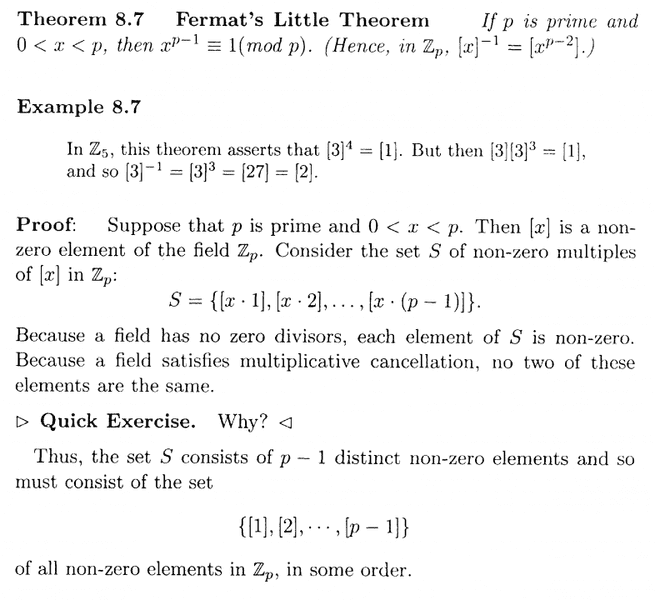
?temp_hash=bbfb5a4056b517e37a95ed1b249b4210.png

?temp_hash=bbfb5a4056b517e37a95ed1b249b4210.png
My questions regarding the above are as follows:
Question 1

In the above text from Anderson and Feil we read the following:

" ... ... Because a field has no zero divisors, each element of ##S## is non-zero ... "Can someone please demonstrate exactly why this follows ... ?

Question 2

In the above text from Anderson and Feil we read the following:" ... ... Because a field satisfies multiplicative cancellation, no two of these elements are the same .. ... "Can someone please demonstrate exactly why it follows that no two of the elements of ##S## are the same .. ... "
Help will be appreciated ...

Peter*** EDIT ***

oh dear ... can see that the answer to Question 1 is obvious ... indeed it follows from the definition of zero divisor ... apologies ... brain not in gear ...
 

Attachments

  • Anderson and Feil - 1 - Theorem 8.7 ... PART 1  ... ....png
    Anderson and Feil - 1 - Theorem 8.7 ... PART 1 ... ....png
    34.6 KB · Views: 4,081
  • Anderson and Feil - 2 - Theorem 8.7 ... PART 2 ... ....png
    Anderson and Feil - 2 - Theorem 8.7 ... PART 2 ... ....png
    35.3 KB · Views: 976
Physics news on Phys.org
Math Amateur said:
Question 2
In the above text from Anderson and Feil we read the following:
" ... ... Because a field satisfies multiplicative cancellation, no two of these elements are the same .. ... "
Can someone please demonstrate exactly why it follows that no two of the elements of ##S## are the same .. ... "
It's also obvious. If we assumed ##[x\cdot n]=[x\cdot m]## then what would this mean? You can use all field operations and again the lack of zero divisors. In general, the question to be answered is: why do fields allow multiplicative cancellations? The reason doesn't require this special field, so you may as well prove: ##a\cdot m = b \cdot m \Longrightarrow a = b## for ##a,b \neq 0## of course.
 
  • Like
Likes   Reactions: Math Amateur
Thanks for the help fresh_42 ... grateful for your help ...

If ##[ x \cdot n ] = [ x \cdot m ]## then by cancellation in a field, we have n = m which cannot be the case for the members of the set S ...

Cancellation works in fields since every element of a field has an inverse ...

... so if ##a \cdot m = b \cdot m## then we can post-multiply by ##m^{-1}## and get ##a = b## ...

Hope that's right ...

Peter
 
Math Amateur said:
Thanks for the help fresh_42 ... grateful for your help ...

If ##[ x \cdot n ] = [ x \cdot m ]## then by cancellation in a field, we have n = m which cannot be the case for the members of the set S ...

Cancellation works in fields since every element of a field has an inverse ...

... so if ##a \cdot m = b \cdot m## then we can post-multiply by ##m^{-1}## and get ##a = b## ...

Hope that's right ...

Peter
Well, partially. You cannot rule out the case ##m=0## at prior and operate with ##m^{-1}##.

Therefore wait as long as you can with additional assumptions.

This is more of a general advice. Instead operate without (multiplicative) inverse elements.
 
  • Like
Likes   Reactions: Math Amateur

Similar threads

Replies
2
Views
2K
  • · Replies 7 ·
Replies
7
Views
2K
  • · Replies 1 ·
Replies
1
Views
2K
  • · Replies 3 ·
Replies
3
Views
2K
  • · Replies 6 ·
Replies
6
Views
3K
  • · Replies 5 ·
Replies
5
Views
2K
  • · Replies 10 ·
Replies
10
Views
3K
  • · Replies 2 ·
Replies
2
Views
1K
Replies
1
Views
2K
  • · Replies 9 ·
Replies
9
Views
2K