Splitting Fields: Anderson and Feil, Theorem 45.4 ....

Click For Summary

Discussion Overview

The discussion revolves around the proof of Theorem 45.4 from Anderson and Feil's "A First Course in Abstract Algebra," specifically focusing on the concept of splitting fields and the properties of polynomials over different fields. Participants seek clarification on specific aspects of the theorem's proof, including the nature of polynomial coefficients and differentiation methods.

Discussion Character

  • Technical explanation
  • Conceptual clarification
  • Debate/contested
  • Mathematical reasoning

Main Points Raised

  • Peter questions whether the polynomial \( g \) should be considered over \( F \) instead of \( K \), given that \( f \) is in \( F[x] \) and thus has coefficients in \( F \).
  • Some participants argue that if \( \alpha \in K - F \), then \( g \) may not be in \( F \) because its coefficients could depend on \( \alpha \).
  • One participant provides an example with \( F = \mathbb{R} \) and \( K = \mathbb{C} \) to illustrate that \( g \) can indeed have coefficients that are not in \( F \).
  • Peter seeks clarification on the term "term-by-term differentiation" and its implications for showing that \( f' \in F[x] \).
  • Another participant explains that term-by-term differentiation involves expanding the polynomial and differentiating each term, leading to coefficients that remain in \( F \).

Areas of Agreement / Disagreement

Participants express differing views on the nature of the polynomial \( g \) and its coefficients, indicating that there is no consensus on whether \( g \) must be over \( F \) or can be influenced by \( \alpha \). The discussion on term-by-term differentiation also reflects varying levels of understanding and interpretation.

Contextual Notes

There are unresolved assumptions regarding the definitions of the fields \( F \) and \( K \), and the implications of polynomial differentiation methods on the membership of \( f' \) in \( F[x] \).

Math Amateur
Gold Member
MHB
Messages
3,920
Reaction score
48
I am reading Anderson and Feil - A First Course in Abstract Algebra.

I am currently focused on Ch. 45: The Splitting Field ... ...

I need some help with some aspects of the proof of Theorem 45.4 ...

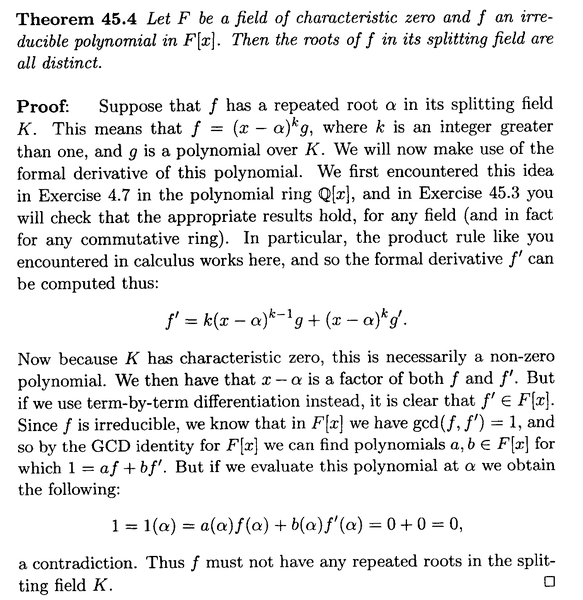
Theorem 45.4 and its proof read as follows:
?temp_hash=979d95a5224d19aff491ca54c9b89ab9.png


My questions on the above proof are as follows:Question 1In the above text from Anderson and Feil we read the following:"... ... This means that ##f = ( x - \alpha)^k g##, where ##k## is an integer greater than ##1## and ##g## is a polynomial over ##K## ... ... Since ##f## is in ##F[x]## ... that is ##f## is over ##F## ... shouldn't ##g## be over ##F## not ##K##?

(I am assuming that ##f## being "over ##F##" means the coefficients of ##f## are in ##F## ... )

Question 2In the above text from Anderson and Feil we read the following:"... ... We then have that ##x - \alpha## is a factor of both ##f## and ##f'##. But if we use term-by-term differentiation instead, it is clear that ##f'\in F[x]##. ... ... "What do Anderson and Feil mean by term-by-term differentiation in this context ... ... and if they do use term-by-term differentiation (what ever they mean) how does this show that ##f'\in F[x]## ... ... ?
Hope someone can help ...

Help will be much appreciated ... ...

Peter
 

Attachments

  • A&W _ Theorem 45.4 ... ... .png
    A&W _ Theorem 45.4 ... ... .png
    52.7 KB · Views: 502
Physics news on Phys.org
If ##\alpha\in K-F## then ##g## will not necessarily be in ##F## as its coefficients will be functions of ##\alpha##.

Consider ##F=\mathbb R,\ K=\mathbb C## and ##f(x)=(x^2+1)^2=(x-i)^2(x+i)^2##, which has roots ##i## and ##-i##, both of multiplicity 2. Taking ##\alpha=i## we get ##g(x)=(x+i)^2##, which is not in ##\mathbb R[x]##.
 
  • Like
Likes   Reactions: Math Amateur
Math Amateur said:
"... ... We then have that ##x - \alpha## is a factor of both ##f## and ##f'##. But if we use term-by-term differentiation instead, it is clear that ##f'\in F[x]##. ... ... "
I was going off to have dinner, thinking I didn't have time to work out the second one. Then I realized it's actually the easier of the two.

By 'term-by-term' they mean writing the polynomial in expanded, unfactorised form as ##f(x)=\sum_{k=0}^n c_kx^k## and then differentiating to get ##f'(x)=\sum_{k=1}^n kc_kx^{k-1}##. The coefficients are of the form ##kc_k## which, since ##k## is in ##\mathbb N## rather than ##F##, means ##\sum_{j=1}^k c_k##, which must be in ##F## since ##c_k## is. Hence ##f'\in F[x]##.
 
  • Like
Likes   Reactions: Math Amateur and Greg Bernhardt
andrewkirk said:
If ##\alpha\in K-F## then ##g## will not necessarily be in ##F## as its coefficients will be functions of ##\alpha##.

Consider ##F=\mathbb R,\ K=\mathbb C## and ##f(x)=(x^2+1)^2=(x-i)^2(x+i)^2##, which has roots ##i## and ##-i##, both of multiplicity 2. Taking ##\alpha=i## we get ##g(x)=(x+i)^2##, which is not in ##\mathbb R[x]##.
Thanks Andrew ... good example ... makes it pretty clear ...

Peter
 
  • Like
Likes   Reactions: Greg Bernhardt

Similar threads

  • · Replies 6 ·
Replies
6
Views
3K
  • · Replies 1 ·
Replies
1
Views
2K
  • · Replies 7 ·
Replies
7
Views
2K
  • · Replies 9 ·
Replies
9
Views
2K
  • · Replies 10 ·
Replies
10
Views
3K
Replies
1
Views
2K
  • · Replies 6 ·
Replies
6
Views
2K
Replies
8
Views
2K
  • · Replies 2 ·
Replies
2
Views
2K
  • · Replies 3 ·
Replies
3
Views
3K