Splitting Fields: Anderson and Feil, Theorem 45.6 ....

Click For Summary
SUMMARY

The discussion centers on Theorem 45.6 from Anderson and Feil's "A First Course in Abstract Algebra," which states that if ##K## is a normal extension of a field ##F## with characteristic zero, then ##K = F(\alpha)## for some algebraic element ##\alpha## over ##F##. Participants clarify that the conditions for applying Theorem 45.5 are met, specifically that ##K## is a finite algebraic extension of ##F##. The conversation emphasizes the importance of recognizing linear dependence among the set of elements in ##K## and how this relates to establishing that elements of ##K## are algebraic over ##F##.

PREREQUISITES
  • Understanding of normal extensions in field theory
  • Familiarity with algebraic extensions and their properties
  • Knowledge of linear independence and vector spaces
  • Basic grasp of Galois theory concepts
NEXT STEPS
  • Study Anderson and Feil's Theorem 45.5 in detail
  • Explore the concept of normal extensions in field theory
  • Learn about linear independence in vector spaces
  • Investigate the implications of algebraic elements in field extensions
USEFUL FOR

Students and educators in abstract algebra, particularly those studying field theory and Galois theory, will benefit from this discussion. It is also valuable for anyone seeking to deepen their understanding of algebraic extensions and their applications.

Math Amateur
Gold Member
MHB
Messages
3,920
Reaction score
48
I am reading Anderson and Feil - A First Course in Abstract Algebra.

I am currently focused on Ch. 45: The Splitting Field ... ...

I need some help with an aspect of the proof of Theorem 45.6 ...

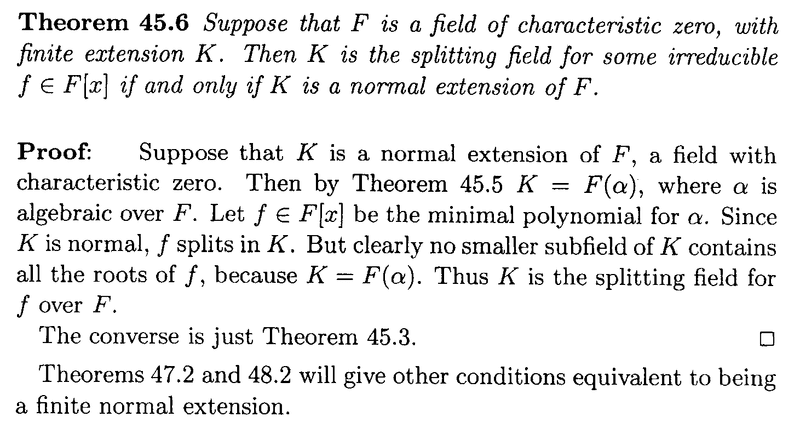
Theorem 45.6 and its proof read as follows:
?temp_hash=e4d3c679eb07bb16c3e25a7846ea7af0.png


At the start of the proof of Theorem 45.6 we read the following:

"Suppose that ##K## is a normal extension of ##F##, a field with characteristic zero. Then by Theorem 45.5, ##K = F( \alpha )##, where ##\alpha## is algebraic over ##F##. ... .. "
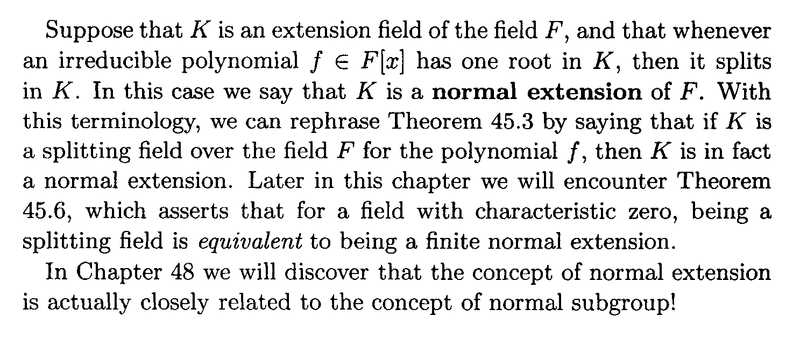
Can someone please explain exactly how ##K = F( \alpha )## follows in the above statement ... ?The quote mentions Anderson and Feil's Theorem 45.5 and also mentions that K is a normal extension so I am providing the statement of Theorem 45.5 and Anderson and Feil's definition of a normal extension as follows ... ...

?temp_hash=e4d3c679eb07bb16c3e25a7846ea7af0.png

Hope someone can help ...

Peter
 

Attachments

  • A&F - Theorem 45.6 and proof ...  ....png
    A&F - Theorem 45.6 and proof ... ....png
    41.6 KB · Views: 599
  • A&F - Statement of Theorem 45.5 ... ....png
    A&F - Statement of Theorem 45.5 ... ....png
    8.9 KB · Views: 520
  • A&F - Defintion of a Normal Extension ... ....png
    A&F - Defintion of a Normal Extension ... ....png
    41 KB · Views: 531
Physics news on Phys.org
Gather what you have: ##F \subseteq K## a finite extension. This means ##\dim_FK =: n < \infty##.
Now what does that mean for ##\{1,a,a^2,a^3,\ldots ,a^n\}\,##, if we take an arbitrary element ##a \in K\,##?
Can you deduce from that, that the conditions for Theorem 45.5 are met?
And what does ##F \subseteq K## simple algebraic extension mean?
 
Thanks for the advice to "Gather what you have: ... "...

I was myopically focused on the first sentence of the proof where we are given

(i) ##K## is a normal extension of ##F##
(ii) ##F## is a field with characteristic zero

and was wondering about how to get from this to the initial conditions of Theorem 45.5 that

(i) ##F## is a field with characteristic zero
(ii) ##K## was a finite algebraic extension of ##F## BUT ... in my tunnel vision I neglected that ##K## was given as a finite extension ... sorry for such a simple oversight ...... HOWEVER ... still concerned that we need to establish that ##K## is algebraic over ##F## ... that is all elements of ##K## are algebraic over ##F## ... before applying Theorem 45..5 ...Peter
 
Math Amateur said:
... HOWEVER ... still concerned that we need to establish that KKK is algebraic over ##F## ... that is all elements of ##K## are algebraic over ##F## ... before applying Theorem 45..5 ...
That's why I wrote - with ##n## being the dimesion of ##K## over ##F##
fresh_42 said:
Now what does that mean for ##\{1,a,a^2,a^3,\ldots ,a^n\}\,##, if we take an arbitrary element ##a \in K\,##?
How many elements has this set? Can they be linear independent, and if not, what does that mean?
 
fresh_42 said:
Gather what you have: ##F \subseteq K## a finite extension. This means ##\dim_FK =: n < \infty##.
Now what does that mean for ##\{1,a,a^2,a^3,\ldots ,a^{ n - 1} \}\,##, if we take an arbitrary element ##a \in K\,##?
Can you deduce from that, that the conditions for Theorem 45.5 are met?
And what does ##F \subseteq K## simple algebraic extension mean?
Just to answer your questions ...

You write:

"Now what does that mean for ##\{1,a,a^2,a^3,\ldots ,a^n \},##, if we take an arbitrary element ##a \in K\,##?"

It means that ##\{1,a,a^2,a^3,\ldots ,a^{n - 1} \} ,## is a basis for the vector space ##K## over ##F## ... and that ##\{1,a,a^2,a^3,\ldots ,a^n \},## is a linearly dependent set ... ... is that correct?

You write:

"Can you deduce from that, that the conditions for Theorem 45.5 are met?"

... regarding conditions for Theorem 45.5 to be met ... see my previous post ...
You write:

"And what does ##F \subseteq K## simple algebraic extension mean?""Means that ##K## is of the form ##K = F( \alpha )## ...

Peter
 
fresh_42 said:
That's why I wrote - with ##n## being the dimesion of ##K## over ##F##

How many elements has this set? Can they be linear independent, and if not, what does that mean?
As mentioned in the previous post the set is linearly dependent ... so this means that any element of the set can be expressed as a linear combination of the others ...

Peter
 
  • Like
Likes   Reactions: fresh_42
Math Amateur said:
It means that ##\{1,a,a^2,a^3,\ldots ,a^{n - 1}\}## is a basis for the vector space ##K## over ##F## ... is that correct?
I don't know. I don't care either. This would exclude e.g. all ##a \in F \subseteq K## without reason.

It means the set ##\{1,a,a^2,a^3,\ldots ,a^{n}\}## is linear dependent - in any case. Linear dependency means, we have a non trivial expression of zero: ##0 = c_0\cdot 1 + c_1\cdot a + c_2\cdot a^2 + \ldots + c_n\cdot a^n## with not all ##F \ni c_i=0##. If we define ##p(x)=c_0\cdot 1 + c_1\cdot x + c_2\cdot x^2 + \ldots + c_n\cdot x^n## we get a polynomial in ##F[x]## with ##p(a)=0## and ##a## is algebraic.

##K=F(\alpha)## for a certain ##\alpha \in K## is the result of theorem 45.5.
 
  • Like
Likes   Reactions: Math Amateur
Thanks for all your help fresh_42 ...

Gradually building a basic understanding of Galois theory, thanks to your support ...

Peter
 

Similar threads

  • · Replies 1 ·
Replies
1
Views
2K
  • · Replies 9 ·
Replies
9
Views
2K
  • · Replies 3 ·
Replies
3
Views
2K
  • · Replies 6 ·
Replies
6
Views
3K
  • · Replies 10 ·
Replies
10
Views
3K
Replies
1
Views
2K
  • · Replies 3 ·
Replies
3
Views
3K
  • · Replies 6 ·
Replies
6
Views
2K
Replies
2
Views
2K
  • · Replies 2 ·
Replies
2
Views
2K