Splitting Fields: Anderson and Feil, Theorem 45.5 ....

Click For Summary

Discussion Overview

The discussion centers on aspects of the proof of Theorem 45.5 from Anderson and Feil's "A First Course in Abstract Algebra," specifically regarding the nature of algebraic elements and their relationship to irreducible polynomials in the context of splitting fields. Participants explore the implications of reducible polynomials and the characteristics of fields.

Discussion Character

  • Technical explanation
  • Conceptual clarification
  • Debate/contested

Main Points Raised

  • Some participants question how algebraic elements ##\alpha## and ##\beta## can be roots of irreducible polynomials in ##F[x]##, given the definition of algebraic elements provided by Anderson and Feil.
  • There is a discussion about the implications of considering a reducible polynomial ##p(x) = f(x) \cdot g(x)## and whether ##\alpha## must be a root of either ##f## or ##g##.
  • One participant suggests that if ##\alpha## is a root of a reducible polynomial, the process of factoring could lead to identifying an irreducible polynomial.
  • Another participant notes that in fields with characteristic zero, it is not straightforward to conclude that either ##f(\alpha)=0## or ##g(\alpha)=0##.
  • In contrast, when the characteristic is a prime ##p##, it is discussed that ##p## dividing the product ##f(\alpha) \cdot g(\alpha) = 0## implies that ##p## must divide one of the factors, leading to either ##f(\alpha)=0## or ##g(\alpha)=0##.
  • Participants express uncertainty about the implications of these characteristics and reflect on their understanding of the concepts involved.

Areas of Agreement / Disagreement

Participants express differing views on the implications of reducible polynomials and the characteristics of fields. There is no consensus on how these concepts interact, particularly regarding the transition from reducible to irreducible polynomials.

Contextual Notes

The discussion includes limitations related to the definitions of algebraic elements and the assumptions about polynomial irreducibility. Participants also highlight the complexity introduced by different field characteristics.

Math Amateur
Gold Member
MHB
Messages
3,920
Reaction score
48
I am reading Anderson and Feil - A First Course in Abstract Algebra.

I am currently focused on Ch. 45: The Splitting Field ... ...

I need some help with some aspects of the proof of Theorem 45.5 ...

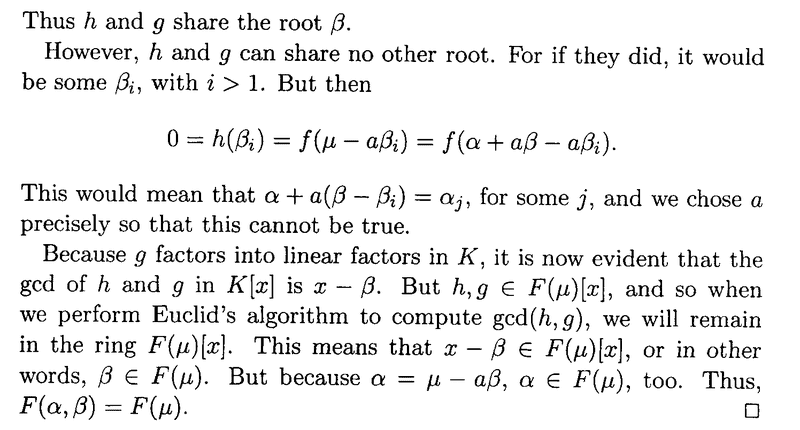
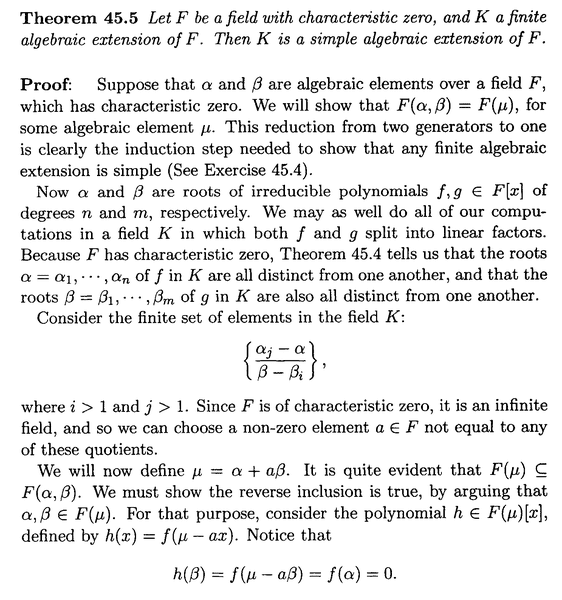
Theorem 45.5 and its proof read as follows:
?temp_hash=6827701059bafb016e0aaa98e096587f.png

?temp_hash=6827701059bafb016e0aaa98e096587f.png


In the above text from Anderson and Feil we read the following:

"... ... Now ##\alpha## and ##\beta## are roots of irreducible polynomials ##f, g \in F[x]## ... ...Now, we are just given that \alpha and \beta are algebraic elements of a field ##F## ... ... how, exactly, do we know that they are roots of irreducible polynomials in ##F[x] ##... .,.. ?
"( NOTE: A&F's definition of algebraic over ##F## does not mention irreducible polynomials but says:

"If ##E## is an extension field of a field ##F## and ##\alpha \in E## is a root of a polynomial in ##F[x]##, we say ##\alpha## is algebraic over ##F##. ...)

Hope someone can help ...

PeterEdit: Hmm ... wonder if Kronecker's Theorem has something to do with irreducible polynomials entering this discussion ...
 

Attachments

  • A&F - 1 - Theorem 45.5 and proof ... PART 1 ....png
    A&F - 1 - Theorem 45.5 and proof ... PART 1 ....png
    53 KB · Views: 541
  • A&F - 2 - Theorem 45.5 and proof ... PART 2 ....png
    A&F - 2 - Theorem 45.5 and proof ... PART 2 ....png
    35.5 KB · Views: 586
Physics news on Phys.org
Math Amateur said:
Now, we are just given that ##\alpha## and ##\beta## are algebraic elements of a field ##F## ... ... how, exactly, do we know that they are roots of irreducible polynomials in ##F[x]## ... .,.. ?
Math Amateur said:
"If ##E## is an extension field of a field ##F## and ##\alpha \in E## is a root of a polynomial in ##F[x]##, we say ##\alpha## is algebraic over ##F##. ...)
What happens, if you consider a polynomial ##p(x) \in F[x]## that is reducible, say ##p(x)=f(x)\cdot g(x)## and ##p(\alpha)=0\,##? Remember that ##\operatorname{char} F =0##.
 
  • Like
Likes   Reactions: Math Amateur
fresh_42 said:
What happens, if you consider a polynomial ##p(x) \in F[x]## that is reducible, say ##p(x)=f(x)\cdot g(x)## and ##p(\alpha)=0\,##? Remember that ##\operatorname{char} F =0##.
... ... well ... I guess ##\alpha## must be a root of either ##f## or ##g## ... and if it is a root of ##f## then ##f## is irreducible ... if it is not just continue your process until we end up with an irreducible ... so we end up with an irreducible polynomial ... so, given this, assume one at the start

Is that correct ...?

Peter
 
  • Like
Likes   Reactions: fresh_42
Math Amateur said:
... ... well ... I guess ##\alpha## must be a root of either ##f## or ##g## ... and if it is a root of ##f## then ##f## is irreducible ... if it is not just continue your process until we end up with an irreducible ... so we end up with an irreducible polynomial ... so, given this, assume one at the start

Is that correct ...?

Peter
Yes, this is true. You just can assume a minimal (and irreducible) polynomial. I wonder how it is, if the characteristic is not zero, then we cannot conclude that either ##f(\alpha)=0## or ##g(\alpha)=0##. At least not as easy, but I don't remember this special case.

Edit: I think I got it. If ##\operatorname{char} F = p## and ##f(\alpha)\cdot g(\alpha)=0## then ##p## divides this product, and the property of ##p## being a prime means it divides one of the factors, which in return translates to ##f(\alpha)=0## or ##g(\alpha)=0##.
 
  • Like
Likes   Reactions: Math Amateur
fresh_42 said:
Yes, this is true. You just can assume a minimal (and irreducible) polynomial. I wonder how it is, if the characteristic is not zero, then we cannot conclude that either ##f(\alpha)=0## or ##g(\alpha)=0##. At least not as easy, but I don't remember this special case.

Thanks fresh_42 ... ...

Hmm ... very interesting point ... cannot see reason yet ... reflecting ...

Thanks again ...

Peter
 
Math Amateur said:
Thanks fresh_42 ... ...

Hmm ... very interesting point ... cannot see reason yet ... reflecting ...

Thanks again ...

Peter
No, not really. Read my edit.
 
  • Like
Likes   Reactions: Math Amateur
fresh_42 said:
No, not really. Read my edit.


... oh ... OK ... yes ...

Peter
 
Math Amateur said:
... oh ... OK ... yes ...

Peter
Hi fresh_42 ...

Just confirming something ...

You write:"... ... If ##\operatorname{char} F = p## and ##f(\alpha)\cdot g(\alpha)=0## then ##p## divides this product... ... "

I am assuming that ##p## divides ##f(\alpha)\cdot g(\alpha)## because ##p \cdot 1 = f (\alpha)\cdot g(\alpha) = 0## ... ...Is that correct?

Peter
 
Math Amateur said:
Hi fresh_42 ...

Just confirming something ...

You write:"... ... If ##\operatorname{char} F = p## and ##f(\alpha)\cdot g(\alpha)=0## then ##p## divides this product... ... "

I am assuming that ##p## divides ##f(\alpha)\cdot g(\alpha)## because ##p \cdot 1 = f (\alpha)\cdot g(\alpha) = 0## ... ...Is that correct?

Peter
Yes, this is correct. If ##\operatorname{char}F = p##, then ##p=\operatorname{char}F = \underbrace{1+\ldots +1}_{p-times} =0## in this field. Think of ##\mathbb{Z}_2## or ##\mathbb{Z}_3## where the elements are ##\{0,1\}\, , \,\{0,1,2\},## resp., which means ##1+1=2=0## in the first case and ##1+1+1=3=0## in the second case.
 
  • Like
Likes   Reactions: Math Amateur
  • #10
Thanks for all your help and support on the above posts!

Most grateful for your help!

Peter
 

Similar threads

  • · Replies 1 ·
Replies
1
Views
2K
  • · Replies 7 ·
Replies
7
Views
2K
  • · Replies 3 ·
Replies
3
Views
2K
  • · Replies 6 ·
Replies
6
Views
3K
  • · Replies 10 ·
Replies
10
Views
3K
  • · Replies 6 ·
Replies
6
Views
2K
  • · Replies 2 ·
Replies
2
Views
2K
Replies
1
Views
2K
  • · Replies 3 ·
Replies
3
Views
3K
Replies
2
Views
2K