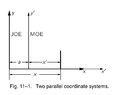
Feynman's proof that Newton's laws are invariant under spatial translation
Join the discussion
Registration is free. Ask a follow-up in this thread, or start your own.
45 replies · 6K views
Physics news on Phys.org
- 13,923
- 16,801
Actually, I think the original quote does too: "Since the equations are the same, the phenomena appear the same." (Or I'm missing something...)gmax137 said:Yes, and unfortunately this thread bounces back and forth between the two ideas.
Science Advisor
Homework Helper
- 6,962
- 6,042
But this caveat is, unless specifically stated otherwise , fundamentally part of the physics canon.Ibix said:So Feynman is proving that his model of the laws of physics are translation invariant and hence his equipment is predicted to be translation invariant. He does not prove (and you cannot prove) that this is a correct model of reality, but it's been an accurate model every time so far.
Perhaps Feynman should have said "Since the equations are the same, canonically the phenomena must appear the same." but this seems a bit pedantic. The book is after all a physics text.
- 13,923
- 16,801
Indeed. But I certainly managed to get a long way through my physics education without coming across a clear statement of the distinction between the mathematical models (about which you can formally prove things) and reality (where you can only test). I don't think Feynman's being particularly clear on that distinction here, and perhaps you are right that it would be pedantic of him to do so, but I wonder if it's confused the OP.hutchphd said:But this caveat is, unless specifically stated otherwise , fundamentally part of the physics canon.
mark2142
- 228
- 42
That I understand. I meant how it’s right everywhere from the logic I gave?PeroK said:The idea is that if you do an experiment in your bathtub, you don't have to look up the laws of physics that apply specifically in your bathtub. You can use the same laws of fluid mechanics that everyone else uses.
Otherwise, we'd have a different set of laws of physics for every bathtub - and every swimming pool etc.
mark2142 said:This does not happen. We can write the correct laws using the new coordinates. There is no absolute space and origin from which the laws are right.
mark2142
- 228
- 42
Ok! I am simply asking how is “right everywhere” is same as “right from everywhere”?hutchphd said:I, for one, do not understand the distinction you are trying to create. Perhaps you could succinctly restate your question.
You can see in the logic I had put a question mark. The math says only “right from everywhere” not “right everywhere”.mark2142 said:This does not happen. We can write the correct laws using the new coordinates. There is no absolute space and origin from which the laws are right. So it’s right everywhere or from everywhere ?
- 13,923
- 16,801
Take a piece of equipment and study it. Move it somewhere and study it again from a distance. Is it working the same? Repeat and repeat until you are convinced that the laws you have that describe the instrument are "right everywhere".mark2142 said:Ok! I am simply asking how is “right everywhere” is same as “right from everywhere”?
Bring the equipment back to you. Now you move somewhere and study it again from a distance. The laws governing your function don't change (we just established that) and the equipment hasn't moved. Thus the results will be the same and the laws are "right from everywhere".
mark2142
- 228
- 42
It’s already been explained before in many posts and I already know the laws don’t change upon displacement. I want to understand the proof that Feynman gave. I am unable to follow from math that laws don’t change upon displacement. The math is proving the law is same for different observers.Ibix said:Take a piece of equipment and study it. Move it somewhere and study it again from a distance. Is it working the same? Repeat and repeat until you are convinced that the laws you have that describe the instrument are "right everywhere".
Bring the equipment back to you. Now you move somewhere and study it again from a distance. The laws governing your function don't change (we just established that) and the equipment hasn't moved. Thus the results will be the same and the laws are "right from everywhere".
- 24,488
- 15,063
I'm not aware that Feynman anywhere proved Noether's theorem in his textbooks. Do you have the source. I'm sure, it's a masterpiece. Otherwise you'll find this proof in any modern textbook on classical analytical mechanics, e.g.,
F. Scheck, Mechanics (5th ed.), Springer (2007)
F. Scheck, Mechanics (5th ed.), Springer (2007)
Science Advisor
Homework Helper
- 6,962
- 6,042
Is the OP aware of the Messenger Lecture on symmetry? He does some fun hand waving on Noether.
Science Advisor
Education Advisor
- 3,212
- 3,841
mark2142 said:It’s already been explained before in many posts and I already know the laws don’t change upon displacement. I want to understand the proof that Feynman gave. I am unable to follow from math that laws don’t change upon displacement. The math is proving the law is same for different observers.
I think @Ibix has answered this question, essentially, "Feynman has not proved that the 'real' laws don’t change upon displacement"
Ibix said:... So Feynman is proving that his model of the laws of physics are translation invariant and hence his equipment is predicted to be translation invariant. He does not prove (and you cannot prove) that this is a correct model of reality, but it's been an accurate model every time so far.
"his model" in this case is Newton's ##\vec F = m \vec a##
- 13,923
- 16,801
I think the only difference is how you interpret the offset, ##a##. Is it the distance between two coordinate system origins, or is it the negative of the x displacement between two pieces of identical equipment measured in the same coordinate system? (I may have incorrectly assigned the negative sign there, so beware.) Depending which way you interpret it you are proving either.mark2142 said:The math is proving the law is same for different observers.
mark2142
- 228
- 42
(Now this means that there exists a way to measure x, y, and z on three perpendicular axes, and the forces along those directions, such that these laws are true.)Ibix said:Depending which way you interpret it you are proving either.
Do we measure x by scale and F by some machine?
Can you tell how do we measure and write newtons law?
- 29,891
- 21,766
By doing physics theory in the classroom and experiments in the lab.mark2142 said:Can you tell how do we measure and write newtons law?
mark2142
- 228
- 42
So if we assume right most vertical line as origin and the body move to middle vertical line y’ then we can write a law which we call newtons law for the displacement. Then body moves to left most line y and again we can write the same law with different coordinates. So if we see we can realise that the law doesn’t change from middle line y’ to left most line y. Law is translational invariant. That’s what I think of. Yes?
Attachments