Undergrad Field Extensions - Lovett, Theorem 7.1.10 - Another question

  • Thread starter Thread starter Math Amateur
  • Start date Start date
  • Tags Tags
    Field Theorem
Click For Summary
SUMMARY

The forum discussion centers on Theorem 7.1.10 from Stephen Lovett's "Abstract Algebra: Structures and Applications," specifically regarding the proof that \( F(\alpha) \subset F[\alpha] \). Participants clarify that the expression \( \gamma = \frac{a(\alpha)}{b(\alpha)} \) can be represented with \( b(\alpha) \) having minimal degree, which leads to the conclusion that \( b(x) \) must be a constant. The discussion also addresses the implications of the minimal polynomial \( p(x) \) and the necessity for \( b(x) \) to divide \( a(x) \) under certain conditions, emphasizing the importance of polynomial degree in rational expressions.

PREREQUISITES
  • Understanding of field extensions in abstract algebra
  • Familiarity with polynomial functions and their degrees
  • Knowledge of rational expressions and their properties
  • Basic concepts of minimal polynomials and irreducibility
NEXT STEPS
  • Study the properties of minimal polynomials in field theory
  • Learn about polynomial division and its applications in algebra
  • Explore the implications of rational expressions in field extensions
  • Investigate the structure of \( F[\alpha] \) and its relationship to \( F(\alpha) \)
USEFUL FOR

Students and researchers in abstract algebra, particularly those focusing on field theory and polynomial functions, will benefit from this discussion. It is also valuable for educators seeking to clarify concepts related to field extensions and rational expressions.

Math Amateur
Gold Member
MHB
Messages
3,920
Reaction score
48
I am reading "Abstract Algebra: Structures and Applications" by Stephen Lovett ...

I am currently focused on Chapter 7: Field Extensions ... ...

I need help with another aspect of the proof of Theorem 7.1.10 ...Theorem 7.1.10, and its proof, reads as follows:
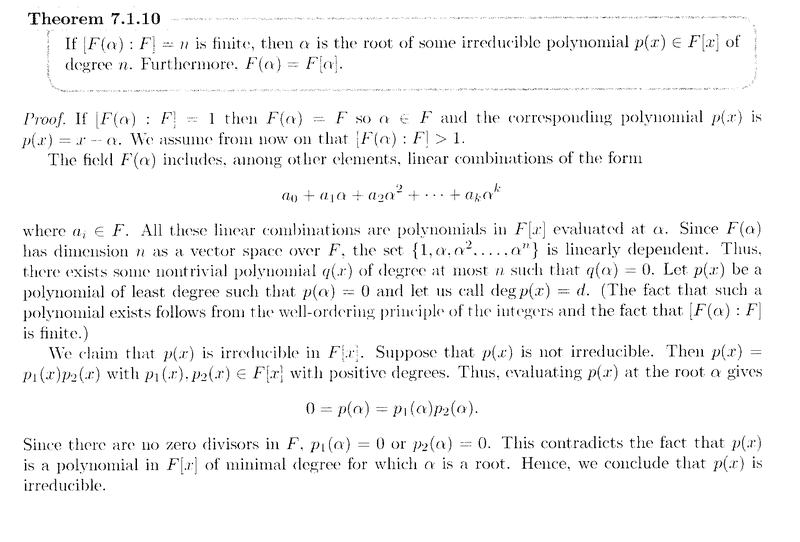
?temp_hash=fafd85d9bfb791bd35a72edac733b362.png

?temp_hash=fafd85d9bfb791bd35a72edac733b362.png


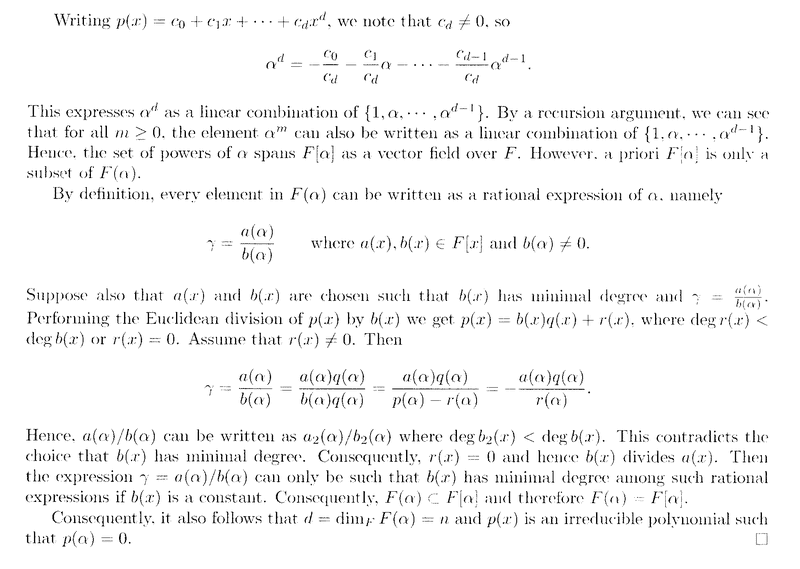
In the proof of the above Theorem, towards the end of the proof, Lovett concerns himself with proving that ##F( \alpha ) \subset F[ \alpha ]## ... ...

To do this he points out that every element in ##F( \alpha )## can be written as a rational expression of ##\alpha##, namely ...

##\gamma = \frac{ a( \alpha )}{ b( \alpha )}##

where ##a( \alpha ), b( \alpha ) \in F[x]## and ##b( \alpha ) \neq 0## ...

Lovett then says ...

" ... ... Suppose also that ##a( \alpha )## and ##b( \alpha )## are chosen such that ##b( \alpha )## has minimal degree and ##\gamma = \frac{ a( \alpha )}{ b( \alpha )}##. ... ... "What does Lovett mean by choosing ##a( \alpha )## and ##b( \alpha )## such that ##b( \alpha )## has minimal degree ... ... ?

It cannot mean choosing special elements for ##b( \alpha )## ... as then ##\gamma## would not be a representative element of ##F( \alpha )## ...

Can someone please clarify this issue ...

Peter

EDIT Does it just mean that when we have ... for example ...##\gamma = \frac{ a( \alpha )}{ b( \alpha )} = \frac{ x^3 - 3x }{ x^4 + 7x }##we just (in this case, for example) we just 'cancel' the ##x## ... and similarly for other examples ...
 

Attachments

  • Lovett - 1 - Theorem 7.1.10 and proof - PART 1 .....png
    Lovett - 1 - Theorem 7.1.10 and proof - PART 1 .....png
    43.9 KB · Views: 574
  • Lovett - 2 - Theorem 7.1.10 and proof - PART 2 .....png
    Lovett - 2 - Theorem 7.1.10 and proof - PART 2 .....png
    43.1 KB · Views: 537
Physics news on Phys.org
Yes.

The representation of a number ##\gamma## as a quotient ##\frac{a(\alpha)}{b(\alpha)}## is usually not unique.
However, the set ##\mathcal{Q}_\gamma = \left\{ \left. \frac{a(x)}{b(x)} \,\right\vert \,a,b \in F[x]\, , \,\gamma = \frac{a(\alpha)}{b(\alpha)} \right\} ## can be partially ordered by the degree of ##b(x)##. Furthermore, ##\deg b(x) \geq 0##, and thus there must be a minimal element in any ordered chain in ##\mathcal{Q}_\gamma##. Such an element is chosen.

This doesn't mean this element is unique, as we still can have common factors of nominator and denominator of degree ##0##, i.e. elements of ##F##, or even different polynomials ##b(x)## and ##b'(x)## in the representation of ##\gamma##. But as the argument only relies on the degree of ##b(x)##, we don't care, whether elements of ##F## have been canceled or not, or which ##b(x)## of minimal degree (i.e. which ordered chain in ##\mathbb{Q}_\gamma##\,) we chose. Even ##\alpha## itself can be in ##F##, in which case nothing would have been to prove, so we can rule out this case, too, if we like.
 
fresh_42 said:
Yes.

The representation of a number ##\gamma## as a quotient ##\frac{a(\alpha)}{b(\alpha)}## is usually not unique.
However, the set ##\mathcal{Q}_\gamma = \left\{ \left. \frac{a(x)}{b(x)} \,\right\vert \,a,b \in F[x]\, , \,\gamma = \frac{a(\alpha)}{b(\alpha)} \right\} ## can be partially ordered by the degree of ##b(x)##. Furthermore, ##\deg b(x) \geq 0##, and thus there must be a minimal element in any ordered chain in ##\mathcal{Q}_\gamma##. Such an element is chosen.

This doesn't mean this element is unique, as we still can have common factors of nominator and denominator of degree ##0##, i.e. elements of ##F##, or even different polynomials ##b(x)## and ##b'(x)## in the representation of ##\gamma##. But as the argument only relies on the degree of ##b(x)##, we don't care, whether elements of ##F## have been canceled or not, or which ##b(x)## of minimal degree (i.e. which ordered chain in ##\mathbb{Q}_\gamma##\,) we chose. Even ##\alpha## itself can be in ##F##, in which case nothing would have been to prove, so we can rule out this case, too, if we like.
Thanks fresh_42 ... most helpful ...

BUT ... just a couple more clarifications pertaining to Lovett's argument that ##b(x)## must be a constant (an argument I am having trouble fully understanding ... )

(QUESTION 1) Lovett brings the minimal polynomial ##p(x)## into the argument ... why is he doing this ... what is his objective in this matter ... ?

Further ... ... Lovett writes ... :

" ... ... Hence ##a( \alpha ) / b( \alpha )## can be written as ##a_2( \alpha ) / b_2( \alpha )## where ##\text{ deg } b_2( x ) \lt \text{ deg } b( x)##. This contradicts the choice that ##b( x)## has minimal degree. Consequently, ##r(x) = 0## and hence ##b(x)## divides ##a(x)##. ... .. "

(QUESTION 2) I cannot see how in this argument Lovett concludes that ##b(x)## divides ##a(x)## ... ... ? Can you help ...?Then Lovett writes:

" ... ... Then the expression ##\gamma = a( \alpha ) / b( \alpha )## can only be such that ##b(x)## has minimal degree among such rational expressions if ##b(x)## is a constant. ... ... "

(QUESTION 3) I do not follow this argument that ##b(x)## must be a constant ... can you help ... ?

Peter
 
Last edited:
Hi Peter,
Math Amateur said:
(QUESTION 1) Lovett brings the minimal polynomial ##p(x)## into the argument ... why is he doing this ... what is his objective in this matter ... ?
About the "why" question: (I'll try not to write "Because it works." and guess a motivation instead. Truth is, finding a proof is usually a process of trial and error. You still can see this in Lovett's style, which mostly is a sequence of many small contradiction arguments. Not very pleasant to read.)

If we gather all we have about ##\gamma ## and ##\alpha ##, then it is ##\gamma = \frac{a(\alpha)}{b(\alpha)}## and ##p(\alpha)=0##, so it makes sense to relate those three polynomials ( ##a,b,p## ), i.e. see what divisions bring. The goal is to show ##b(x)=b_0 \in F## so that all quotients ## \gamma ## are already in ##F[\alpha]##. This means the degree of ##b(x)## has to be ##1## for this purpose. Division is a good method in algebra to reduce degrees or similar valuations or to use it in an induction argument.
Further ... ... Lovett writes ... :

" ... ... Hence ##a( \alpha ) / b( \alpha )## can be written as ##a_2( \alpha ) / b_2( \alpha )## where ##\text{ deg } b_2( x ) \lt \text{ deg } b( x)##. This contradicts the choice that ##b( x)## has minimal degree. Consequently, ##r(x) = 0## and hence ##b(x)## divides ##a(x)##. ... .. "
##a_2(\alpha) = a(\alpha)\cdot q(\alpha)## and ##b_2(\alpha)=-r(\alpha)##. We also have (Euclid's algorithm) ##\deg b_2(x) = \deg r(x) < \deg b(x)##. Minimality of ##\deg b(x)## in the representation of ##\gamma ##, however, implies that ##b_2(x)=r(x)=0##. (We have chosen ##b(x)## this way, see my earlier post.)

Now I'm also lost. I assume it's a typo, since ##r(x)=0## implies ##b(x) \mid p(x)##. Now ##p(x)## is irreducible, and therefore a factor ##b(x) ## of it has to be a unit, i.e. an element of ##F\, : \, b(x)=b_0 \in F##.

(QUESTION 2) I cannot see how in this argument Lovett concludes that ##b(x)## divides ##a(x)## ... ... ? Can you help ...?
Me neither, see above. ##a(x)## should be replaced by ##p(x)## here.
Then Lovett writes:

" ... ... Then the expression ##\gamma = a( \alpha ) / b( \alpha )## can only be such that ##b(x)## has minimal degree ##b(x)## has minimal degree among such rational expressions if ##b(x)## is a constant. ... ... "

(QUESTION 3) I do not follow this argument that ##b(x)## must be a constant ... can you help ... ?
We have written ##\gamma = \frac{a_2(\alpha)}{b_2(\alpha)}## with the settings for ##a_2(x),b_2(x)## I mentioned above. But ##\deg b(x)## was chosen minimal among all possible representations of ##\gamma## in this way.

I hope my answer on your first question covers the other two.

I've forgotten one point. The argument that ##b(x)## has to be a unit uses the fact, that otherwise ##q(x)=q_0## would be the unit (by irreducibility of ##p(x)##). But then ##0=p(\alpha)=b(\alpha)\cdot q(\alpha) = b(\alpha) \cdot q_0## and ##b(\alpha)=0## which can't be by the choice of ##b(\alpha)## as the denominator of ##\gamma##. Thus ##b(x)## has to be the unit.
 
Last edited:
  • Like
Likes Math Amateur
fresh_42 said:
Hi Peter,

About the "why" question: (I'll try not to write "Because it works." and guess a motivation instead. Truth is, finding a proof is usually a process of trial and error. You still can see this in Lovett's style, which mostly is a sequence of many small contradiction arguments. Not very pleasant to read.)

If we gather all we have about ##\gamma ## and ##\alpha ##, then it is ##\gamma = \frac{a(\alpha)}{b(\alpha)}## and ##p(\alpha)=0##, so it makes sense to relate those three polynomials ( ##a,b,p## ), i.e. see what divisions bring. The goal is to show ##b(x)=b_0 \in F## so that all quotients ## \gamma ## are already in ##F[\alpha]##. This means the degree of ##b(x)## has to be ##1## for this purpose. Division is a good method in algebra to reduce degrees or similar valuations or to use it in an induction argument.

##a_2(\alpha) = a(\alpha)\cdot q(\alpha)## and ##b_2(\alpha)=-r(\alpha)##. We also have (Euclid's algorithm) ##\deg b_2(x) = \deg r(x) < \deg b(x)##. Minimality of ##\deg b(x)## in the representation of ##\gamma ##, however, implies that ##b_2(x)=r(x)=0##. (We have chosen ##b(x)## this way, see my earlier post.)

Now I'm also lost. I assume it's a typo, since ##r(x)=0## implies ##b(x) \mid p(x)##. Now ##p(x)## is irreducible, and therefore a factor ##b(x) ## of it has to be a unit, i.e. an element of ##F\, : \, b(x)=b_0 \in F##.Me neither, see above. ##a(x)## should be replaced by ##p(x)## here.

We have written ##\gamma = \frac{a_2(\alpha)}{b_2(\alpha)}## with the settings for ##a_2(x),b_2(x)## I mentioned above. But ##\deg b(x)## was chosen minimal among all possible representations of ##\gamma## in this way.

I hope my answer on your first question covers the other two.

I've forgotten one point. The argument that ##b(x)## has to be a unit uses the fact, that otherwise ##q(x)=q_0## would be the unit (by irreducibility of ##p(x)##). But then ##0=p(\alpha)=b(\alpha)\cdot q(\alpha) = b(\alpha) \cdot q_0## and ##b(\alpha)=0## which can't be by the choice of ##b(\alpha)## as the denominator of ##\gamma##. Thus ##b(x)## has to be the unit.
Thanks fresh_42 ... just reflecting on your post ...

But one quick clarification ...

You write:

" ... ... The goal is to show ##b(x)=b_0 \in F## so that all quotients ## \gamma ## are already in ##F[\alpha]##. This means the degree of ##b(x)## has to be ##1## for this purpose. ... ... "Can you explain your reasoning that the degree of ##b(x)## has to be ##1## ... ...

If ##b(x)=b_0 \in F## then doesn't the degree of ##b(x)## have to be ##0## ... ... ?Hope you can clarify ... ... must be misunderstanding you somehow ...

Peter
 
Yep, it's late up here ... Of course ##0##, sorry.
 
  • Like
Likes Math Amateur
fresh_42 said:
Yep, it's late up here ... Of course ##0##, sorry.
No problems ... your posts have been extremely helpful!

Thanks again ... from the edge of the world in southern Tasmania ... early afternoon here ...

Peter
 
  • Like
Likes fresh_42

Similar threads

  • · Replies 6 ·
Replies
6
Views
2K
  • · Replies 2 ·
Replies
2
Views
2K
  • · Replies 1 ·
Replies
1
Views
2K
  • · Replies 4 ·
Replies
4
Views
2K
  • · Replies 12 ·
Replies
12
Views
3K
  • · Replies 2 ·
Replies
2
Views
2K
  • · Replies 18 ·
Replies
18
Views
3K
Replies
2
Views
2K
  • · Replies 5 ·
Replies
5
Views
2K
  • · Replies 4 ·
Replies
4
Views
2K