Final Angular Momentum of a Space Station

Click For Summary
SUMMARY

The discussion centers on calculating the final angular momentum of a space station using the equations Li = Lrf + Ltf and Iωo = Iωf + mvRsinθ. Participants identified a potential error in the calculation due to the angle input in degrees instead of radians, leading to discrepancies in the final angular velocity, with values of 3.94 rad/s and 3.99 rad/s being discussed. The conversation highlights the importance of considering initial angular momentum and the frame of reference for the ejected package's speed.

PREREQUISITES
  • Understanding of angular momentum equations, specifically Li = Lrf + Ltf.
  • Familiarity with rotational dynamics, including Iωo = Iωf + mvRsinθ.
  • Knowledge of trigonometric functions and their input modes (degrees vs. radians).
  • Basic physics concepts related to rotational motion and frame of reference.
NEXT STEPS
  • Research the implications of initial angular momentum in rotational dynamics.
  • Learn about the differences between using degrees and radians in trigonometric calculations.
  • Explore the effects of frame of reference on angular momentum calculations.
  • Study advanced rotational dynamics problems involving multiple bodies and forces.
USEFUL FOR

Physics students, educators, and professionals involved in mechanics, particularly those focusing on rotational dynamics and angular momentum calculations.

marjine
Messages
10
Reaction score
1
Homework Statement
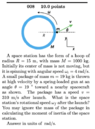
A space station has the form of a hoop of
radius R = 15 m, with mass M = 1000 kg.
Initially its center of mass is not moving, but
it is spinning with angular speed ωi = 4 rad/s.
A small package of mass m = 19 kg is thrown
at high velocity by a spring-loaded gun at an
angle θ = 19 ◦
toward a nearby spacecraft
as shown. The package has a speed v =
310 m/s after launch. What is the space
station’s rotational speed ωf after the launch?
You may ignore the mass of the package in
calculating the moment of inertia of the space
station.
Answer in units of rad/s.
Relevant Equations
Conservation of angular momentum: Lf=Li
Rotational angular momentum: Iω
Translational angular momentum: mvrsinθ
Li = Lrf +Ltf
Iωo = Iωf + mvRsinθ
I = MR^2
(MR^2)ωo = (MR^2)ωf + mvRsinθ
ωf = (MR^2ωo -mvRsinθ)/MR^2 = 3.99
 
Physics news on Phys.org
Is there a diagram that goes with this problem? What is the angle of the the package measured with respect to?
 
gneill said:
Is there a diagram that goes with this problem? What is the angle of the the package measured with respect to?

I can't figure out how to upload the diagram so I'll do my best to explain it: the hoop is drawn with a horizontal line through the center, theta is the angle of the velocity vector above that dotted line. Hope that helps, sorry.
 

Attachments

  • Screen Shot 2023-04-20 at 2.57.53 PM.png
    Screen Shot 2023-04-20 at 2.57.53 PM.png
    33.6 KB · Views: 118
marjine said:
I can't figure out how to upload the diagram so I'll do my best to explain it: the hoop is drawn with a horizontal line through the center, theta is the angle of the velocity vector above that dotted line. Hope that helps, sorry.
Click "Attach files", lower left at the same height as "Post reply" and follow instructions. It's easy and leaves nothing to our imagination.
 
marjine said:
ωf = (MR^2ωo -mvRsinθ)/MR^2 = 3.99
I agree with your algebra but get a different numerical answer.
 
haruspex said:
I agree with your algebra but get a different numerical answer.
I think it's because OP entered "19" in the argument of a sine algorithm that expected radians. I got 3.94 rad/s under that assumed mistake.

To @marjine: Make sure your calculator is set to "degrees" and redo the calculation.
 
kuruman said:
I think it's because OP entered "19" in the argument of a sine algorithm that expected radians. I got 3.94 rad/s under that assumed mistake.
Good thought, but the difference from initial angular velocity is 0.01rad/s according to @marjine and 0.06 according to that presumed error (which I confirm).
 
haruspex said:
Good thought, but the difference from initial angular velocity is 0.01rad/s according to @marjine and 0.06 according to that presumed error (which I confirm).
It is interesting to note that if the (more correct) form for the initial angular momentum ##L_0= (M+m)R^2\omega_0## is considered despite the problem statement's suggestion not to, the final answer (with the correct sine) is 3.94 rad/s. The discrepancy introduced by ignoring the initial angular momentum of the package is significant in this case.

An additional assumption is that the speed of the ejected package is relative to the center of the hoop, not relative to the point of launch. The problem is unclear on that.

Finally, this problem crosses over to the twilight zone and enters the realm of incredulity. A solid iron hoop of radius 15 m and mass 1000 kg will have a radius of 2 cm. Some space station ##\dots##
 
kuruman said:
An additional assumption is that the speed of the ejected package is relative to the center of the hoop, not relative to the point of launch.
I guess you mean a non-rotating frame at the hoop's centre.
Isn't that largely equivalent to the choice of including the package's mass in the initial angular momentum? If we include it, the thrower does not need to supply the tangential momentum, so taking the velocity as relative to the ejection point is equivalent to excluding it and taking the velocity in the inertial frame.
Then again, we could take either of the other two combinations.
kuruman said:
A solid iron hoop of radius 15 m and mass 1000 kg will have a radius of 2 cm.
The space station was constructed by an advanced civilisation of ants.
 
  • #10
kuruman said:
I think it's because OP entered "19" in the argument of a sine algorithm that expected radians. I got 3.94 rad/s under that assumed mistake.

To @marjine: Make sure your calculator is set to "degrees" and redo the calculation.
The calculator mode is always the first thing I check when I get a physics problem wrong hahaha. 3.94 rad/s is not the correct answer, unfortunately.
 
  • #11
marjine said:
The calculator mode is always the first thing I check when I get a physics problem wrong hahaha. 3.94 rad/s is not the correct answer, unfortunately.
I didn't say or imply that 3.94 rad/s is the correct answer. It is the answer one gets if one uses the wrong argument for the sine.

I suggest that you read post #5 by @haruspex and redo the calculation to see if you still get 3.99 rad/s.
 

Similar threads

Replies
335
Views
16K
Replies
3
Views
2K
Replies
5
Views
3K
  • · Replies 11 ·
Replies
11
Views
3K
  • · Replies 8 ·
Replies
8
Views
2K
  • · Replies 8 ·
Replies
8
Views
2K
Replies
5
Views
1K
  • · Replies 4 ·
Replies
4
Views
2K
  • · Replies 62 ·
3
Replies
62
Views
13K
  • · Replies 7 ·
Replies
7
Views
3K