Find an expression for a sequence involving the sum of nth powers

Click For Summary
The discussion centers on finding an expression for a sequence involving the sum of nth powers. The initial solution presented was deemed incorrect due to failure to satisfy the initial conditions. Participants suggested the need for a general solution with three unknowns, which could be computed from the initial conditions. A simpler approach using new variables was proposed, but one participant emphasized the importance of using diagonalization techniques learned in their linear algebra course. Ultimately, the original poster corrected their mistake in matrix multiplication and confirmed their approach was valid.
rugerts
Messages
153
Reaction score
11
Homework Statement
a_n = 2*a_n-1 + a_n-2 -2*a_n-3.
a_0 = 5
a_1 = 18
a_2 = 14
Relevant Equations
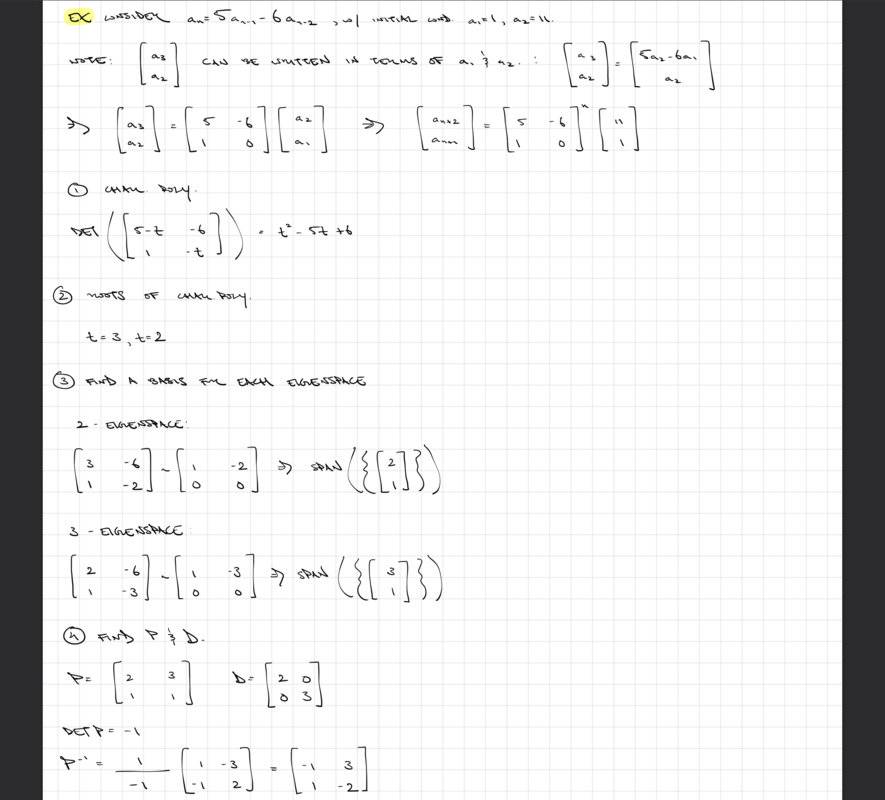
No real equations. Shown below is a similar example done in class that I'm trying to base my solution around.
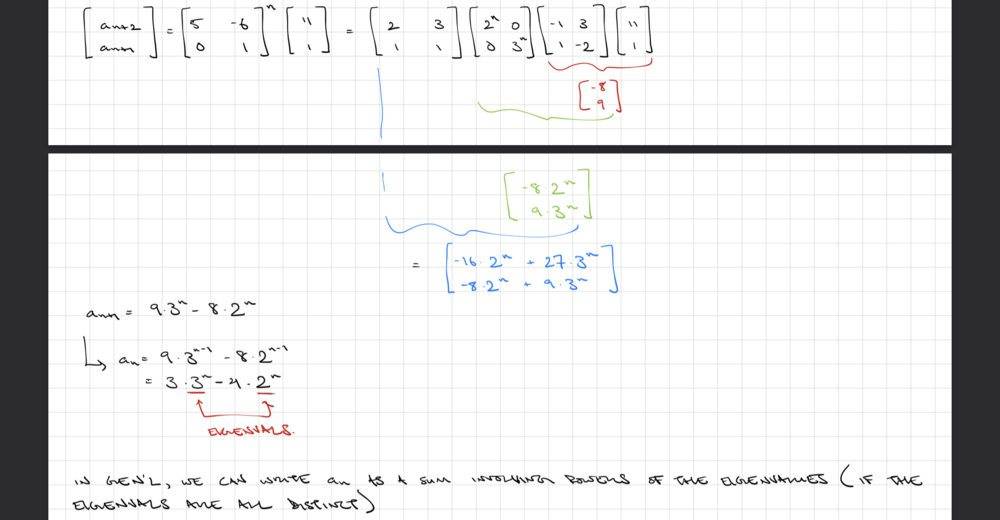
Example done in class:
IMG-0203.jpg
IMG-0204.jpg
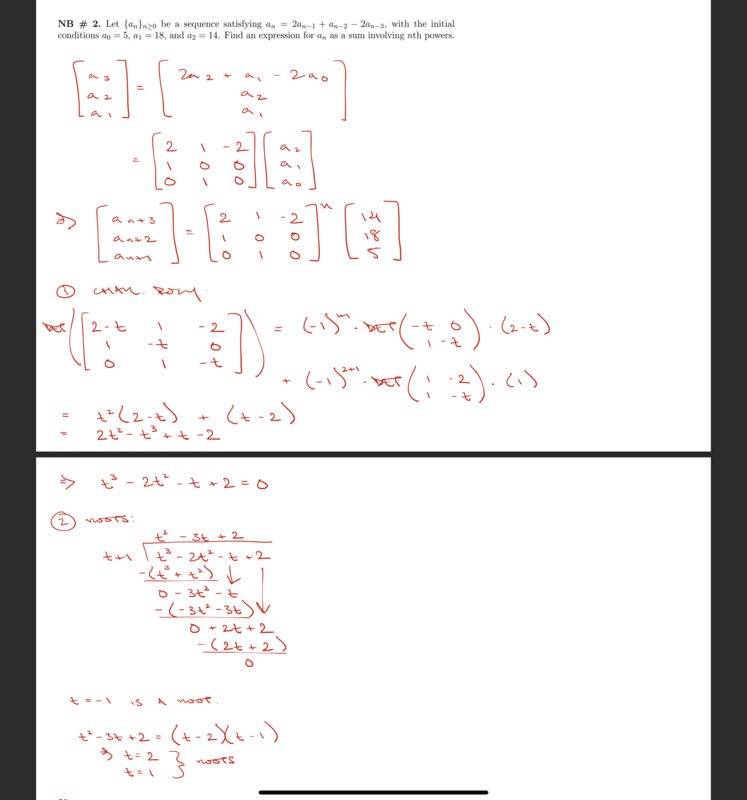
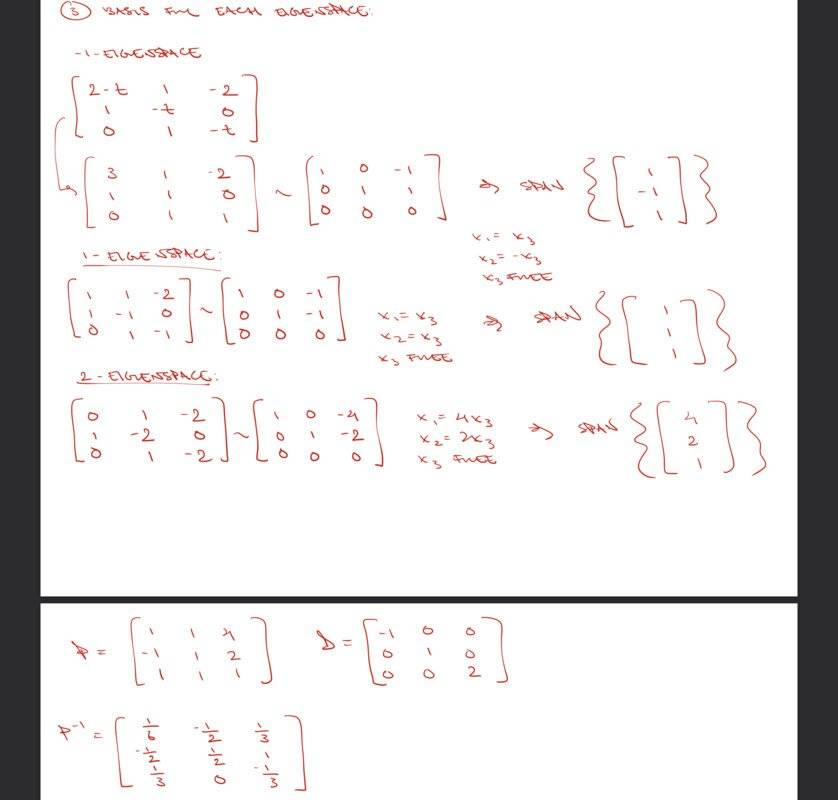
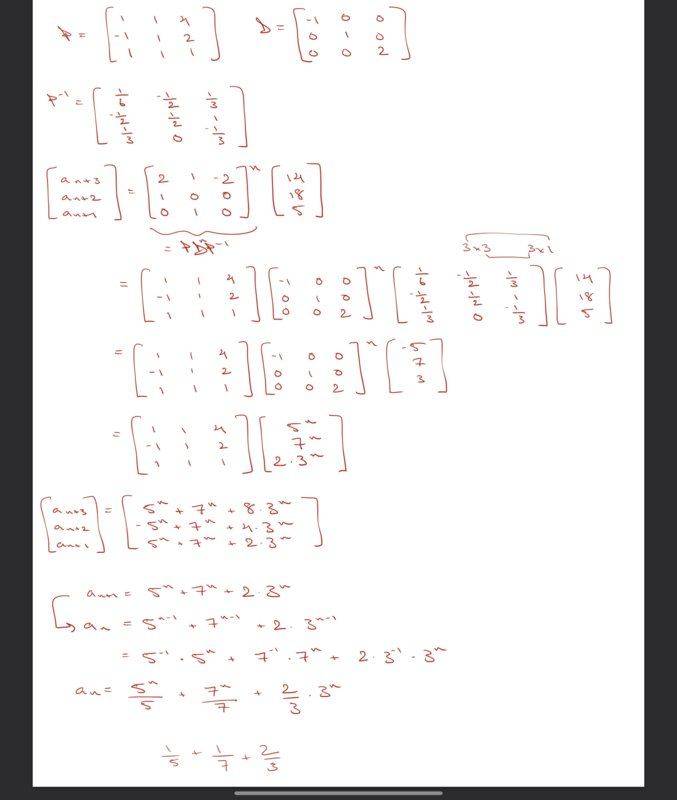
The problem and my solution:
IMG-0199.jpg

IMG-0201.jpg

IMG-0202.jpg


My solution seems incorrect because if I try to plug in 0, I don't get the initial condition given in the problem.

Does anyone see what I've done wrong along the way?

Thanks.
 

Attachments

  • IMG-0201.jpg
    IMG-0201.jpg
    36.9 KB · Views: 255
  • IMG-0202.jpg
    IMG-0202.jpg
    33.7 KB · Views: 227
Physics news on Phys.org
The equations would be much easier to read when typed here, with explanations what you do why.
$$a_n = \frac{5^n}{5} + \frac{7^n}{7} + \frac 2 3 3^n$$
You shouldn't get three different equations for an+1, an+2 and an+3.

Where do you plug in your initial conditions? You should have a general solution with three unknowns (which looks very different from what you got), these unknowns can be computed based on the initial conditions.
 
mfb said:
The equations would be much easier to read when typed here, with explanations what you do why.
$$a_n = \frac{5^n}{5} + \frac{7^n}{7} + \frac 2 3 3^n$$
You shouldn't get three different equations for an+1, an+2 and an+3.

Where do you plug in your initial conditions? You should have a general solution with three unknowns (which looks very different from what you got), these unknowns can be computed based on the initial conditions.
Did you look through the first example I was shown in lecture? That general solution only has powers of n in it, which I think is the goal. Maybe I'm misunderstanding you.
 
Not been through all your calculation, but I think you can do a quite simpler calculation in this case if you define a new variable, either
bn = an - 2an-1
or probably better
cn = an - an-2.

You then get a very simple series for the new variable, which you can convert into one, well maybe you should call it two, for the an .
 
epenguin said:
Not been through all your calculation, but I think you can do a quite simpler calculation in this case if you define a new variable, either
bn = an - 2an-1
or probably better
cn = an - an-2.

You then get a very simple series for the new variable, which you can convert into one, well maybe you should call it two, for the an .
Interesting. I hate to turn down simpler solutions but I think, since this is a course in linear algebra and we've just covered diagonalization, that we're expected to solve this using that technique.
 
rugerts said:
Did you look through the first example I was shown in lecture? That general solution only has powers of n in it, which I think is the goal. Maybe I'm misunderstanding you.
If you consider powers of 0 and -1 it will work...
 
So I actually had a mistake in matrix multiplication. I've got the correct solution now. My approach was fine. Thanks all.
 
  • Like
Likes WWGD

Similar threads

  • · Replies 7 ·
Replies
7
Views
2K
Replies
3
Views
2K
  • · Replies 22 ·
Replies
22
Views
895
  • · Replies 38 ·
2
Replies
38
Views
3K
  • · Replies 3 ·
Replies
3
Views
2K
  • · Replies 2 ·
Replies
2
Views
2K
Replies
2
Views
5K
  • · Replies 3 ·
Replies
3
Views
1K
  • · Replies 4 ·
Replies
4
Views
3K
  • · Replies 2 ·
Replies
2
Views
1K