Find an Expression For the Voltage

Join the discussion
Registration is free. Ask a follow-up in this thread, or start your own.
3 replies · 2K views
mmmboh
Messages
401
Reaction score
0
Hey, so I have an assignment and this is one of the questions on it, I did it but I am not sure if what I did is right.
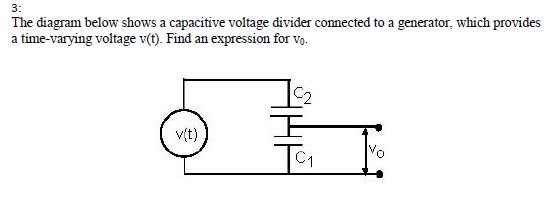
2chpe38.jpg


What I did was find Ceq=(C1C2)/(C1+C2))

So then Q=CV(t)=(C1C2)/(C1+C2))V(t)

Then I found the voltage across C2=Q/C2=(C1C2)/(C1+C2))V(t)/C2=(C1)/(C1+C2))V(t)

And then V0=V(t)-(C1)/(C1+C2))V(t)

Can anyone tell me if what I did is right or if I am completely off?
 
Physics news on Phys.org
mmmboh said:
Hey, so I have an assignment and this is one of the questions on it, I did it but I am not sure if what I did is right.
2chpe38.jpg


What I did was find Ceq=(C1C2)/(C1+C2))

So then Q=CV(t)=(C1C2)/(C1+C2))V(t)
For starters, shouldn't it be Q = CVT = (C1C2VT)/(C1+C2)?
 
mmmboh said:
Hey, so I have an assignment and this is one of the questions on it, I did it but I am not sure if what I did is right.
2chpe38.jpg


What I did was find Ceq=(C1C2)/(C1+C2))

So then Q=CV(t)=(C1C2)/(C1+C2))V(t)

Then I found the voltage across C2=Q/C2=(C1C2)/(C1+C2))V(t)/C2=(C1)/(C1+C2))V(t)

And then V0=V(t)-(C1)/(C1+C2))V(t)

Can anyone tell me if what I did is right or if I am completely off?
You could have just found the voltage across [tex]c_1[/tex] like you did for [tex]c_2[/tex] and stopped there.: [tex]\frac{q}{c_1}=v_o=v(t) \frac{c_2}{c_1+c_2}[/tex]
Your expression you found simplifies to that anyway:
[tex]v_o=v(t)[1 - \frac{c_1}{c_1+c_2}][/tex]
[tex]v(t)[\frac{c_1+c_2}{c_1+c_2} - \frac{c_1}{c_1+c_2}]= v(t) \frac{c_1+c_2 - c_1}{c_1+c_2}=v(t) \frac{c_2}{c_1+c_2}[/tex]
I don't know if you know about complex impedance yet but you can also use that to arrive to the same answer:
[tex]Z_T = Z_C_1 + Z_C_2[/tex]
[tex]Z_T = \frac{1}{\omega c_1}+\frac{1}{\omega c_2}[/tex]
These impedances work like resistance with v = IR. Therefore,voltage division works too.
[tex]v_o = v(t) \frac{ Z_C_1}{Z_T}[/tex]
[tex]v_o = v(t) \frac{ \frac{1}{\omega c_1}}{\frac{1}{\omega c_1}+\frac{1}{\omega c_2}}[/tex]
Omegas cancel and you come to the same answer.
 
Last edited:
Leptos said:
For starters, shouldn't it be Q = CVT = (C1C2VT)/(C1+C2)?
Just for the record: no, Q=CV for a capacitor, as the OP said.