Find Eigenvalues & Eigenvectors for Exercise 3 (2), Explained!

Click For Summary

Homework Help Overview

The discussion revolves around finding eigenvalues and eigenvectors for a specific exercise in linear algebra. Participants express confusion regarding the transition between two matrices during the solution process and seek clarification on the operations involved.

Discussion Character

  • Exploratory, Assumption checking, Mathematical reasoning

Approaches and Questions Raised

  • Participants discuss the requirement for vectors satisfying the equation ##Ax=\lambda x## and the condition that the determinant of ##A-\lambda I## must be zero. There are inquiries about the specific operations used to manipulate matrices, including row operations and their implications.

Discussion Status

Several participants have provided insights into the steps taken to derive the eigenvalues and the corresponding eigenvectors. There is ongoing exploration of the row operations needed to transition between matrices, with some participants questioning the validity of certain operations based on specific conditions.

Contextual Notes

There is a note regarding the condition that dividing a row by ##2 + 2a## is only valid if ##a \neq -1##, indicating a potential constraint that requires separate consideration.

member 731016
Homework Statement
Please see below
Relevant Equations
Please see below
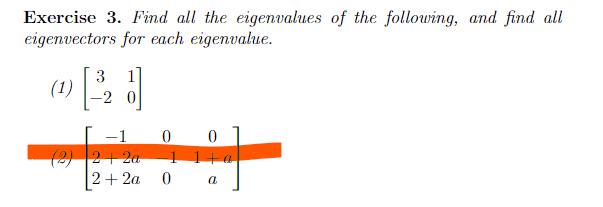
For exercise 3 (2),
1686025959535.png
,
The solution for finding the eigenvector is,
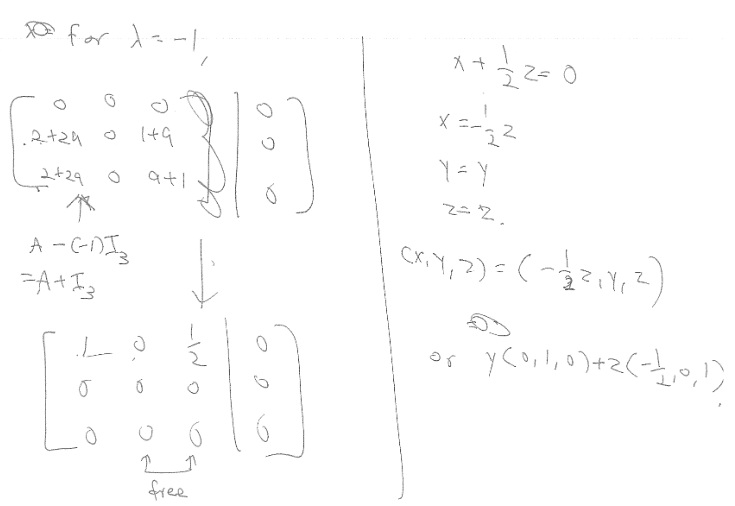
1686025997702.png

However, I am very confused how they got from the first matrix on the left to the one below and what allows them to do that. Can someone please explain in simple terms what happened here?

Many Thanks!
 
Physics news on Phys.org
You are looking for vectors for which ##Ax=\lambda x##. This is solvable if the determinant of ##A-\lambda I## is zero. Should give you three possible values for ##\lambda## , (different or two or three equal). You then solve ##(A-\lambda I)\vec x=\vec 0## with simple operations like subtracting one row from another.

##\ ##
 
  • Like
Likes   Reactions: member 731016
ChiralSuperfields said:
Homework Statement: Please see below
Relevant Equations: Please see below

For exercise 3 (2),
View attachment 327486,
The solution for finding the eigenvector is,
View attachment 327487
However, I am very confused how they got from the first matrix on the left to the one below and what allows them to do that. Can someone please explain in simple terms what happened here?

Many Thanks!
When you apply the concept as required; you shall end up with the equation,

##(-1-λ)(λ^2-aλ+λ-a)=0##.

you picked your ##λ=-1## and if you substitute the eigen value back into the matrix, you can confirm that it satisfies the equation.

...

from there, we now have to now deal with the equation, ##(2+2a)x+(1+a)z=0##


Last edited:
  • Like
Likes   Reactions: SammyS and member 731016
BvU said:
You are looking for vectors for which ##Ax=\lambda x##. This is solvable if the determinant of ##A-\lambda I## is zero. Should give you three possible values for ##\lambda## , (different or two or three equal). You then solve ##(A-\lambda I)\vec x=\vec 0## with simple operations like subtracting one row from another.

##\ ##
Thank you for your reply @BvU!

Sorry what operations were used to get from,
1686041103340.png

Orange matrix to pink matrix?

Many thanks!
 
chwala said:
When you apply the concept as required; you shall end up with the equation,

##(-1-λ)(λ^2-aλ+λ-a)=0##.

you picked your ##λ=-1## and if you substitute the eigen value back into the matrix, you shall end up with,

still posting
Thank you for your reply @chwala!
 
ChiralSuperfields said:
Thank you for your reply @BvU!

Sorry what operations were used to get from,
View attachment 327490
Orange matrix to pink matrix?

Many thanks!
...switching of rows combined with understanding of row reduced echelon form...
 
  • Like
Likes   Reactions: member 731016
ChiralSuperfields said:
what operations were used to get from orange matrix to pink matrix?
Subtract row 2 from row 3 (gives ##0,0,0##)
Divide row 2 by ##2+2a## (gives ##1,0,{1\over 2}##)
Swap row 1 and 2

:smile:

##\ ##
 
  • Like
Likes   Reactions: member 731016 and chwala
BvU said:
Subtract row 2 from row 3 (gives ##0,0,0##)
Divide row 2 by ##2+2a## (gives ##1,0,{1\over 2}##)
Swap row 1 and 2

:smile:

##\ ##

Note that dividing a row by 2 + 2a is only valid if a \neq -1. This case will require separate treatment.
 
  • Like
Likes   Reactions: chwala and member 731016

Similar threads

Replies
5
Views
2K
  • · Replies 10 ·
Replies
10
Views
2K
  • · Replies 2 ·
Replies
2
Views
2K
  • · Replies 3 ·
Replies
3
Views
2K
  • · Replies 6 ·
Replies
6
Views
2K
  • · Replies 1 ·
Replies
1
Views
4K
  • · Replies 19 ·
Replies
19
Views
4K
  • · Replies 4 ·
Replies
4
Views
1K
  • · Replies 2 ·
Replies
2
Views
2K
Replies
8
Views
3K