Setting Free variables when finding eigenvectors

Click For Summary
SUMMARY

The discussion centers on the selection of free variables when calculating eigenvectors after determining eigenvalues. Participants highlight that both variables, 'a' and 'b', can be chosen as free variables, leading to eigenvectors that differ only by a scalar multiple. It is established that if ##\vec u## is an eigenvector for a given eigenvalue, then any scalar multiple, including ##-\vec u##, is also an eigenvector corresponding to the same eigenvalue. Normalization of eigenvectors is recommended to ensure they have a length of one.

PREREQUISITES
  • Understanding of eigenvalues and eigenvectors in linear algebra
  • Familiarity with scalar multiplication of vectors
  • Knowledge of vector normalization techniques
  • Basic proficiency in solving linear equations
NEXT STEPS
  • Study the properties of eigenvectors and eigenvalues in linear transformations
  • Learn about the process of normalizing vectors in linear algebra
  • Explore the implications of choosing different free variables in eigenvector calculations
  • Investigate the geometric interpretation of eigenvectors in multidimensional spaces
USEFUL FOR

Students and professionals in mathematics, particularly those studying linear algebra, as well as anyone involved in fields requiring eigenvalue analysis, such as physics and engineering.

Sunwoo Bae
Messages
60
Reaction score
4
Homework Statement
Confusion in finding eigenvector? (example shown below)
Relevant Equations
matrix multiplication
upon finding the eigenvalues and setting up the equations for eigenvectors, I set up the following equations.

So I took b as a free variable to solve the equation int he following way.
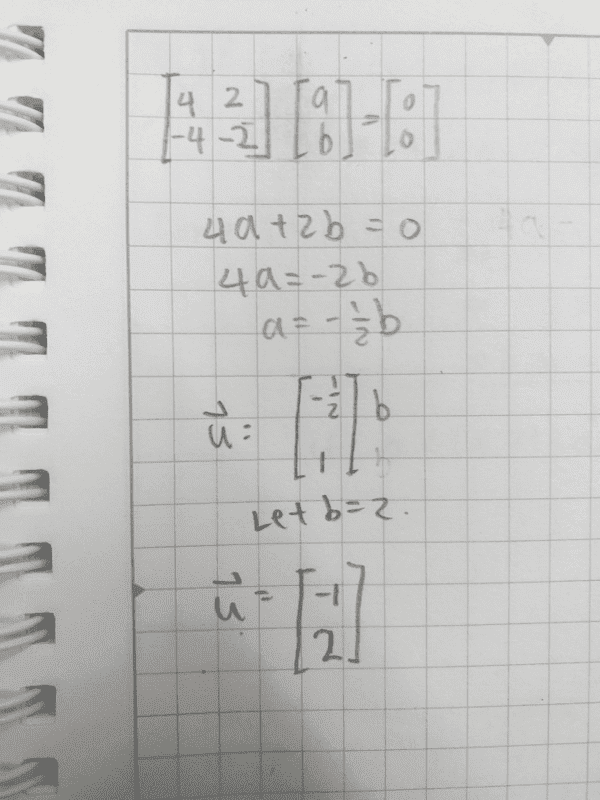
1597304906485.png


But I also realized that it would be possible to take a as a free variable, so I tried taking a as a free variable too.
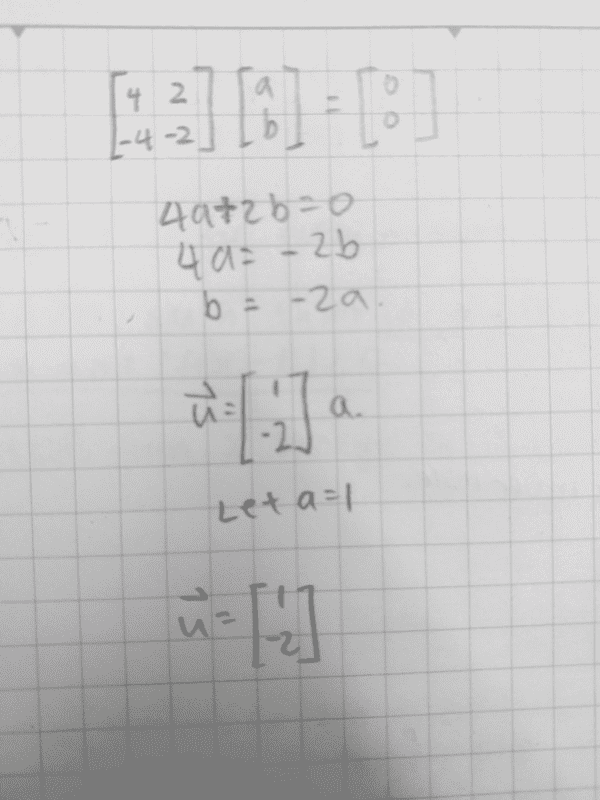
1597305037416.png


But now I am confused because this results in vectors that is different in sign. Can anyone explain whether I should use a or b as a free variable?
 
Physics news on Phys.org
If ##\vec u## is an eigenvector (corresponding to a certain eigenvalue), then ##-\vec u## is also an eigenvector (corresponding to the same eigenvalue). Both your answers are correct.

In general, ##c \vec u## is also an eigenvector for any number ##c \ne 0##. Often you choose ##c## such that the eigenvector is normalised - i.e. has length ##1##,
 
  • Like
Likes   Reactions: etotheipi and DrClaude

Similar threads

Replies
5
Views
2K
  • · Replies 7 ·
Replies
7
Views
2K
Replies
8
Views
2K
  • · Replies 3 ·
Replies
3
Views
2K
  • · Replies 6 ·
Replies
6
Views
2K
  • · Replies 19 ·
Replies
19
Views
4K
  • · Replies 2 ·
Replies
2
Views
2K
Replies
4
Views
2K
  • · Replies 5 ·
Replies
5
Views
15K
  • · Replies 5 ·
Replies
5
Views
2K