Peter_Newman
- 155
- 11
Hey everybody, 
I have a joint density of the random variables ##X## and ##Y## given and want to find out ##P(X+Y>1/2)##.
The joint density is as follows:
$$f_{XY}(x,y) = \begin{cases}\frac{1}{y}, &0<x<y,0<y<1 \\ 0, &else \end{cases}$$
To get a view of this I created a plot:
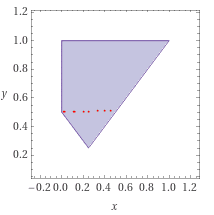
As usual I would split the area up into two sub areas (see red dots) and doube integrate this. In this case for instance my calculation is the following:
$$P(X+Y>1/2) = P(Y>1/2 - X) = \int_{y=0.5}^{1} \int_{x=0}^{y} \frac{1}{y} \, dx dy + \int_{0.25}^{0.5} \int_{x=0.5-y}^{y} \frac{1}{y} \, dx dy \approx 0.5 + 0.1534 \approx 0.6534$$
The solution should be ##P(X+Y>1/2) = \frac{\ln(2)}{2}##, which I can not explain, that why I'am asking here. I think in my integral there could be a mistake, but I don't see the error...
I would be very happy for answers to this! Thank you!
I have a joint density of the random variables ##X## and ##Y## given and want to find out ##P(X+Y>1/2)##.
The joint density is as follows:
$$f_{XY}(x,y) = \begin{cases}\frac{1}{y}, &0<x<y,0<y<1 \\ 0, &else \end{cases}$$
To get a view of this I created a plot:
As usual I would split the area up into two sub areas (see red dots) and doube integrate this. In this case for instance my calculation is the following:
$$P(X+Y>1/2) = P(Y>1/2 - X) = \int_{y=0.5}^{1} \int_{x=0}^{y} \frac{1}{y} \, dx dy + \int_{0.25}^{0.5} \int_{x=0.5-y}^{y} \frac{1}{y} \, dx dy \approx 0.5 + 0.1534 \approx 0.6534$$
The solution should be ##P(X+Y>1/2) = \frac{\ln(2)}{2}##, which I can not explain, that why I'am asking here. I think in my integral there could be a mistake, but I don't see the error...
I would be very happy for answers to this! Thank you!