Find Serret-Frenet Triad for Curve y = f(x): Solve Diff. Eq. -U`(s)

  • Thread starter Thread starter hilton
  • Start date Start date
  • Tags Tags
    Bead Wire
Click For Summary
SUMMARY

The discussion focuses on deriving the Serret-Frenet Triad for the curve defined by the function y = f(x) using the specific case of U = x²/2. Participants detail the steps to find the Triad, describe the resultant vector force acting on a bead, and address the differential equation x'' = -U'(x). The conclusion indicates that the expected solution is a cycloid, suggesting a potential error in the problem setup or calculations.

PREREQUISITES
  • Understanding of differential equations, specifically second-order equations.
  • Familiarity with the Serret-Frenet formulas for curves in a plane.
  • Knowledge of vector calculus and forces in physics.
  • Basic understanding of potential energy functions and their derivatives.
NEXT STEPS
  • Study the Serret-Frenet formulas in detail to apply them to various curves.
  • Learn how to solve second-order differential equations, particularly in the context of physics.
  • Investigate the properties of cycloids and their applications in mechanics.
  • Explore the implications of potential energy functions in classical mechanics.
USEFUL FOR

This discussion is beneficial for students and professionals in mathematics, physics, and engineering, particularly those interested in mechanics and the analysis of curves in motion.

hilton
Messages
2
Reaction score
0
Homework Statement
Consider the motion of a particle in a potential: x`` = −U`(x). Can this equation also describe the arclength parameter of a bead sliding under gravity on an appropriately shaped wire? That is, find the curve y = V (x) such that the arc length parameter s of a bead sliding on this curve under
gravity (g = const. pointing down the y-axis) satisfies the same equation: s`` = −U`(s), and state under what conditions on U this is possible. Find V in the following two cases: (i) U = x^2/2 and (ii) U = −cos x.
Relevant Equations
Serret-Frenet Triad, F=ma
For the case first case U=x^2/2 :
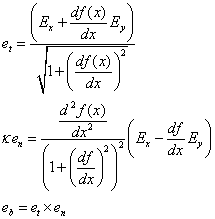
1) Find the Serret-Frenet Triad for a any curve y = f(x):
For a curve on a plane, the Triad could be find in this way:
243069


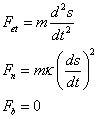
2) The vector force resultant acting in the bead could be discribed in this way:
243067

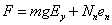
3) The vector force acting in the bead could be discribed in this way:
243070

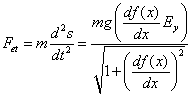
4) Multypling (3) with (1) and equalizing to (2):
243073

5) From the question, we know that (4) is equal to -U`(s), so solving the differential equation, we have:
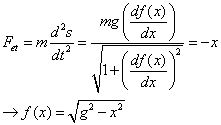
243075

6) But the answer is a cycloid , so there is somethig wrong.
 
Physics news on Phys.org
hilton said:
Problem Statement: Consider the motion of a particle in a potential: x`` = −U`(x). Can this equation also
What do the grave accents (` ) mean in this x`` , `( notation?
 
The derivative
 

Similar threads

  • · Replies 6 ·
Replies
6
Views
2K
  • · Replies 8 ·
Replies
8
Views
926
Replies
3
Views
16K
  • · Replies 2 ·
Replies
2
Views
3K
  • · Replies 1 ·
Replies
1
Views
1K
  • · Replies 17 ·
Replies
17
Views
3K
  • · Replies 5 ·
Replies
5
Views
3K
  • · Replies 4 ·
Replies
4
Views
4K
  • · Replies 6 ·
Replies
6
Views
3K
Replies
4
Views
5K