Find the acceleration of the system (2 blocks sliding on a table)

Click For Summary
SUMMARY

The discussion focuses on calculating the acceleration of a system involving two blocks: a 7 kg block and a 5 kg block, with a force of 50 N applied in Case 1 and a hanging mass in Case 2. Both cases yield an acceleration of 3 m/s², calculated using Newton's second law (F = ma) and accounting for friction. The participants debate the discrepancy between their calculations and textbook answers, questioning whether Case 1 assumes a frictionless surface. The coefficient of friction is specified as 0.2.

PREREQUISITES
  • Understanding of Newton's second law of motion (F = ma)
  • Knowledge of friction and its coefficient (0.2 in this case)
  • Basic principles of forces acting on a system of masses
  • Familiarity with free body diagrams (FBD) for visualizing forces
NEXT STEPS
  • Learn how to derive equations of motion for multiple masses in a system
  • Study the effects of friction on acceleration in mechanical systems
  • Explore the use of LaTeX for formatting equations in discussions
  • Investigate the implications of frictionless surfaces in physics problems
USEFUL FOR

Students studying physics, educators teaching mechanics, and anyone interested in understanding the dynamics of systems involving multiple masses and forces.

paulimerci
Messages
287
Reaction score
47
Homework Statement
A 7kg block rests initially on a table in case 1 and case 2 above. The coefficient of friction between the block and the table is 0.2. The block is attached by a cord of negligible mass which hangs over a frictionless pulley. In case 1 a force of 50N is exerted on the pulley and in case 2, a 5kg mass is hung. Calculate the acceleration of the system in case 1 and in case 2.
Relevant Equations
F = ma
In both the cases 7 kg mass accelerates towards the right because of the 50N force. The unbalanced forces in both the cases are the force of gravity due to 5kg block and force of friction. Applying Newton's second law of motion to cases 1 and 2 yields the following results for acceleration:
Where m1=5kg, m2 = 7kg, g=10m/s2
Case 1,
a = Net force/ total mass

a = m1g - friction force/(m1+m2)
= m1g - friction force/ (m1+m2)
= 50 - (0.2x7x10)/12 = 3m/s2

Case2,
a = Net force/ total mass

a = m1g - friction force/(m1+m2)
= 50 - (0.2x7x10)/12 = 3m/s2

In both the cases acceleration came out to be the same. But the textbook gives a different answer where Case 1 acceleration is greater than Case 2. Does that mean in Case 1 the surface is taken as frictionless?
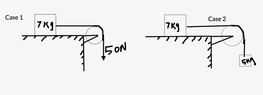
 

Attachments

  • Screen Shot 2022-11-22 at 10.06.08 AM.png
    Screen Shot 2022-11-22 at 10.06.08 AM.png
    7.3 KB · Views: 139
Physics news on Phys.org
paulimerci said:
Homework Statement:: A 7kg block rests initially on a table in case 1 and case 2 above. The coefficient of friction between the block and the table is 0.2. The block is attached by a cord of negligible mass which hangs over a frictionless pulley. In case 1 a force of 50N is exerted on the pulley and in case 2, a 5kg mass is hung. Calculate the acceleration of the system in case 1 and in case 2.
Relevant Equations:: F = ma

In both the cases 7 kg mass accelerates towards the right because of the 50N force. The unbalanced forces in both the cases are the force of gravity due to 5kg block and force of friction. Applying Newton's second law of motion to cases 1 and 2 yields the following results for acceleration:
Where m1=5kg, m2 = 7kg, g=10m/s2
Case 1,
a = Net force/ total mass

a = m1g - friction force/(m1+m2)
= m1g - friction force/ (m1+m2)
= 50 - (0.2x7x10)/12 = 3m/s2

Case2,
a = Net force/ total mass

a = m1g - friction force/(m1+m2)
= 50 - (0.2x7x10)/12 = 3m/s2

In both the cases acceleration came out to be the same. But the textbook gives a different answer where Case 1 acceleration is greater than Case 2. Does that mean in Case 1 the surface is taken as frictionless?
What is the force of tension from the hanging weight when the system is accelerating at ##a##?

Present the following:

Case 1- FBD od 7 kg block.

Case 2 - FBD of 7 kg Block and 5 kg Block for case 2.
 
Last edited:
paulimerci said:
Does that mean in Case 1 the surface is taken as frictionless?
No.

paulimerci said:
a = m1g - friction force/(m1+m2)
= m1g - friction force/ (m1+m2)
= 50 - (0.2x7x10)/12 = 3m/s2
Brackets, brackets, brackets !
and 3m/s2 looks horrible too ! ##3 ## m/s2 !

What is m2 doing in your equations for case 1 ? :nb)

##\ ##
 
In case 1 what does m1g represent? There is only one mass and that the 7 kg mass on the table. It is pulled by a constant force of 50 N. What is Newton;s second law in this case?
 
BvU said:
No.Brackets, brackets, brackets !
and 3m/s2 looks horrible too ! ##3 ## m/s2 !

What is m2 doing in your equations for case 1 ? :nb)

##\ ##
I see that things are a bit more confused than what my gut thought was error. :olduhh:
 
  • Like
Likes   Reactions: kuruman
Lets work in all variables.

##M## = 7 kg mass

##m##= 5 kg mass

Start with case 1:

What is Newtons Second law for the mass ##M## in the ## x \rightarrow^+ ##

Please, take a minute and try to format the equations using latex. It is not difficult to learn.
 
kuruman said:
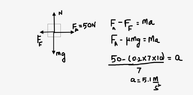
In case 1 what does m1g represent? There is only one mass and that the 7 kg mass on the table. It is pulled by a constant force of 50 N. What is Newton;s second law in this case?
 

Attachments

  • Screen Shot 2022-11-22 at 11.00.19 AM.png
    Screen Shot 2022-11-22 at 11.00.19 AM.png
    8.2 KB · Views: 112
That's better. What about case 2?
 
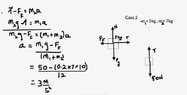
kuruman said:
That's better. What about case 2?
 

Attachments

  • Screen Shot 2022-11-22 at 11.16.32 AM.png
    Screen Shot 2022-11-22 at 11.16.32 AM.png
    13.2 KB · Views: 128
  • Like
Likes   Reactions: erobz
  • #10
That's good. Congratulations, you've done it. Now please consider learning how to use LaTeX.
 
  • Like
Likes   Reactions: erobz
  • #11
For future reference its always better to just state your directional conventions so we don't have to reverse engineer it from the equations you provide.
 
  • #12
kuruman said:
That's good. Congratulations, you've done it. Now please consider learning how to use LaTeX.
Thank you, Will try!
 
  • #13
erobz said:
For future reference its always better to just state your directional conventions so we don't have to reverse engineer it from the equations you provide.
okay! Thank you!
 
  • #14
paulimerci said:
Thank you, Will try!
I'm trying to add equations using LateX and I see the preview icon is not working and is there any way to check the equations that I entered in LateX mode is correct?
 
  • #15
paulimerci said:
I'm trying to add equations using LateX and I see the preview icon is not working and is there any way to check the equations that I entered in LateX mode is correct?
When this happens to me I reload the page.
 
  • #16
kuruman said:
When this happens to me I reload the page.
Thanks I did, still not working.
 
  • #17
paulimerci said:
I'm trying to add equations using LateX and I see the preview icon is not working and is there any way to check the equations that I entered in LateX mode is correct?
They won't load until someone post some Latex in the thread.

##F = m a ##

Now, preview should work for you.
 
  • #18
erobz said:
They won't load until someone post some Latex in the thread.

##F = m a ##

Now, preview should work for you.
Are there any ways to check online without posting them?
 
  • #19
paulimerci said:
Are there any ways to check online without posting them?
Is the preview still not working?
 
  • #20
erobz said:
Is the preview still not working?
It's not working.
 
  • #21
Did you use the delimiters # (doubled) and $ (doubled)? I can't think of anything else.
 
  • #22
kuruman said:
Did you use the delimiters # (doubled) and $ (doubled)? I can't think of anything else.
I tried $(doubled) first, but it didn't work. I then tried $(single), but that didn't either.
 
  • #23
paulimerci said:
Thanks I did, still not working.
To be clear, it can be necessary to reload the page and then toggle preview a couple of times. If it is still not working, please just post some anyway so that we can see if you are doing it right.
 
  • #24
haruspex said:
To be clear, it can be necessary to reload the page and then toggle preview a couple of times. If it is still not working, please just post some anyway so that we can see if you are doing it right.
As of right now, it's fixed. I'll let you know if that changes. Thank you.
 

Similar threads

  • · Replies 6 ·
Replies
6
Views
2K
  • · Replies 17 ·
Replies
17
Views
2K
  • · Replies 5 ·
Replies
5
Views
2K
Replies
13
Views
3K
  • · Replies 3 ·
Replies
3
Views
2K
  • · Replies 3 ·
Replies
3
Views
3K
  • · Replies 5 ·
Replies
5
Views
1K
  • · Replies 6 ·
Replies
6
Views
2K
  • · Replies 7 ·
Replies
7
Views
811
  • · Replies 4 ·
Replies
4
Views
3K